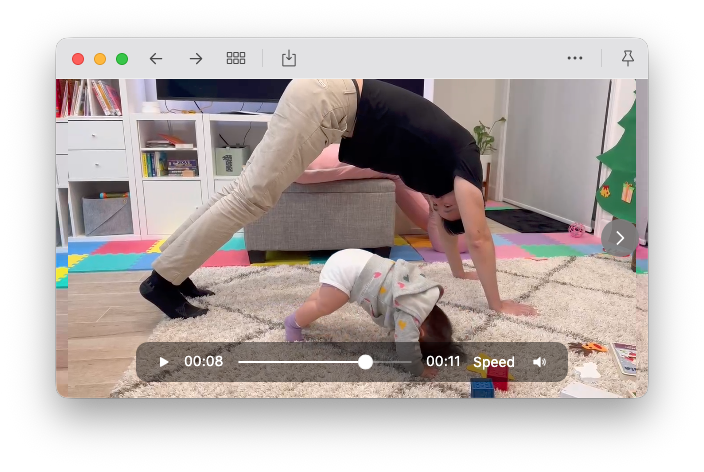
Rhea Learns by Imitation: First Steps in Embodied Learning
What you are seeing is a very early form of learning: imitation.
At this age, infants do not learn through explanation or rules. Instead, they learn by observing movement and attempting to reproduce it with their own body.
In this video, Rhea copies a yoga “down-dog” pose performed by her father. The action may look simple, but it reflects an important stage in development: learning through direct physical mirroring.
At this stage, accuracy is not the goal. What matters is engagement — the attempt to align body and observation.
You may notice that children at this age often repeat what they see in fragments: posture, timing, or partial movement. This is expected. The brain is building a basic mapping between perception and motion.
For parents, this kind of moment does not require correction or instruction. It is more useful to think of it as shared activity. When a child imitates, they are not performing for accuracy — they are exploring how their body connects to the world around them.
Over time, these small imitation moments accumulate. They form the foundation for later abilities such as coordinated movement, language imitation, and structured learning.
What looks like play is, in fact, one of the earliest forms of learning: learning by copying what is present.