
Living Museum of Learning
The QR Code That Forgot Its Memory
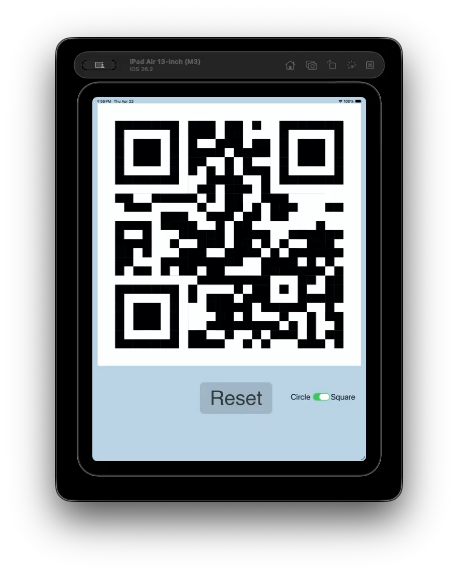
Nicole’s QR Code iOS project entered Phase 2, where she added a visual toggle between Circle and Square styles. The underlying QR structure remained the same, but the rendering changed between two distinct visual languages.
While testing an 8-second demo, she noticed an unexpected behavior: every time she switched styles, the QR code regenerated randomly. What appeared to be a visual toggle was actually resetting the entire underlying data.
She realized the system was not preserving state. Instead of storing a fixed QR data structure, the app was regenerating new data on each toggle. This led her to an important insight: the QR code itself must be stable, while only the rendering layer should change.
Under the surface, her implementation already included a structured system:
a 25 × 25 grid-based QR layout randomized filling simulating data regions manually constructed finder patterns and calibration blocks a rendering layer controlled by a simple Circle/Square toggle
But the key learning moment was conceptual, not visual.
She began separating:
• data (the QR matrix, ~550 cells) • rendering (circle or square style) • state (what must persist across UI changes)
This marked her first exposure to a core software design principle:
👉 separation of data and presentation
From this point onward, the system must ensure that:
QR data is generated once and stored visual style is only a rendering layer UI interactions do not mutate underlying data unintentionally
In simple terms:
The QR code should remain stable. Only how it looks should change.