Living Museum of Learning
The Best Part Was What Nicole Taught Herself
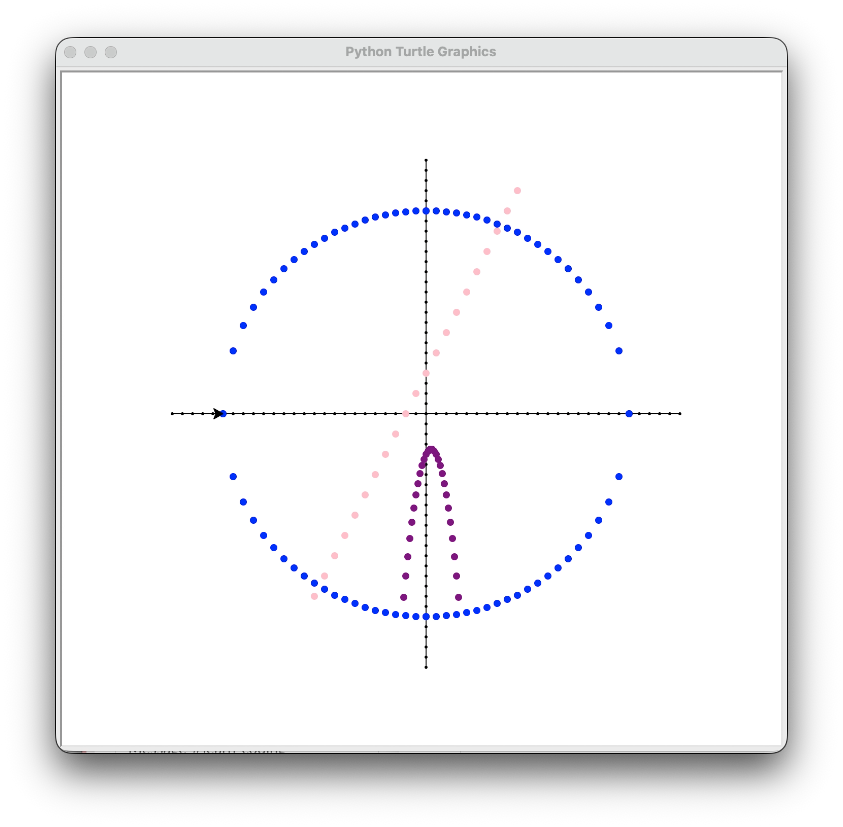
Nicole wrote a substantial Python Turtle program that plotted a coordinate plane, a linear function, a parabola, and a circle point by point. She even created a short video recording the turtle as it gradually drew the entire scene. The project had become much more than a programming exercise. It was becoming a mathematical visualization system.
Her circle program suddenly failed. The value inside math.sqrt() occasionally became negative, causing the program to crash. She had never considered that a simple condition could prevent the error. After a small hint, she introduced an if statement to avoid invalid values, and the entire program began working correctly. One small idea changed everything. The lesson was not merely about debugging. It was about discovering that programs can protect themselves.
Later, Nicole revisited a list of vi commands that had been shared earlier. Most of the commands were explained directly, but two entries were intentionally left unfinished: o: try to find out ;-) O: try to find out ;-) She quickly figured out the first. Then she explored the second. But she did not stop there. She returned with additional discoveries of her own: 34G gg G H M L None of these had been assigned. None had been required. She simply became curious enough to continue exploring.
Many important learning moments happen after instruction ends.
A student encounters an error and discovers a new idea.
A small hint opens an entirely new understanding.
A puzzle encourages independent exploration.
Eventually, students begin teaching themselves.
At that point, curiosity becomes more powerful than instruction.