
Living Museum of Learning
A 9th Grader Plays with Linear Algebra
During a lesson discussion, Sal asked a foundational question: “Why do we bother using vector form to represent a line in 2D space?” Albert responded simply: “Because it’s the general way.” That short answer led to a deeper curiosity: “Then how do we represent a line in 3D space?”
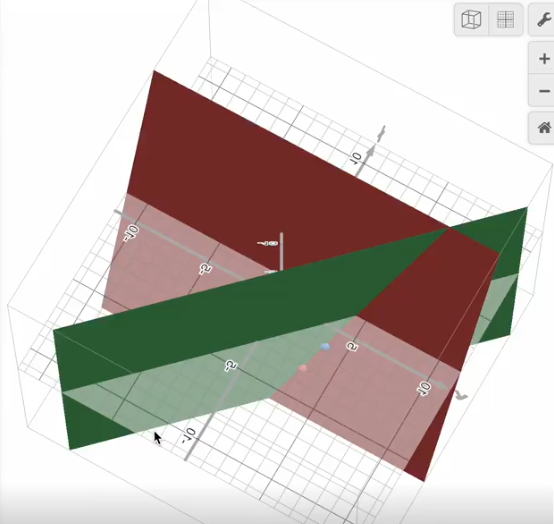
Instead of staying at the conceptual level, Albert moved into exploration. We opened Desmos.com and began constructing geometric objects directly. He defined two planes: x - y = -3 3x + z = 4 Then observed their intersection: a line in 3D space. What started as a question became a concrete geometric construction.
Albert derived the parametric vector form of the intersection line: (-1 - m, 2 - m, 7 + 3m) Then he added a slider for the parameter m. A point began to move smoothly along the line in space. What was once an abstract expression became: motion visualization continuous transformation A static equation turned into something alive.
This moment revealed an important shift:
Linear algebra is not just symbolic manipulation Vector forms are not just “compact notation” Geometry in higher dimensions becomes intuitive when made visible
With a few lines of code and a slider, a 9th grader experienced:
the connection between algebraic form and geometric motion