
Living Museum of Learning
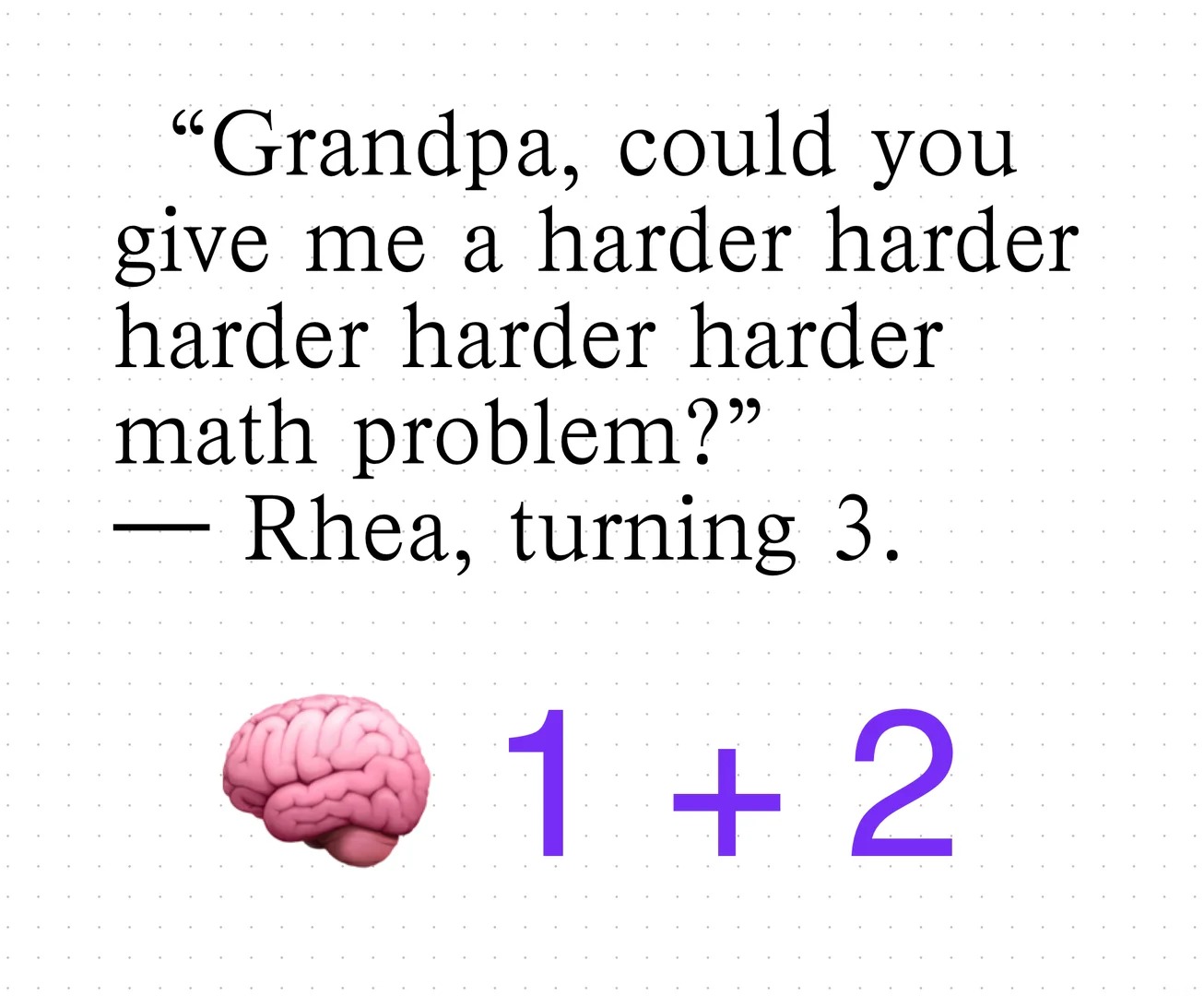
A Harder, Harder, Harder Math Problem
One evening, Rhea and I played a small mathematics game remotely.
There were no worksheets.
No calculators.
No abacus.
Only fingers, a book, and simple addition problems such as:
1 + 1
2 + 1
2 + 2
Rhea was not yet three years old.
After several problems, she suddenly asked:
“Grandpa, could you give me a harder harder harder math problem?”
The request itself was surprising.
She was not asking:
Am I right?
Is this finished?
Is this enough?
She was asking:
Can it be harder?
I replied:
Ready?
No fingers.
No book.
Use your brain.
What is 1 + 1?
Rhea stopped.
She turned around.
She crossed her arms.
For several seconds she appeared to be thinking very seriously.
Then she announced:
Two!
For the first time, she seemed to realize that the answer could come from inside her own mind.
The problem was tiny.
The discovery was larger.
Curiosity can appear before formal instruction.
Challenge itself can become attractive.
Mental calculation begins as confidence, not technique.
The desire for harder problems is often more important than the problems themselves.
Learning starts when children ask for the next question.
At nearly three years old, Rhea had not yet learned arithmetic in any formal sense.
But she had already discovered something valuable:
Harder problems can be exciting.
Perhaps the most memorable part of the evening was not:
1 + 1 = 2
It was:
“harder harder harder ...”
Because sometimes the first sign of learning is not an answer.
It is asking for the next question.
🌱 iOS Dream Team
Small circles. Big thinkers.