
Living Museum of Learning
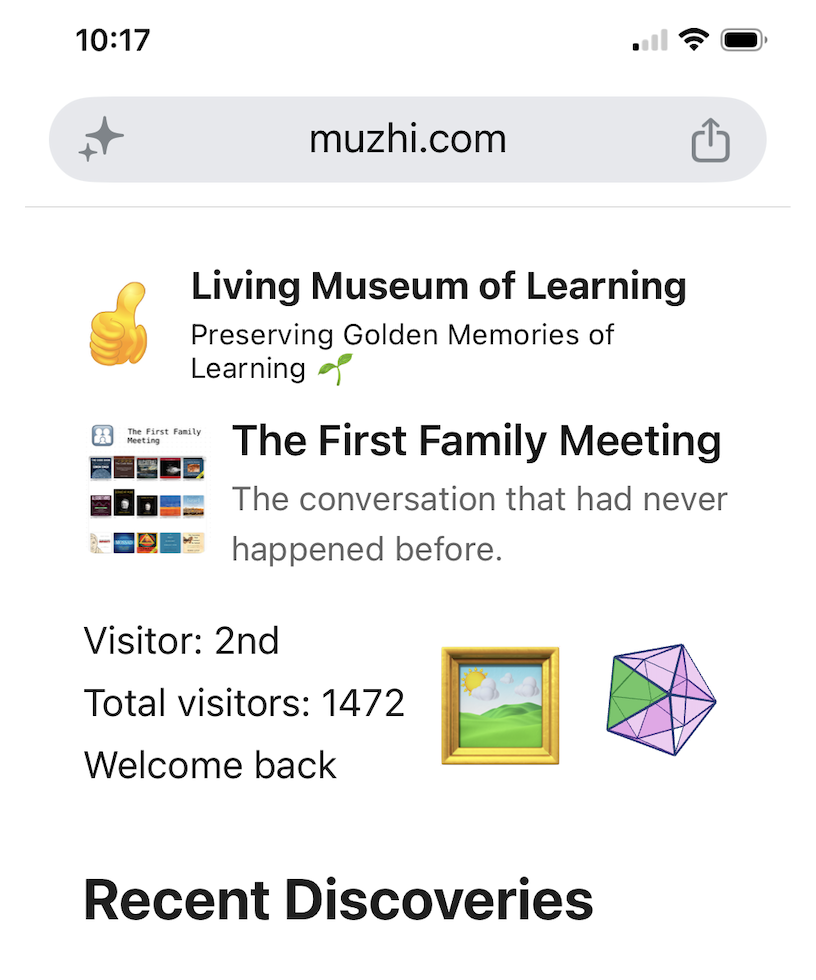
The Day Our Homepage Woke Up
For years, our museum had been a place to preserve stories, photos, and discoveries. Every exhibit was meaningful, but once a page loaded, everything became still. A few days earlier, I had rediscovered a p5.js program I wrote on March 8, 2023—a slowly rotating icosahedron. Looking at it again brought back the same childlike excitement I had felt years ago. What if our museum itself could become alive?
Instead of building an entirely new website, we took one tiny step. We added a local copy of p5.min.js, created a small homepage-icon.js, and patiently migrated the old sketch onto the homepage. After fixing one bug (canvas = createCanvas(...)), separating the visitor counter from the gallery layout, and carefully adjusting the spacing and colors, a miniature diamond finally appeared beside the Museum Gallery icon. On the smallest iPhone screen, it rotated quietly on a white background, asking for nothing yet somehow impossible to ignore.
Something unexpected happened. I found myself staring at that tiny spinning diamond for ten minutes or longer. Outside my CN Tower–facing window, the night traffic on Highway 401 and Highway 404 continued to flow thirty-one floors below, but my attention stayed on those fifty-six pixels. At that moment, I realized we had not merely added an animation. The homepage itself had woken up. The Living Museum of Learning had gained its first heartbeat.
Large visions are often born from surprisingly small artifacts. We had imagined an entire Living Gallery Wing filled with mathematical beauty, student creations, algorithms, and interactive discoveries. Yet the journey began with one miniature polyhedron, patiently polished until it felt exactly right. The smallest living artifact changed the emotional character of the entire homepage. Sometimes the first proof of an idea isn't a grand system—it's a quiet detail that makes you want to keep looking.
A museum no longer has to display only static artifacts. Every exhibit can become a living program that visitors explore, interact with, and even learn from in real time.
By treating code itself as an artifact. A reusable p5.js engine, a shared library, and small JavaScript sketches allow each creation to become a permanent resident of the Living Gallery.
Because a living artifact invites curiosity instead of merely presenting information. If one tiny spinning diamond can make its creator forget the city lights outside his window, imagine what hundreds of living creations by curious children might inspire in visitors around the world.