Living Museum of Learning
Back to Work
Four days had passed without a lesson.
Those four days weren't spent learning mathematics.
They were spent learning something even more important.
Cloud's family paused.
They listened.
For the first time, they sat down calmly and seriously to discuss his future.
Cloud made his own commitment.
When he returned, there were no speeches.
No ceremonies.
No dramatic declarations.
We simply went back to work.
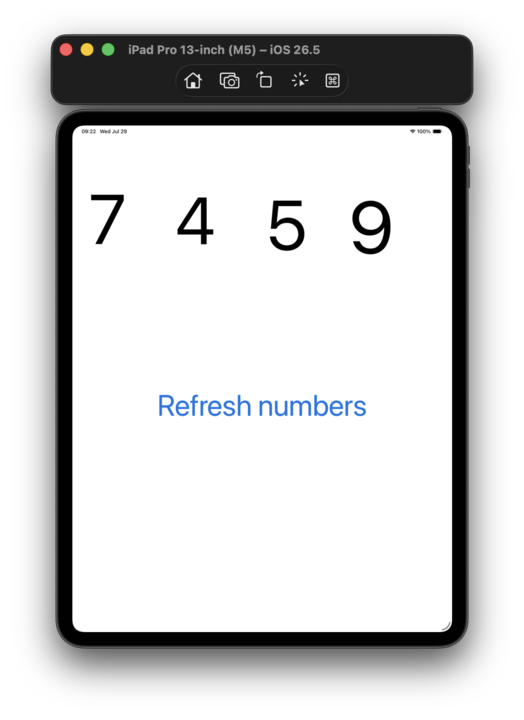
Before opening Khan Academy, I asked Cloud to revisit the little iPhone app he had built a week earlier.
Within a few minutes, he added one missing feature:
Refresh Numbers.
It was only one button.
But it completed his first real iOS application.
Then something delightful happened.
Instead of using someone else's software,
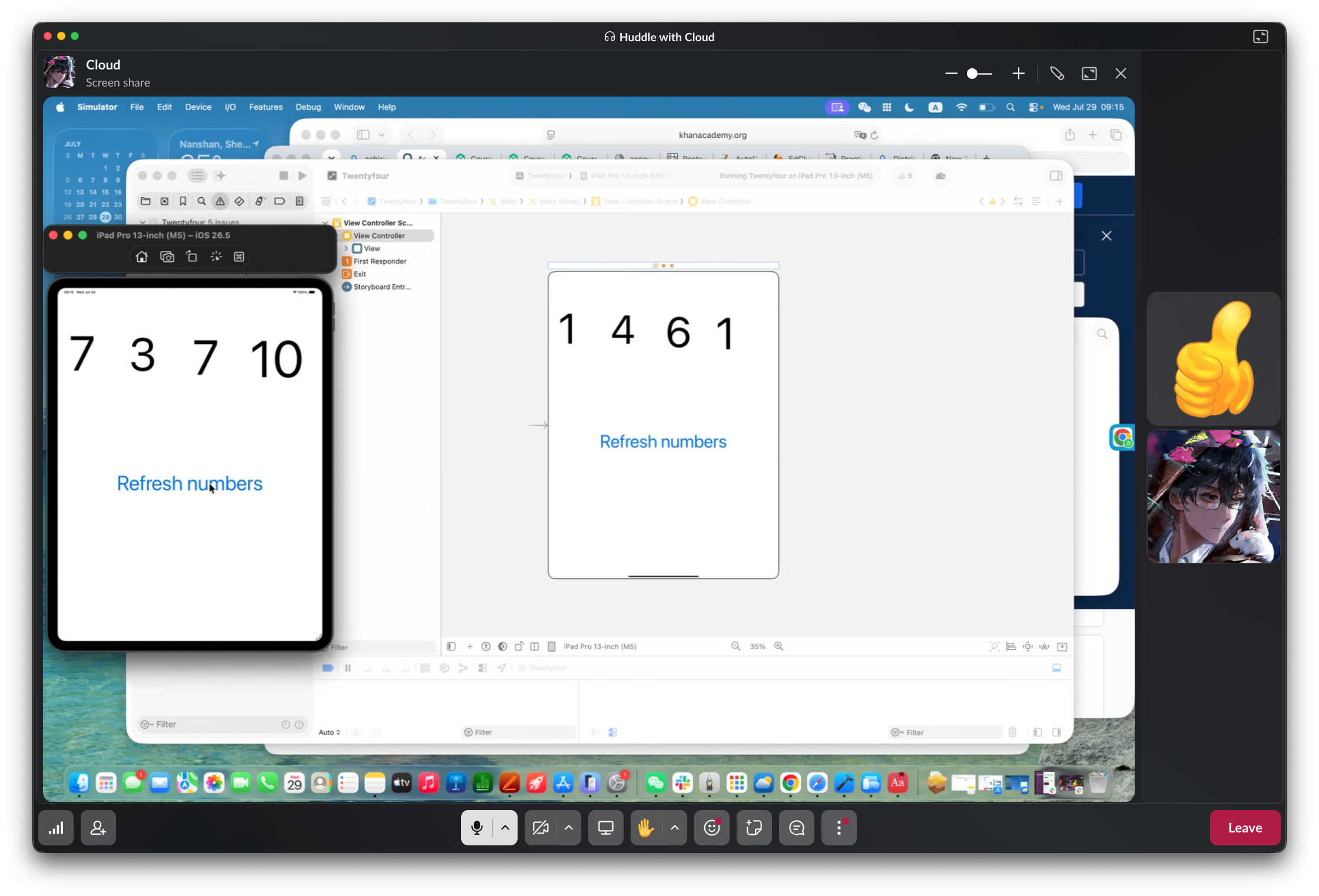
Cloud began solving 24-point puzzles inside his own app.
The programmer became the first user.
Most of the puzzles fell quickly.
Two remained surprisingly memorable:
7, 3, 3, 10
and
10, 2, 10, 3.
They weren't difficult because the arithmetic was complicated.
They were difficult because they demanded stronger number sense.
One of them eventually became homework.
After class, Cloud stayed for another thirty minutes.
He finished the Grade 4 Khan Academy unit we hadn't completed together.
Then he sent me a screenshot.
28/30.
A little later, he asked a simple question.
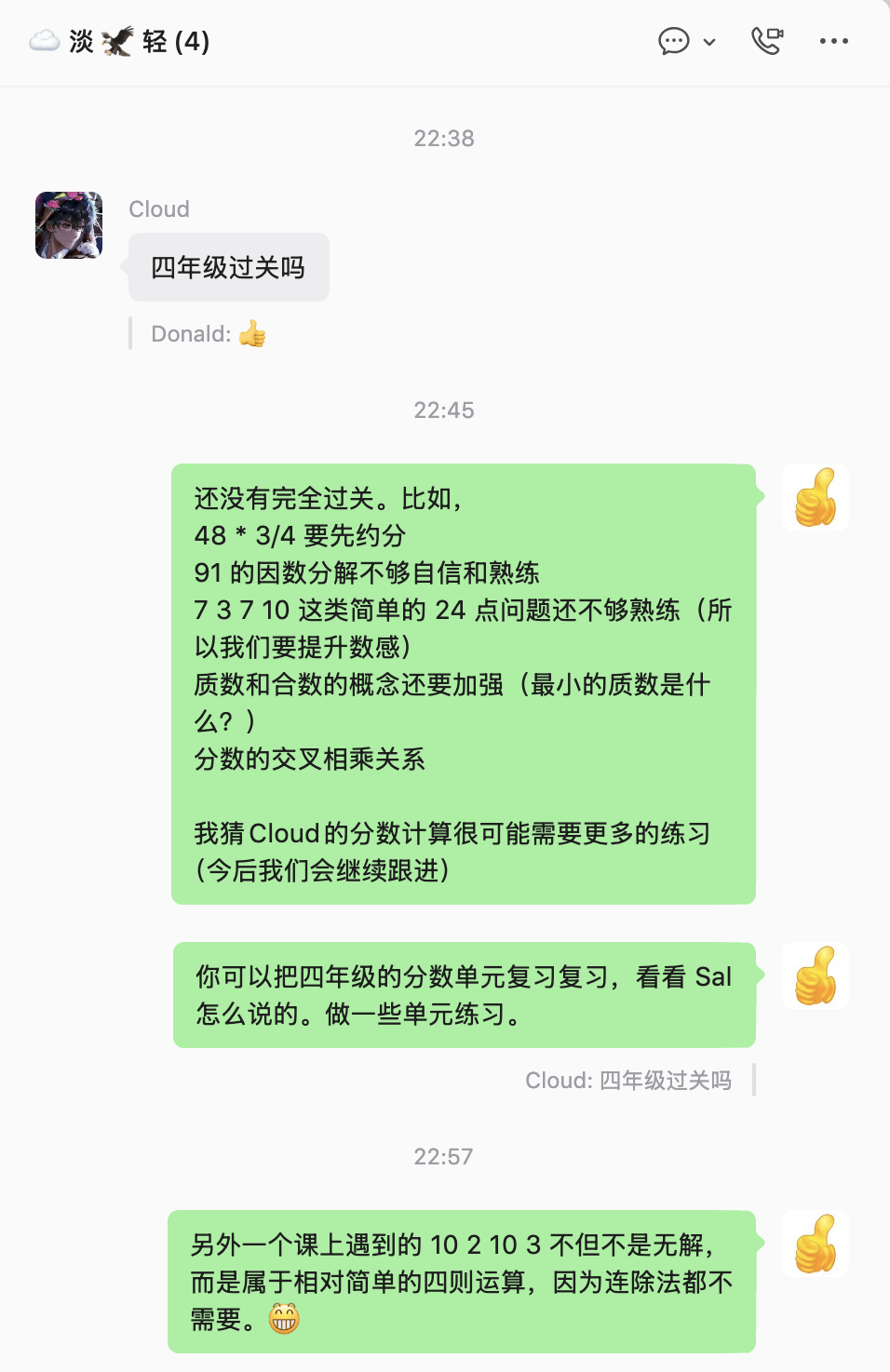
四年级过关吗?
Translation
"Did I pass Grade 4?"
I smiled.
Then I answered honestly.
还没有完全过关。
Translation
"Not completely."
There were still a few things that needed to become second nature.
Simplifying fractions before multiplying, such as 48×
4
3
Factoring numbers like 91 quickly and confidently
Recognizing easy 24-point patterns such as 7, 3, 7, 10
Strengthening number sense
Understanding prime and composite numbers instinctively
Becoming more fluent with fraction arithmetic
None of these were failures.
They were simply the remaining pieces of Grade 4.
Meanwhile, Cloud's mother reminded him about the homework I had assigned.
Cloud also remembered something else.
A few days earlier, we had talked about a reward system.
If he truly mastered the mathematical foundations from Grades 2 through 8, there would be rewards waiting along the way.
So he asked his mother whether it was already time.
Then she later told me:
这是他可爱的地方,他觉得自己行了,就觉得可以争取奖励;你告诉他不足在哪里,他也认同了。
Translation
"That's one of the lovely things about him. When he feels he's accomplished something, he naturally wants to earn the reward. And when you pointed out what he still needed to improve, he accepted it."
Then she added another sentence that made me laugh.
你发完你的评论,他就沉默了,不敢要奖励了……
Translation
"After you sent your comments, he became completely silent. He didn't dare ask for the reward anymore..."
😂
That silence wasn't disappointment.
It was understanding.
Cloud had just learned an important lesson.
Completion isn't the same as mastery.
Many students ask,
"What score did I get?"
Cloud asked,
"Did I pass Grade 4?"
That's a better question.
Because education isn't about collecting scores.
It's about building foundations strong enough that you can confidently stand on them.
When Cloud accepted that Grade 4 wasn't quite finished yet, he wasn't moving backward.
He was becoming a more mature learner.
The reward hadn't disappeared.
It was simply waiting at the real finish line.
A student begins measuring success by understanding instead of scores.
Specific, honest feedback replaces empty praise, and the student accepts it with humility.
The moment a learner asks, "Have I really mastered this?", rather than "Did I finish?", lifelong learning has already begun.