
Living Museum of Learning
The Order Was Never Arbitrary
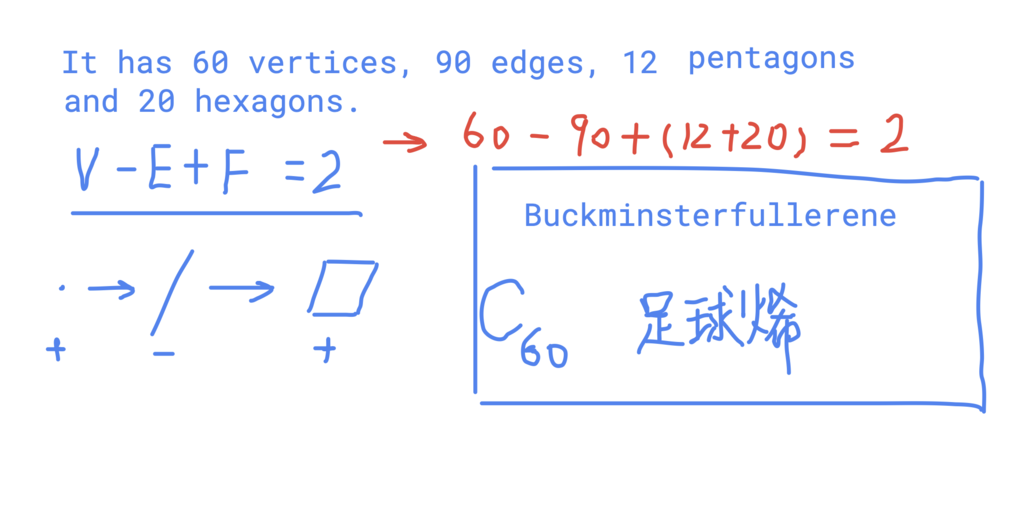
While discussing the geometry of a soccer ball, I asked Albert and Ethan if they still remembered Euler's famous formula for polyhedra:
V − E + F = 2
To my delight, both of them answered immediately. It had been years since we first explored the idea together.
Curious, I challenged Albert.
"How do you remember the order? Why is it V − E + F, instead of F − E + V?"
Albert didn't hesitate.
He pointed to the whiteboard and drew three simple symbols:
• → / → ▱
Then he explained:
V is a vertex, a dot.
E is an edge, a line.
F is a face, a plane.
I was stunned.
0-dimensional.
1-dimensional.
2-dimensional.
The order wasn't something to memorize at all—it naturally follows the increasing dimensions of the building blocks.
For a moment, I was speechless.
That tiny observation transformed the formula.
Instead of being a sequence of letters, it became a progression:
Point → Line → Plane
The order suddenly felt inevitable.
I had taught Euler's formula years earlier, but Albert had quietly built his own geometric understanding and handed it back to me.
The best learning isn't when a student remembers our explanation.
It's when they create a better one.
Years after the lesson, Albert no longer relied on my words. He had organized the idea into his own mental model. In that moment, the student became the teacher.