
Living Museum of Learning
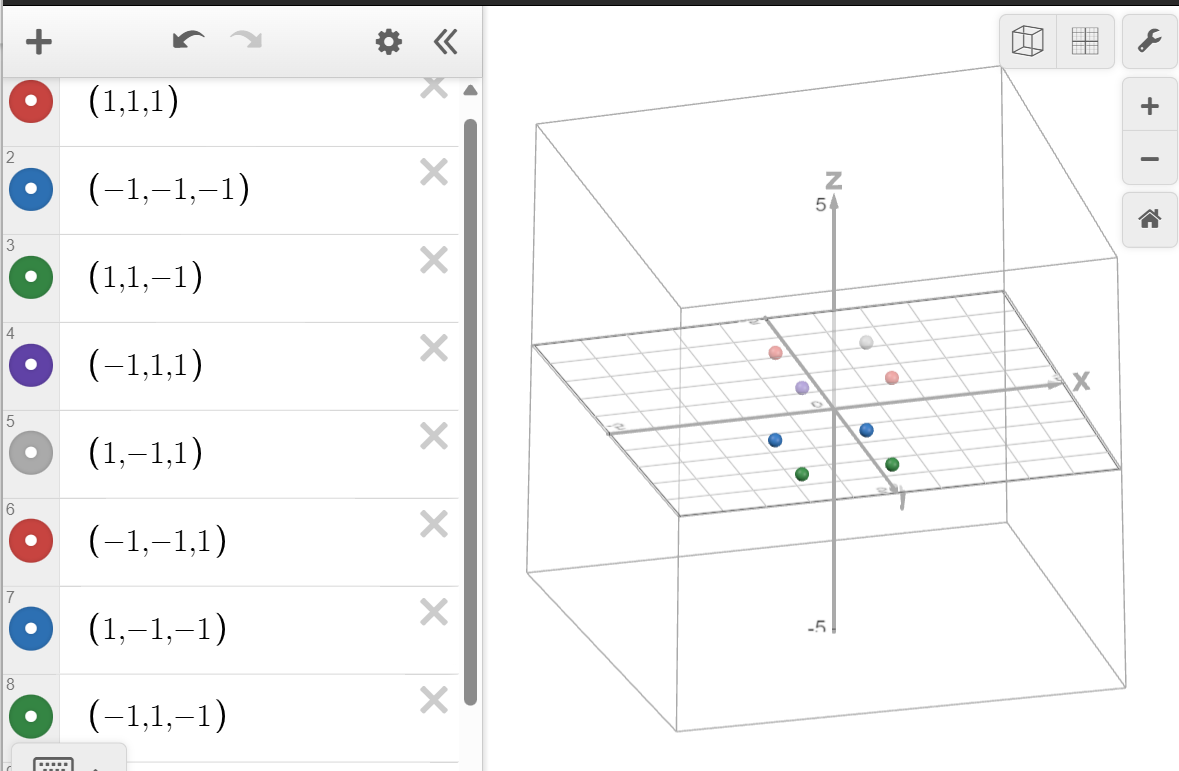
"Put a Dot Wherever You Like."
Oliver had never worked with three-dimensional coordinates before.
Instead of beginning with definitions, formulas, or textbook diagrams, I simply pointed to the screen.
First, we built a little intuition.
Chinese
Z 轴就是指向你的鼻子。
English
The Z-axis points toward your nose.
Then I gave him an unusual first assignment.
Chinese
随便放一个点。
English
Put a dot wherever you like.
He entered three numbers.
A point appeared in space.
Then I said:
Chinese
转动空间,看一看这三个数字和点的位置是不是一致。
English
Rotate the space and see whether the three numbers really match the location of the point.
He immediately grabbed the virtual world with his mouse.
Turning.
Spinning.
Exploring.
Then he laughed.
Chinese
哇!我一拨,它会一直转,就像地球引力一样!
English
Wow! Once I give it a push, it keeps spinning, just like gravity!
A new toy had just entered his world.
The next instruction sounded simple.
Chinese
下一行,放一个原点。
English
On the next line, put a point at the origin.
No hesitation.
Then came the first real challenge.
Chinese
很好。现在放一个和第一个点中心对称的点。
English
Great. Now place the point that is centrally symmetric to the first one.
Oliver thought quietly for a while.
He changed the signs of the X and Y coordinates.
"It works!" he shouted.
Then he rotated the view.
"Oops..."
He immediately realized that Z had been forgotten.
One more sign changed.
Perfect.
He had just discovered three-dimensional symmetry by himself.
Now that he owned the coordinate system, I changed the game.
Chinese
你知道魔方吧?一个立方体有几个顶点?
English
You know a Rubik's Cube, right? How many vertices does a cube have?
"Four."
I looked at him.
He smiled.
"Oops... Eight."
Then I continued.
Chinese
把这八个顶点都放进去。大小随便你决定。
English
Go ahead and place all eight vertices. You can make the cube any size you like.
A moment later, I added one more condition.
Chinese
我们加一个条件,好吗?边长是 2。
English
Can we add one condition? Let the edge length be 2.
Now the thinking became deeper.
Little by little, the numbers 1 and −1 began filling the screen.
Eight rows.
Eight points.
Then Desmos displayed his first cube.
It wasn't drawn by dragging.
It was built entirely from ideas.
The first lesson in a new subject should not be about memorizing definitions.
It should be about discovering a new playground.
Once Oliver realized that every point in space could be created with just three numbers, coordinates stopped being notation.
They became a language.
The cube was not the destination.
It was simply his first sentence.
A student can build an entire three-dimensional world from nothing more than numbers.
Start with exploration instead of explanation, then gradually introduce mathematical structure through carefully chosen challenges.
When students construct a world themselves, mathematics stops being something they memorize and becomes something they own.
"Put a dot wherever you like."
Many teachers would have started with:
"Today's topic is the three-dimensional Cartesian coordinate system..."
I started with freedom.
That's why Oliver immediately felt he had found a new toy.
Only after he fell in love with the world did i begin introducing its rules.
That sequence—play → challenge → structure—is one of the signatures of my teaching philosophy.