
Living Museum of Learning
Cloud's Hidden Engine
When Cloud joined our program, the obvious story was that he was weak in mathematics. We therefore began rebuilding his mathematical foundation from the earliest concepts while simultaneously exploring programming, logic puzzles, Sudoku, typing, and computational thinking.
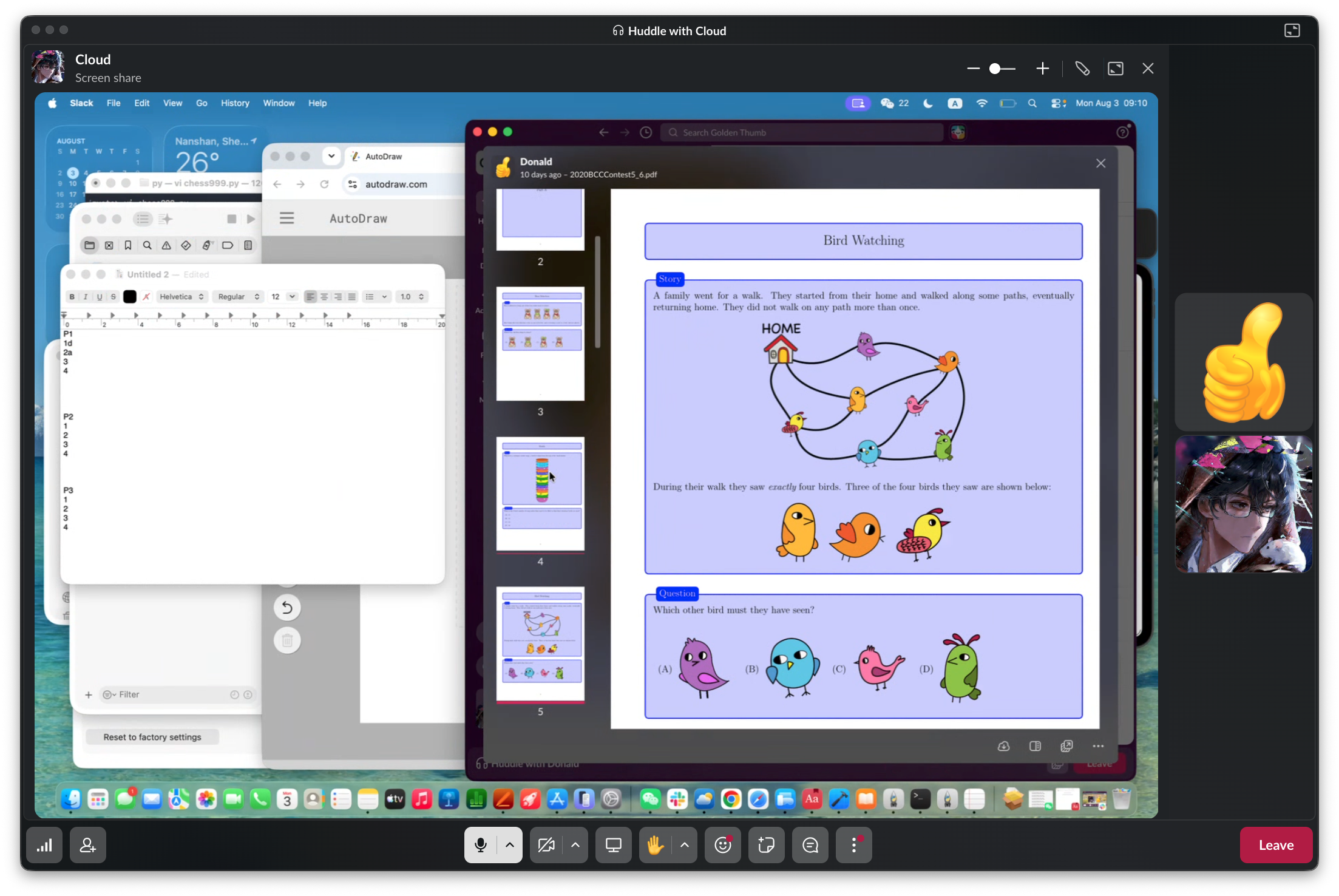
In the 11th class, Cloud attempted all 12 problems from the University of Waterloo's 2020 Beaver Computing Challenge (Grades 5–6). During the contest, he even paused to ask, "Why does a beaver want a carrot?"—a question that revealed curiosity about the assumptions behind the story rather than simply rushing toward an answer.
Cloud first answered one Part B problem incorrectly. Instead of accepting the result, he revisited the problem, found the flaw in his own reasoning, and corrected it.
The final result became 12/12.
More importantly, everyone—including Cloud's family—began to see a different learner.
A stronger picture came into focus.
Cloud's mathematical foundation is still under construction, but his logical reasoning, curiosity, and ability to learn are significantly stronger than previously believed.
The label "weak at math" no longer adequately describes him.
Assessment should reveal potential, not merely measure deficiency.
When computational thinking, programming, and carefully chosen puzzles accompany the rebuilding of mathematical foundations, hidden strengths become visible. Once those strengths are visible, confidence grows naturally—for both the student and the family.