
Living Museum of Learning
The Day Cloud Learned That Understanding Must Be His Own 🌱
Cloud had just learned the algorithm for finding the largest number in a list.
The natural next challenge was finding the second largest.
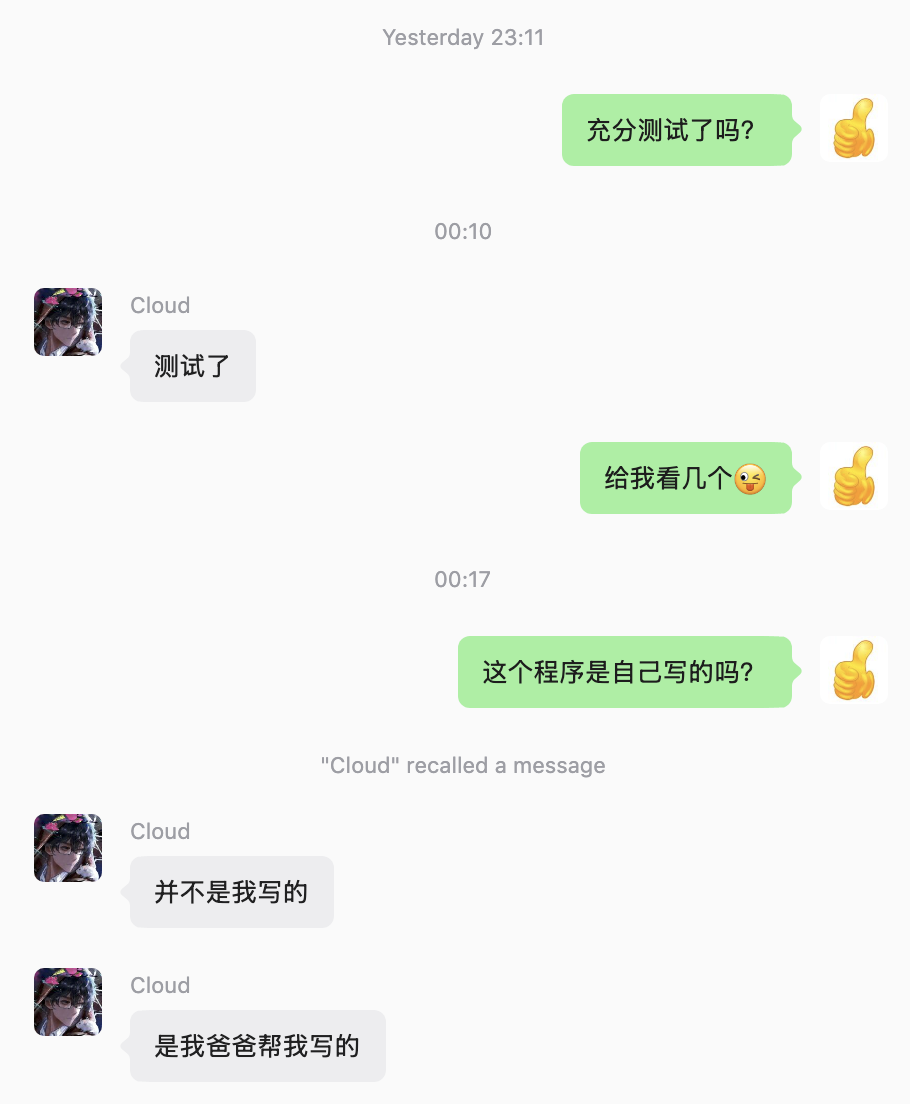
But when he submitted his homework, Donald discovered something important: the code had actually been written by his father.
When asked directly:
“这个程序是自己写的吗?”
“Did you write this program yourself?”
Cloud answered honestly:
“并不是我写的,是我爸爸帮我写的。”
“I didn't write it. My dad helped me write it.”
That honesty was important.
But it also revealed the real problem.
Cloud could explain parts of the code, but he had not yet demonstrated that he could independently build the algorithm.
Donald did not ask him to study his father's solution harder.
Instead, he said:
“重新思考,爸爸的程序你可能看不懂,先不看。”
“Think about it again. You may not understand your dad's program, so don't look at it for now.”
And then came an important rule:
“提交一个自己都看不懂的作业,非常有害!非常有害啊!”
“Submitting homework that you don't even understand yourself is very harmful! Very harmful!”
The goal was no longer simply to produce a correct answer.
The goal was to find out whether the thinking was truly Cloud's own.
The Challenge
Cloud was given a new problem:
Generate 20 random numbers and find the third largest, printing only the numbers and the final answer.
No largest.
No second largest.
And most importantly:
Do it independently.
If he could solve it himself, he would no longer need to ask:
"Did I understand it correctly?"
The result would answer that question for him.
The Discovery
Cloud tried.
His program sometimes worked.
Sometimes it didn't.
“有时候是第三个。”
“Sometimes it is the third one.”
“有时候不是。”
“Sometimes it isn't.”
This was actually a valuable moment.
He was beginning to test the algorithm rather than simply trusting it.
Donald pointed out:
“有时可以有时不可以,说明程序或算法是错的,或不完整的。”
“If it works sometimes and doesn't sometimes, the program or algorithm is wrong or incomplete.”
A program that works on some inputs is not necessarily a correct program.
Back to the Five Rooms
Cloud was trying to jump from finding the largest directly to finding the third largest.
Donald brought him back to the five-room model that Cloud had already understood.
“如果踏踏实实顺着5个房间去延伸思路,就容易水到渠成。”
“If you patiently extend the idea from the five rooms, it becomes much more natural.”
This was the real lesson.
Don't reverse-engineer a complicated solution.
Start from something you genuinely understand.
Then extend the idea.
Then test it.
Then discover where it breaks.
Then fix it.
Cloud did not finish the third-largest problem that night.
But he accomplished something more important.
He admitted that the code wasn't his.
He discovered that being able to explain someone else's program was not the same as being able to reproduce the thinking.
He wrote his own attempt.
He found that it failed.
And instead of pretending, he came back and asked:
"Can you help me find the error?"
That is learning.
The Deeper Lesson
“思考的过程重于结果。”
“The thinking process matters more than the result.”
A correct program written by someone else can hide a student's gaps.
A wrong program written independently can reveal exactly where the learning needs to happen.
The second can be debugged.
And debugging is learning.
欲速则不达。
The more you rush, the farther you may get from the goal.
Sometimes slowing down is the fastest way forward.
Moving from following an algorithm to creating one independently.
Build from genuine understanding, test with different cases, and let mistakes reveal the gaps.
Because the goal is not to make the teacher happy with a correct answer.
It is to make the student's thinking strong enough to find the answer independently.
Epilogue
The second-largest number can wait.
The third-largest number can wait too.
First, Cloud needs to build something much more valuable:
“这是我自己想出来的。”
“I figured this out myself.” 🌱