
Living Museum of Learning
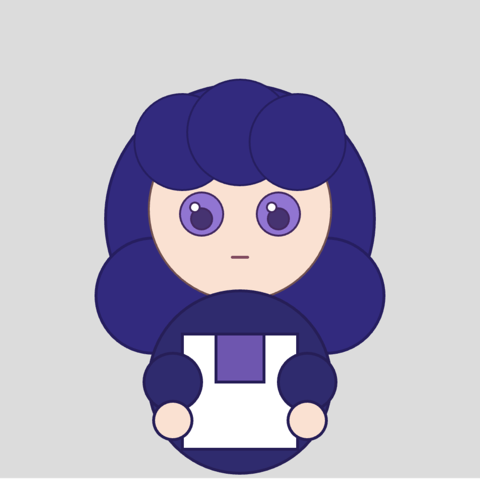
A Girl Made of Circles
Enning had been learning computers for less than a week.
She had just begun exploring P5JS and had learned how to use simple drawing primitives such as circle(), along with colors, coordinates, and basic shapes.
Her homework was deliberately open-ended:
“Create something interesting in P5JS. 😀
Your sister designed and drew a cute house with windows yesterday.
You have a more powerful tool—P5JS.
Surprise me. 👀”
Donald had no idea what she would make.
Then her submission appeared in Slack.
Donald was stunned.
How could this beautiful girl holding something be created from circles?
Enning had not been given instructions to draw a person.
She had not been given a template.
She simply began composing.
A large circle became the hair.
Another became the face.
Three circles became the bangs.
Two circles became the eyes.
Smaller circles became the pupils and highlights.
More circles became the body, arms, and hands.
Squares became clothing.
A line became the mouth.
And suddenly, dozens of elementary shapes had become:
a recognizable, expressive character.
This was no longer simply an exercise in learning circle().
Enning had discovered something much bigger:
Simple primitives can be composed into something much more complex.
She was beginning to think of code not merely as a sequence of instructions, but as a medium for creation.
The program itself remained wonderfully simple:
circle()
square()
line()
fill()
stroke()
coordinates
But the result was anything but a collection of elementary commands.
The complexity emerged from composition.
The most important part of this assignment was that Donald didn't tell Enning what to create.
He gave her:
a tool + a little inspiration + freedom.
Then he waited.
The instruction was simply:
“Surprise me.”
And she did.
This is what open-ended learning can reveal.
When there is no prescribed answer, we get to see not only what a student has learned, but what the student imagines is possible.
Why This Matters
Enning had recently said:
“I'm not good at logical reasoning…”
Yet within days, she was independently experimenting with P5JS, learning new functions, manipulating layers and transparency, and now composing dozens of primitive shapes into her own character.
Perhaps the most important discovery isn't that she learned to draw with code.
It is that she discovered:
“I can make something that wasn't there before.”
And that is a very powerful beginning.