
Living Museum of Learning
The Boy Who Came Back
In the late 1970s and early 1980s, a teenage student attended a high school where the schoolmaster was a commanding figure. He had the unmistakable presence of a leader—and an unusually professional voice when he recited poetry before the students.
The student also had a talent for finding his own interpretation of school rules.
Near the end of one term, students were given several days of independent study before final examinations. The student and his friends climbed over a wall topped with small pieces of glass, entered the locked gymnasium, and played table tennis.
They had a wonderful time.
And the student did very well on the examination.
At the term-ending assembly, the schoolmaster told the entire school about the student who had spent those precious pre-exam days playing table tennis.
But he didn't simply condemn him.
He offered another interpretation:
Perhaps this student had studied so thoroughly beforehand that there was nothing left for him to study during those final days.
A rule-breaking episode became a lesson about preparation, mastery, and judgment.
Years later, the same student faced a very different situation.
His family moved to another province, and he left his beloved school for a new one.
His schoolmaster tried to persuade him to stay.
He left anyway.
The new school was miserable.
Eventually the boy asked himself:
“Can I go back?”
His parents had already packed his things, unpacked them in the new home, and bought a train ticket.
But he returned.
He arrived one morning while everyone else was already in class. His old bed was still there.
He put his belongings down, hurried to the classroom, knocked, and slipped quietly into his old seat.
The class was electrified.
Decades later, the student would remember both episodes—not simply because of what happened, but because of the schoolmaster's way of seeing students.
A historical record now tells us that this schoolmaster was a nationally recognized educator whose philosophy emphasized:
understanding more, analyzing more, and finding more ways to educate.
The student's memories give those words a human face.
Educational philosophy is sometimes easiest to understand through a story.
A great school leader doesn't merely enforce rules.
He asks what lies behind the behavior.
He sees the student beyond the incident.
He knows when to turn a mistake into a lesson—and when to fight for a student's future.
And sometimes, without realizing it, a school creates such a strong sense of belonging that a student who leaves eventually finds his way back.
Rules and discipline can coexist with trust, judgment, and humanity.
Understand the student, analyze the situation, and find a way to turn each moment into an opportunity for growth.
The way an educator sees a child can stay with that child for a lifetime.
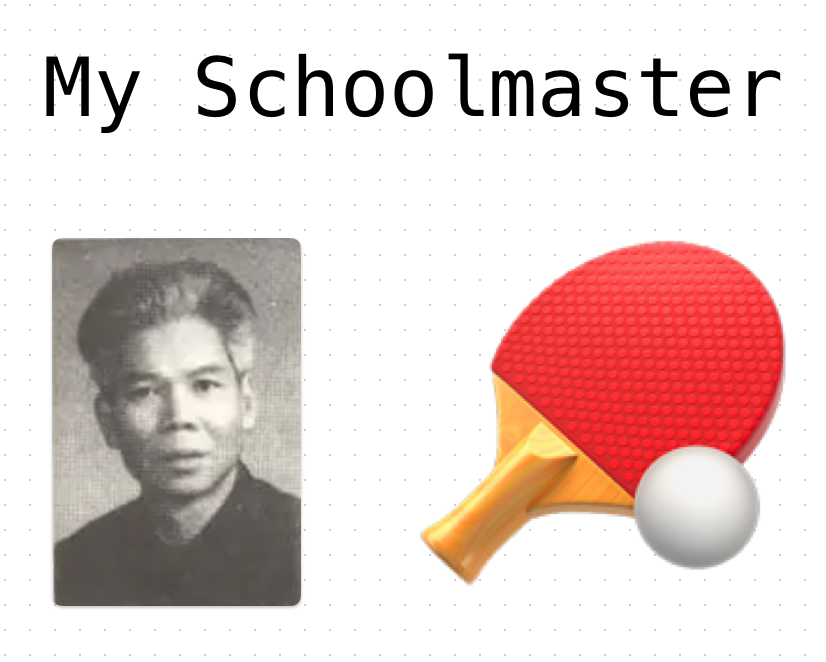
吴亚俊 (1934–2020.11.15 )
Educator and former principal of Fuzhou High School.
National Advanced Worker, 1960.
His educational philosophy emphasized:
“Understand more. Analyze more. Find more ways.”
There was another connection none of us knew at the time.
Decades later, when I searched for the schoolmaster whose office I had once entered as a teenager, I discovered that he was from 邵武, a small place in Fujian where my own childhood had begun.
My father had served there from the very beginning of his army unit, helping build its base from the earth itself.
My father never knew.
I never knew.
Even standing in that schoolmaster's office, we could not have imagined that the man before us and the landscape behind us belonged to the same small corner of the world.