
Living Museum of Learning
Don’t Call Yourself Careless
2026.08.20.
Enning's class was supposed to be one hour.
It became two hours.
Donald had quietly started extending the sisters' classes because the girls were learning so well that stopping at exactly one hour had begun to feel rather artificial. Nobody had officially announced the new schedule. 😂
Today, the extra time was especially useful.
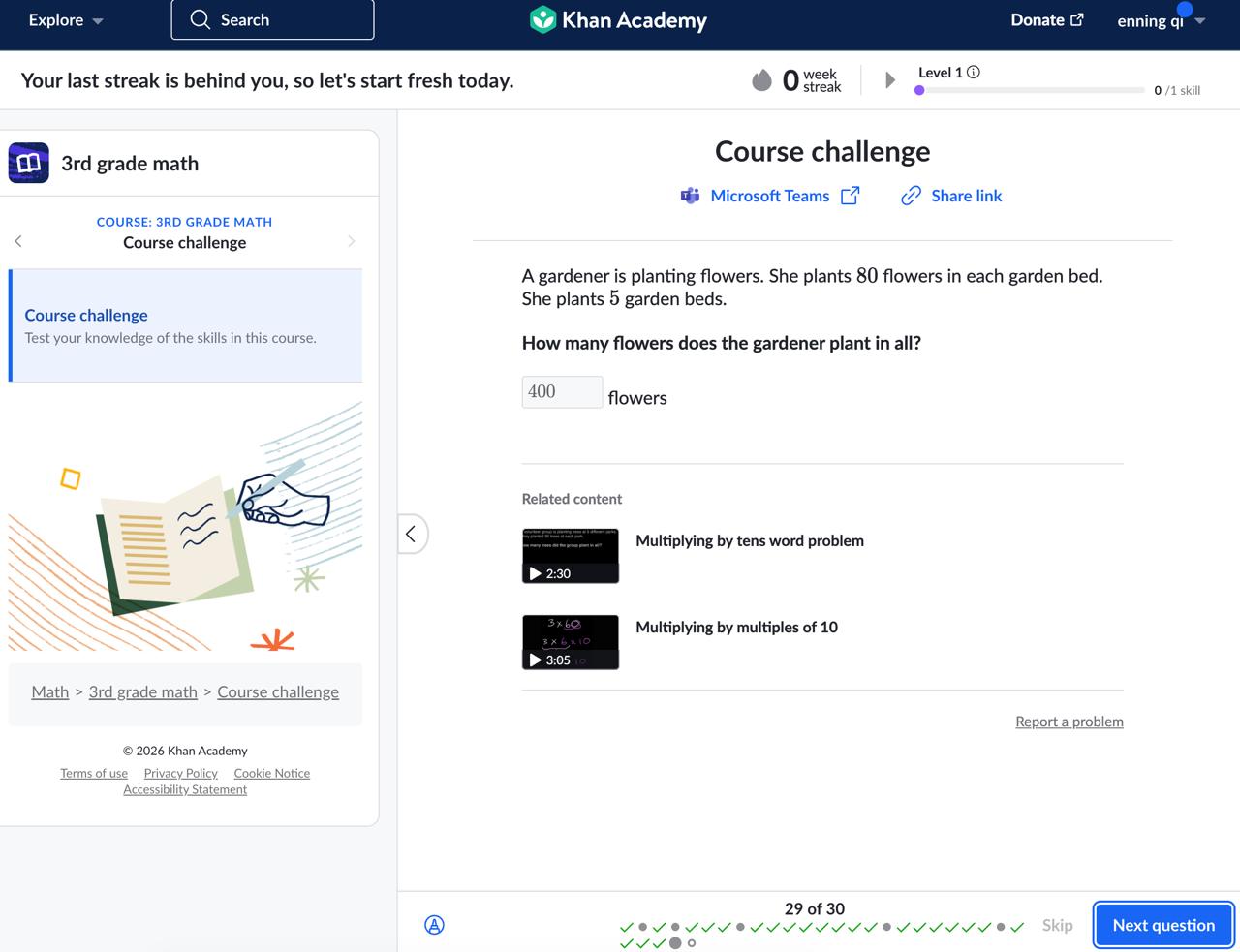
Enning redid Grade 3 Khan Academy mathematics and got 24/30.
Donald didn't treat the score as a verdict.
“We can improve, right?”
Enning smiled.
There were six mistakes.
They would investigate those six today and tomorrow.
Then they would move on to the next grade.
And then the next one — roughly one new grade every other day.
Khan Academy, fortunately, would generate fresh problems every time she tried again.
One problem gave Donald a particularly useful clue:
64 = ? − 283
Enning actually did something very good: she checked her first answer.
But her handwriting was too careless.
She checked.
Wrong.
Rechecked.
Wrong again.
Donald stopped her:
“Could you write slowly and cleanly? You don't want to confuse yourself with such messy draft, right? You don't want to set traps for yourself, right?”
She erased it.
She rewrote it carefully.
The interesting thing wasn't that Enning had made a mistake.
It was how the mistake happened.
Her mathematical thinking was developing a good habit — verification — while her written draft was sometimes making that habit harder.
So Donald didn't tell her:
“You are careless.”
When Enning herself later said,
“I am careless,”
Donald immediately stopped the label:
“Remove the label from yourself. You don't need that excuse to tolerate yourself.”
A mistake is information.
A person is not a mistake.
Then the class returned to Enning's Chinese chessboard p5.js project.
Over the past few days, Donald had probably made Enning fix a hundred tiny things:
bad spaces, inconsistent semicolons, awkward formatting, unclear names, and other details that make code difficult to read or trust.
Today, one of those tiny corrections became something much bigger.
Enning's two half-star functions originally had names she didn't even understand.
She tried the dictionary.
It gave her nothing useful. 😂
She then noticed that the two names weren't consistent.
She changed them first to:
drawHalfStar
halfStar
Then she kept thinking.
Finally:
leftHalfStar
rightHalfStar
She found the inconsistency herself.
Donald then showed her the old drawStar() function — eight line(...) statements doing all the low-level drawing.
He told her that all that code could retire.
Enning murmured:
“2 halves...”
Then:
“Should I copy the line(...) code? I think I need leftHalf(4, 6)...”
She was almost there.
Together they reached:
function drawStar(col, row) {
leftHalfStar(col, row);
rightHalfStar(col, row);
}
Beautifully simple.
A star was no longer eight lines of drawing instructions.
A star was two named concepts.
Then they replayed a trick from a few days earlier:
for(let i = 0; i < 3; i++) {
drawStar(2*i+2, 3);
drawStar(2*i+2, 6);
}
And suddenly the next homework became almost inevitable:
Use for loops for the remaining stars and half stars, except for the six full stars already completed in class.
Enning replied:
“非常感谢.”
Donald noticed the extra “非常”. 😂
Perhaps she had noticed that today's class had quietly become two hours.
And then, in the middle of all this, a completely different kind of event happened.
A new voice suddenly appeared:
“Sorry Donald, Enning needs to take the vaccine shot. Just 5 minutes.”
Enning immediately:
“No, no shot.”
Her mother:
“You should.”
Silence.
Enning:
“No, no shot. Not necessary.”
Then she disappeared.
Five minutes later:
“I'm back.”
Donald:
“Someone came to your home to serve, right?”
Enning:
“Yes. Last time I escaped the shot.”
And she said it with a smile. 😂
It was a tiny interruption, but somehow it belonged perfectly to this new Enning.
She spoke up.
She disagreed.
She negotiated.
She disappeared for five minutes.
She came back.
And then she went straight back to functions and loops.
Today contained several numbers:
24/30 in Grade 3 math.
19 → 23 WPM in typing.
2 hours of class.
And perhaps 100+ tiny code corrections over the past few days.
But the numbers aren't the real story.
The real story is that Enning is gradually learning to treat mistakes as things to debug, rather than evidence of what kind of person she is.
Coding has been quietly training this habit.
A bad space can be fixed.
An inconsistent semicolon can be fixed.
A bad function name can be renamed.
Eight repeated lines can retire.
A mathematical mistake can be checked.
Messy handwriting can be rewritten.
And tomorrow, Khan will give her another completely new set of Grade 3 problems.
They will investigate the six holes.
Then they will move on.
Grade 4.
Then Grade 5.
Then Grade 6...
Not because Donald has decided how far Enning must go.
Because now he has a much more interesting question:
What happens if we simply keep opening the next door?