
Living Museum of Learning
Four Holes in Thirty Questions
Enning is 16. She failed to enter Grade 9 at a local high school, while her younger sister did and is getting ready for the new school term two weeks later.
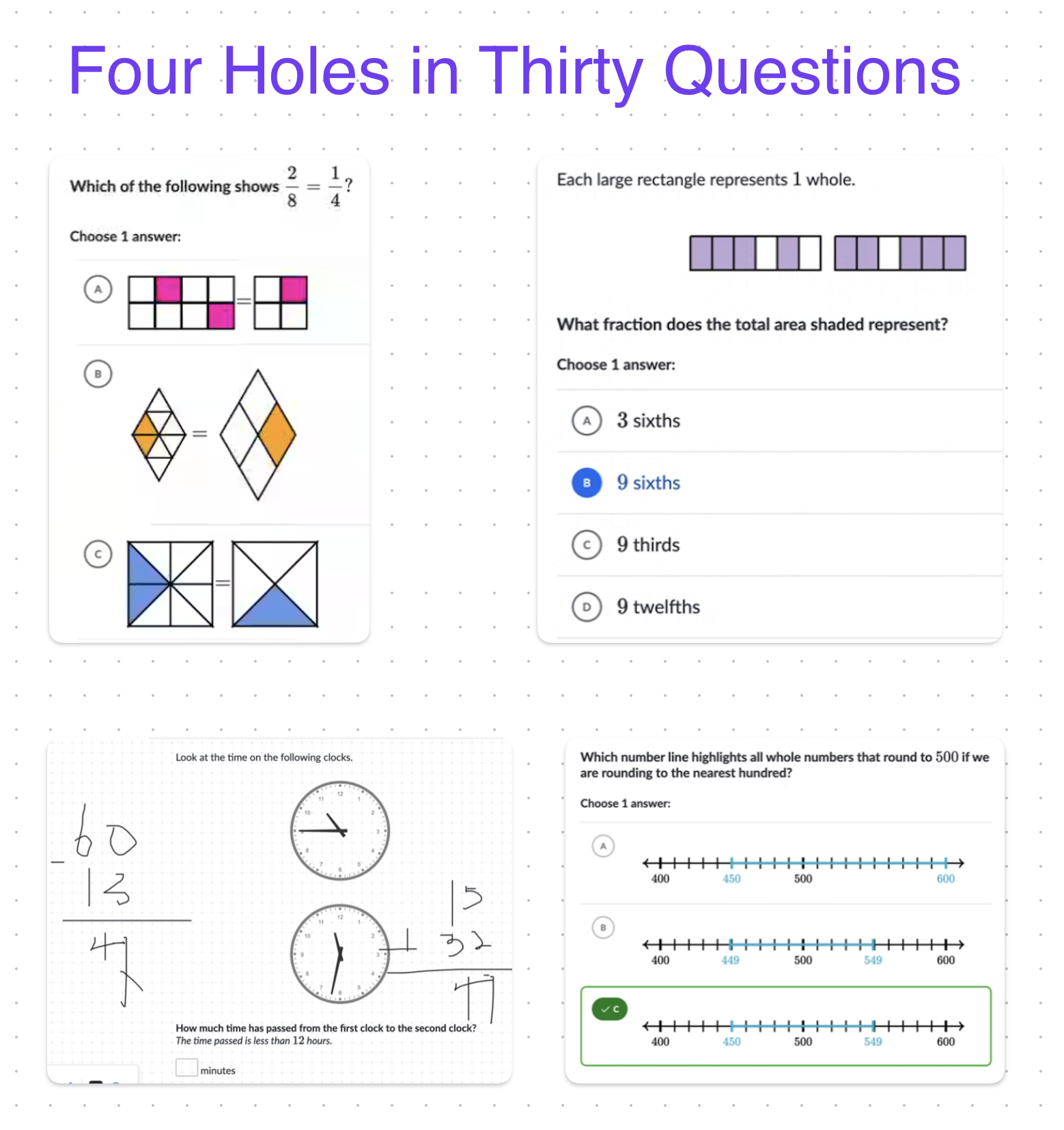
Today, Enning reworked a new set of Khan Academy Grade-3 Course Challenge problems: 30 questions in total. I took four screenshots—not to record mistakes, but to preserve four valuable moments when hidden mathematical holes were discovered and, more importantly, re-learned.
The four holes were surprisingly fundamental: fractions, fractions greater than one, reading a clock, and rounding.
The first question asked:
Which of the following shows 2/8 = 1/4?
All three choices seemed correct.
Enning was confused. So was I.
Then I realized the beautiful trick: when comparing fractions visually, the whole must be the same. If the wholes are different, two pictures can appear to represent the same fraction while actually representing different quantities.
I volunteered the explanation while Enning was still struggling.
Donald was flexible sometimes. LOL.
The second question asked what fraction of the total area was shaded. Enning first chose 9/6, then 9/12—one greater than 1, the other smaller than 1. Her uncertainty was obvious.
The third answer was 47 minutes, but Enning's first attempt was somewhere above 90.
"You don't have the round traditional clock at home, right?"
"Right."
The answer exposed another missing foundation: the clock as a mathematical structure. Enning eventually counted 15 + 32 = 47. I showed her another way:
60 − 13 = 47.
Then came my strange sentence:
"Clock is very, very important in your future learning."
She may be confused by that sentence for days. LOL.
The fourth problem involved rounding. I put the original problem aside and asked a simpler question:
"Round 4.49."
Enning hesitated.
Then she answered:
"5."
Bomb.
The underlying weakness was clear.
The 30-question challenge had quietly become a diagnostic instrument.
Four mistakes were not four failures. They were four doors into Enning's mathematical foundation.
Khan had captured weaknesses that might otherwise remain invisible, while the tutoring session turned each weakness into a moment of reconstruction.
A Grade-3 question was no longer "too easy" for a 16-year-old.
It was exactly what she needed.
A learner can appear to be far behind academically while possessing much more recoverable mathematical potential than a school grade suggests.
The important question is not:
"What grade should she be doing?"
It is:
"What does she actually understand, and where are the holes?"
Once the holes become visible, teaching becomes much more precise.
And sometimes a beautifully designed elementary-school question can teach an adult something too.