
Living Museum of Learning
“这个很简单”
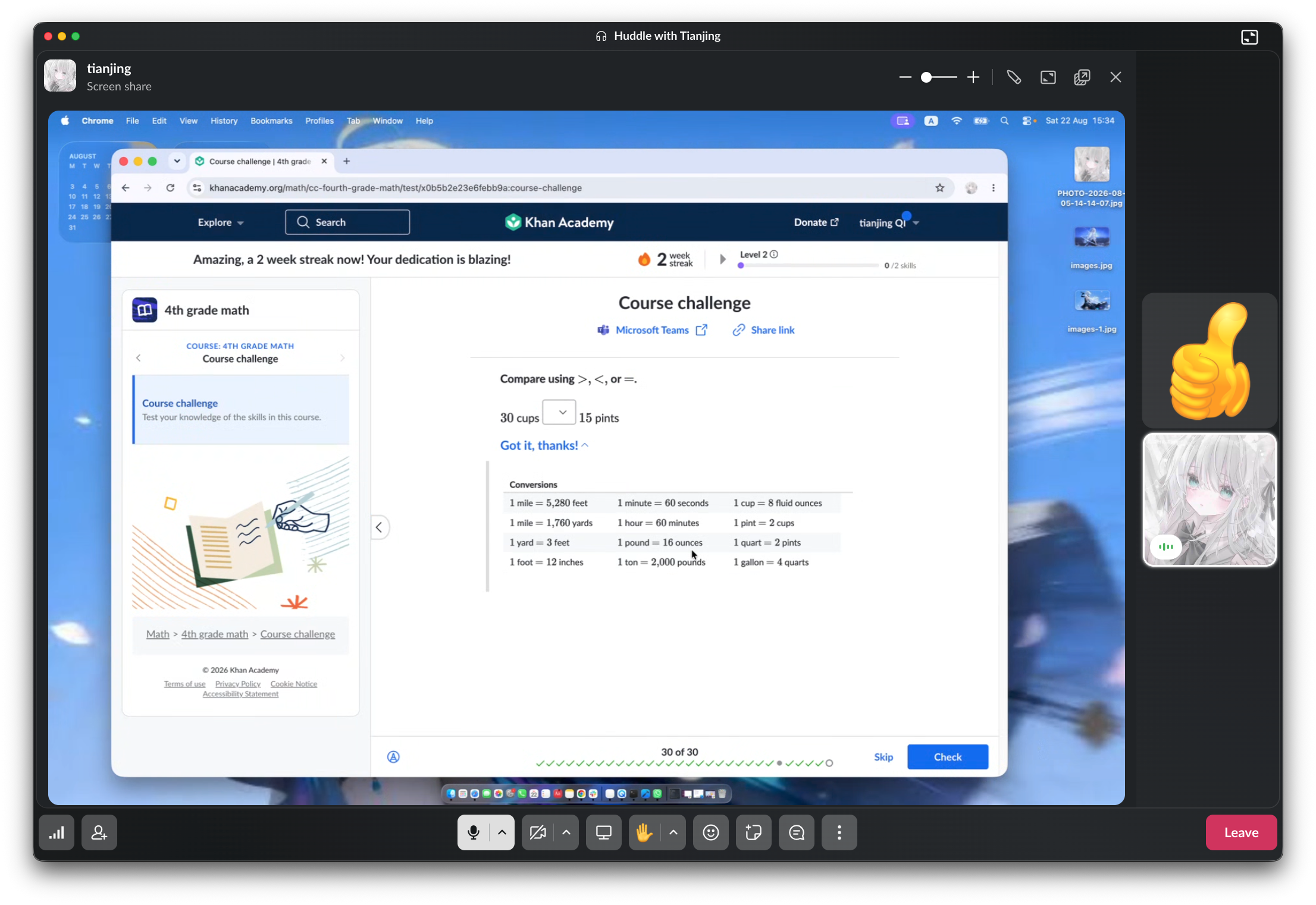
Tianjing had already completed Khan Academy's 4th Grade Course Challenge once, scoring 27/30.
Today she tried it again.
This time she got 29/30.
When she reached the 30th and final question, already knowing she had lost one point, she told herself:
“这下可要特别小心啊。”
“I have to be especially careful this time.”
Donald recorded the moment.
She wasn't even sure whether Donald's 29/30 standard was flexible. 😂
After the congratulations, Donald said:
“Let's take a peek at the 5th grade.”
“It must be harder,” Tianjing said.
The first question appeared:
2.32 × 5.6
Tianjing looked at it and immediately said:
“这个很简单。”
“This one is easy.”
Donald wasn't convinced.
“Show me how you do it.”
She did it perfectly.
“这个” — “this one” — had become Tianjing's signature phrase, appearing everywhere and often. 😂
But the funniest mathematical episode came later.
Donald had sent a question to the family group and received no response, so he sent it again:
“When rounding to the nearest whole number, why does 4.49 become 4 instead of 4.49 → 4.5 → 5? 🤔”
Nine minutes later, Tianjing answered:
“因为四舍五入到整数是看小数点后一位和9没有关系”
“Because when rounding to an integer, you look at the first digit after the decimal point; 9 has nothing to do with it.”
😂
Her answer was interesting.
She knew the rule.
But Donald wasn't satisfied with merely knowing the rule.
He asked:
“Why does this make more sense?”
That little question changes everything.
The goal is no longer:
What is the rule?
It becomes:
Why should the rule make sense?
This was already visible in Tianjing's Gomoku homework.
She had replaced a huge amount of repetitive Swift code with:
for i in 0 ..< 15 {
pencil.move(to: CGPoint(x: gridX,
y: 100 + CGFloat(i) * side))
pencil.addLine(to: CGPoint(x: gridX + 16 * side,
y: 100 + CGFloat(i) * side))
}
And she had written her own little table:
i i + 2 100 + i * 56
0 2 100 + 0 * 56
1 3 100 + 1 * 56
2 4 100 + 2 * 56
...
She was already discovering that a computer doesn't need fifteen separate instructions.
One rule can describe all fifteen lines.
Today Donald began pushing the next level:
What exactly does i + 10 mean?
What exactly does i * 10 + ... mean?
Why does the arithmetic produce the pattern we want?
This is the bridge from using a pattern to understanding the pattern.
Tianjing is now moving between several kinds of thinking:
Mathematics
29/30 on her second attempt, followed by a look into Grade 5.
English
Khan's questions change from attempt to attempt, so repeating the course challenge is also repeated English exposure.
Programming
Her Gomoku board is already moving from manually written coordinates toward loops and mathematical descriptions.
Metacognition
When she reached the final Khan question, she told herself:
“这下可要特别小心啊。”
“I have to be especially careful this time.”
And when she answered the rounding question, Donald immediately asked the next question:
“Why does this make more sense?”
That is perhaps the most interesting transition.
A student can know a rule.
A student can apply a rule.
A student can notice that a rule has exceptions.
But eventually we want something deeper:
“Can I explain why this rule makes sense?”
Tianjing is beginning to live in that territory.
And because she is already comfortable with command line, vi, and Python, Donald can now give her more abstract playgrounds: arrays, patterns, algorithms, perhaps eventually DMOJ.
A student can move from following mathematical rules to questioning, explaining, and testing those rules.
Give her harder problems, ask “show me,” ask “why,” and let programming turn mathematical patterns into something she can manipulate.
Because the deepest learning begins when “I know the rule” is no longer the end of the conversation. It becomes the beginning of “Why does this make sense?”