
Living Museum of Learning
The Two-Hour Detour
Enning's class had ended hours earlier.
Instead of silently struggling with her homework—or simply copying yesterday's code—she sent Donald a private message:
“这里就是直接下面写rect width 还有 rect height 不太理解”
It was the first time she had privately reached out with a technical question.
Donald replied:
print(rect.width) to see the value
Then:
“Go to Slack and I’ll give you a hand.”
They reconnected for a few minutes.
Later, they reconnected again.
The second session lasted about two hours.
What began as a small question about rect.width and rect.height turned into a much deeper investigation of what Enning actually remembered from the previous two weeks.
Donald was shocked by the holes.
Enning had been able to produce increasingly sophisticated-looking code, but when asked to rebuild a simple drawing task from scratch, pieces of the underlying knowledge were missing.
So they slowed everything down.
Painfully slowly.
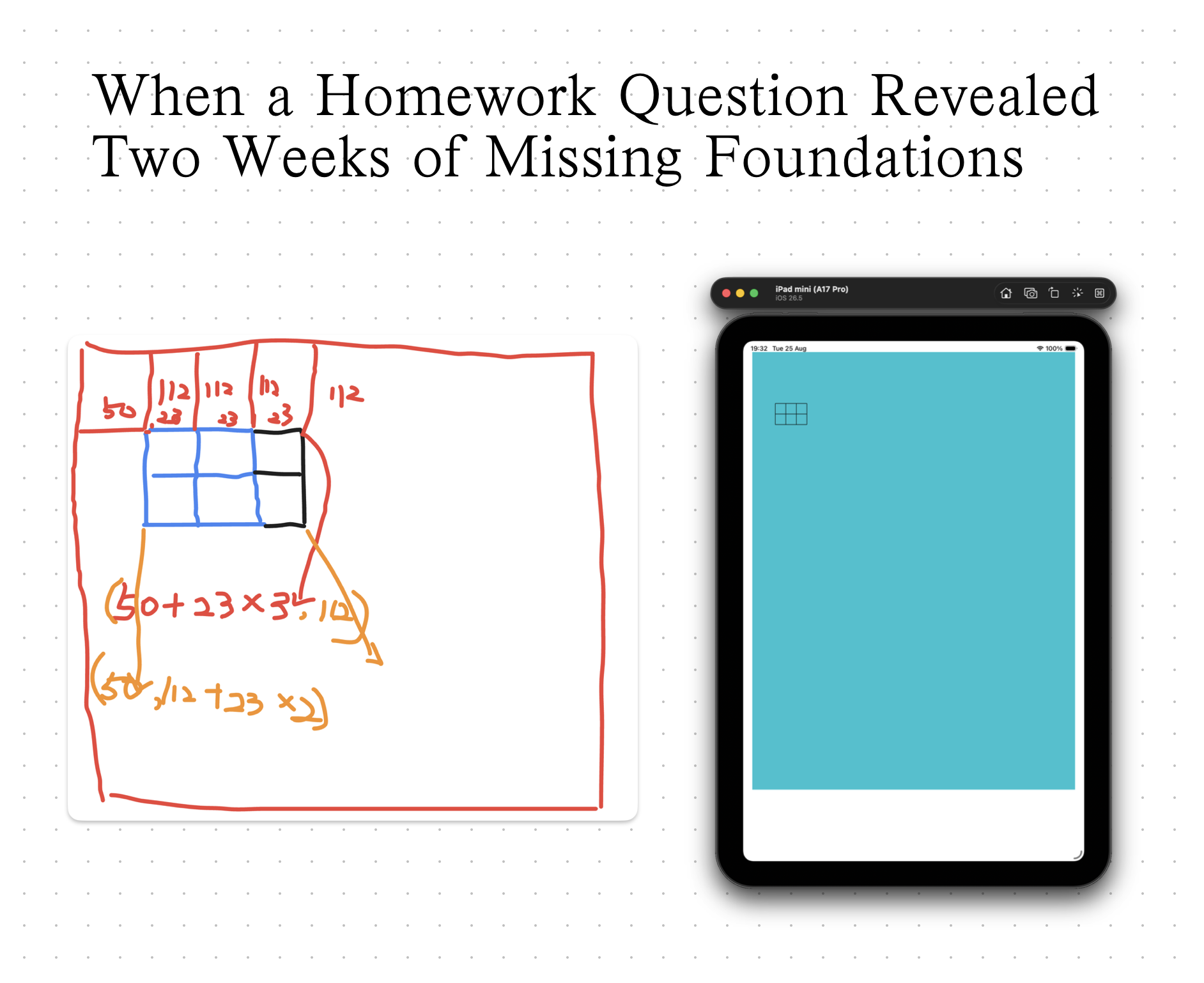
Instead of moving forward, Enning rolled back about one or two weeks and rebuilt the basics.
She reconstructed a simple Snake grid:
create a UIBezierPath
move(to:)
addLine(to:)
repeat the process
finally stroke()
The code was not elegant.
It did not need to be.
For perhaps the first time, the goal was not to make the program look good.
The goal was to make sure Enning knew what each piece was doing.
The two-hour session was exhausting for both teacher and student.
But it revealed something important:
The problem was not simply that Enning needed more effort.
She needed less pressure and more ownership.
Donald had initially been thinking about how to make Enning progress faster.
Now he realized that the more important question was:
How do we keep her curious enough to want to keep learning?
Tianjing's learning style had made acceleration look natural: new material, harder problems, rapid progression.
Enning was different.
For her, moving forward too quickly could leave invisible holes behind. Those holes might remain hidden while she was rewriting familiar code, but become painfully obvious when the template disappeared.
So Donald made a deliberate decision:
Slow down.
Go back.
Rebuild.
Let her succeed.
Give her more fun and less pressure.
The rollback was not a retreat.
It was foundation repair.
The most important learning event that day may not have been anything inside the code.
It was Enning's behavior.
She encountered something she didn't understand.
She asked for help.
She did not wait until the next scheduled class.
She did not pretend she understood.
She did not simply recopy the old solution.
She reached out.
And Donald responded by making himself available twice—including a second session lasting two hours.
That created a different learning loop:
confusion → question → connection → rebuild → understanding → confidence
rather than:
confusion → pressure → copy → temporary completion → forgotten again
At the end of the long day, Donald told her:
“Take a good break today. Don't worry about any homework. 😀”
and:
“We already learned a lot today.”
Enning replied:
“thank you very mu ch”
—with the original typo still intact.
And perhaps that imperfect little message is the perfect final artifact.
She had struggled.
She had asked.
She had worked for two hours.
And she was told:
That's enough for today.
A difficult learning gap can become visible without becoming a source of shame—and a student can learn to ask for help instead of hiding the gap.
Stop advancing, roll back, rebuild the missing foundations, reduce pressure, and make enough room for small successes and curiosity to return.
Long-term learning is not a race through increasingly difficult material. Sometimes the fastest way forward is to slow down before confidence and curiosity are lost.