
Living Museum of Learning
I Never Taught Her This
I thought I knew what Enning was learning in P5JS.
We had worked together on programming, drawing, loops, refactoring, and her iOS projects. I knew the things I had taught her.
But one morning, I accidentally found something I had never seen before.
A P5JS project.
It was unfinished.
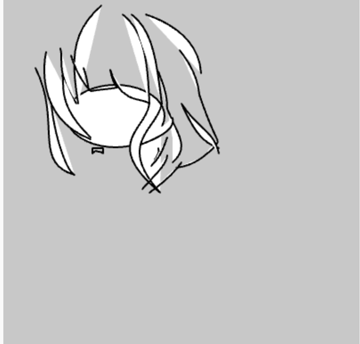
On the screen was what appeared to be a girl: a large oval shape, a long head of hair made from many curves, and an empty face waiting for something to happen.
I looked at the code.
And stopped.
I had never taught Enning ellipse().
I had never taught her bezier().
In fact, I didn't even know she had discovered them.
There was no homework saying:
“Learn Bézier curves.”
There was no lesson saying:
“Draw a girl.”
There was no carefully prepared example from the teacher.
She had simply been experimenting.
The beginning already contained:
ellipse(63,67,55,35)
bezier(55,5,38,20,38,35,42,60)
bezier(32,29,34,35,29,42,41,60)
bezier(24,31,22,40,20,69,49,80)
bezier(33,44,35,48,29,60,49,79)
Then more.
And more.
And more.
Dozens of Bézier curves.
She was discovering that instead of drawing only straight lines and simple shapes, she could use control points to bend lines into curves.
She didn't appear to be studying Bézier curves.
She was using them to make something.
That distinction matters.
The project was still unfinished when I found it.
The face was empty.
The hair was already there.
The long curves created a recognizable outline, but the final character had not yet emerged.
And somehow, the unfinished picture made the discovery more powerful.
I wasn't looking at a polished project that Enning had submitted to me.
I was looking at a project she had apparently started for herself.
Nobody was asking her to do it.
Nobody was watching.
Nobody was grading it.
She had found a tool and was trying to make something with it.
This is a very different kind of learning.
Normally, learning looks like this:
Teacher → lesson → student → exercise → result
But this little project suggested another path:
Idea → curiosity → search → experiment → discovery → creation
The teacher wasn't at the beginning of the chain.
The teacher arrived afterward.
The most important discovery wasn't bezier().
It was self-directed exploration.
A student who waits for instruction asks:
“What should I learn next?”
A student who begins to explore asks:
“What can I make with what I have?”
Enning may not have known what a Bézier curve was.
She didn't need to.
She found a function that seemed useful and experimented with it.
Perhaps she adjusted coordinates.
Perhaps she watched the shape change.
Perhaps she copied an idea and modified it.
Perhaps she simply kept trying until the curves began to look like what she imagined.
Whatever the exact path was, something important had happened:
She had crossed the boundary between learning programming and using programming as a creative medium.
And there is an even deeper lesson for the teacher.
A teacher can carefully design lessons, explain concepts, assign homework, and guide practice.
But the ultimate goal is not to make the student permanently dependent on those lessons.
The real goal is to make the student curious enough to continue when the teacher isn't there.
One morning, I accidentally discovered that Enning had been doing exactly that.
I never taught her this.
And that may be the best part.