
Living Museum of Learning
Why Not Let the Queen Come?
Tianjing had been working on chess.
I told her that the queen is the most powerful piece.
She said she already knew.
Then, without much hesitation, she said:
“国王是最没用的。那为什么不让女王来呢?”
“The king is the least useful. So why not let the queen come?”
😂
That question was much more interesting to me than whether she knew how the pieces moved.
She wasn't asking me for a fact.
She was questioning the design of the system.
If the queen is more powerful, why is the king the piece whose survival determines the game?
And that same habit of looking at a structure and asking “Why does it have to be this way?” was beginning to appear elsewhere.
Tianjing had scored 19/20 on an IQ test.
But an IQ score isn't what tells me whether a learner is becoming confident.
I listen for moments like:
“这个应该没问题。”
“This should be no problem.”
Her little “这个!” moments have become familiar.
They are the moments when she sees something for herself:
I see it.
I understand it.
I can handle this.
Then came her chessboard code.
Before class, she had already written working code for the pieces.
The eight pawns on each side were drawn with for loops.
During class, she quickly recognized that the rooks, bishops, and knights also came in pairs with the same underlying positional pattern.
She put each pair into a two-iteration for loop.
Smoothly.
No drama.
Done.
Then I looked at the two old pawn loops.
“What can we further simplify?”
She seemed genuinely convinced that she had reached the end.
“没有了吧?应该没有了吧。”
“There’s nothing more, right? There shouldn’t be anything more.”
😂
I didn't tell her what to do.
I simply said:
“It’s the same simplification you was doing.”
She looked at the two loops.
“These loops?”
“These loops?”
It sounded like a question.
But she had already got it.
This was not really a lesson about for loops.
Tianjing already knew how to write them.
The important thing was that she was beginning to recognize a pattern behind a solution, and then reuse that pattern somewhere else.
The same thing had happened in chess.
She knew the rules.
Then she questioned the rules.
Why the king?
Why not the queen?
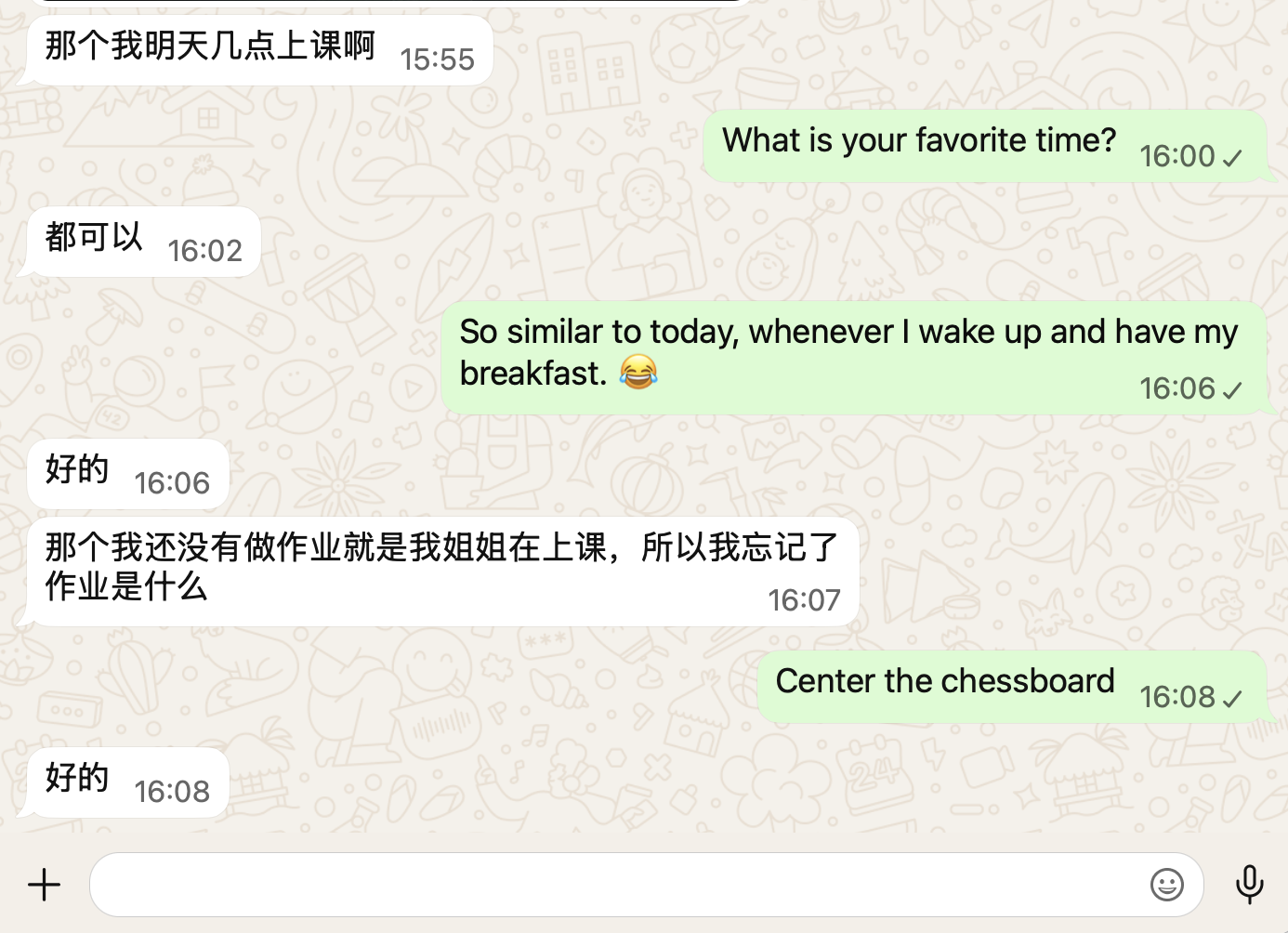
And then something similar happened with her schedule.
For months, her class had effectively been fixed at 3:30 PM England time.
She had never agreed to move it.
But today, when I told the sisters that Enning could start a new bicycle project, Tianjing suddenly said:
“我先上吧。”
“I’ll go first.”
She went hours earlier than her usual class time.
And for the first time, she went before her older sister.
Later, she asked:
“那个我明天几点上课啊?”
“So what time am I having class tomorrow?”
I asked:
“What is your favorite time?”
Her answer:
“都可以。”
“Any time is fine.”
That was new.
Very new.
Something has shifted.
Tianjing is becoming less attached to the given structure.
In chess, she asks:
Why does the king have to be the important one?
In programming, she asks:
Why do I need to write these things separately if they follow the same pattern?
In her schedule, she discovers:
Why does class have to happen at one particular time?
These may look like completely different things.
But underneath them is the same emerging habit:
Don't just accept the structure. Look for the reason. Look for the pattern. Ask whether it can be changed.
That is a very different kind of confidence from simply getting answers right.
A confident learner doesn't only say:
“I know how this works.”
She eventually begins to say:
“Why does it work this way?”
And then:
“Could it work another way?”
A learner who once followed fixed structures can begin to question them, discover patterns, and imagine alternatives.
Let her questions lead. Reuse her own discoveries, rather than always supplying the next answer.
The deepest confidence is not “I know the answer.” It is “I can examine the system itself.”