
Living Museum of Learning
An Almost-Idle Server Gets a New Life
Situation
Six months ago, seven of our published iOS apps were effectively dead. We rescued them one by one, then went further: we refactored their common code and created two of our own shared libraries used across all seven apps.
Among them, Golden Xiangqi and Golden 24 began to feel alive again.
Then came an old memory.
Years ago, Donald had built server-backed apps. One of them, Slots, briefly reached five- or six-digit downloads. Then business became busy, and that part of his programming life gradually went quiet.
This year, something unexpected happened.
The Living Museum of Learning was born. Yesterday, the Museum passed 3,000 visitors.
And suddenly the server was no longer sitting almost idle.
It was active again.
Turning Point
About three months ago, while trying to play Golden 24 together with An and Cindy in a tiny waterfront airplane waiting room, Apple's nearby multiplayer connection failed when there was no Wi-Fi available.
The experience was frustrating — but it planted a new question:
What if Golden Thumb had its own bridge?
Not a huge cloud system. Not an elaborate backend.
Just a tiny server that could help Golden Xiangqi, Golden 24, and future games exchange tiny pieces of information when “nearby” doesn't work.
Emergence
The idea quickly became an educational project.
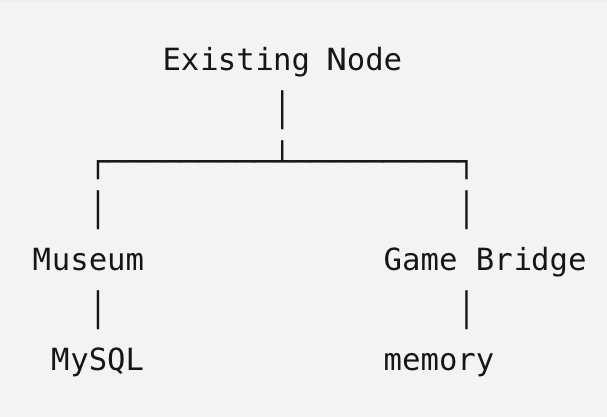
Our existing Node server already serves the Living Museum, with a small MySQL database helping with search.
So why create another server immediately?
The first experiment can simply be:
Existing Node server
→ Museum
→ Game Bridge
The Museum can continue using MySQL.
The Game Bridge can initially keep game rooms and moves in memory.
A move might be almost ridiculously small:
Rhea makes a move in Sunnyvale.
The app sends it to the server.
Grandpa's app polls the server.
The server says:
“Yes. Move #17 happened.”
Grandpa's board animates it.
pa... pa... pa...
The server doesn't play chess.
It doesn't need to understand the game.
It simply carries the move.
Learning
This may become a very different kind of weekend project for Ethan and Albert, both in Grade 11.
Ethan already knows P5.js and has recently built a shining, spinning 3D soccer ball by cutting an icosahedron. He has also built iOS games in the past.
He doesn't need a P5.js course.
Instead, he can discover:
dragging pieces with mousePressed(), mouseDragged(), and mouseReleased();
buttons and game state;
HTTP requests;
polling;
JSON;
sequence numbers;
client/server architecture;
and the difference between a game engine and its network transport.
And the project doesn't have to stop with two players.
Golden 24 already supports more than two players.
Eventually, Grandpa in Toronto, Rhea in Sunnyvale, An, Cindy, and others could share the same little game room.
Meanwhile, Cloud, Tianjing, Enning, and Leo — learners who connect with Donald almost daily and have much more freedom in choosing projects — can enter through completely different doors.
One learner may care about animation.
Another may care about networking.
Another may want to redesign the board.
Another may ask why polling works.
Another may break something completely new.
That's the point.
Emergence
We are not building a toolbox where every learner is taught the same tool and sent home with the same project.
We are building a thinking lab.
The server becomes another piece of laboratory equipment.
The seven rescued apps become another set of specimens.
The Living Museum becomes the place where discoveries are preserved.
And the students become collaborators in an environment where one experiment can unexpectedly create the next one.
A tiny Chinese chess text file can lead to Game Theater.
Game Theater can lead to HTTP.
HTTP can lead to Game Bridge.
Game Bridge can connect two phones.
Two phones can connect two people.
And two people can become a much bigger learning experience.
Theme
A server as a learning bridge
Doors
☑ What Is Possible
An almost-idle Node server can evolve from serving museum content into connecting players, games, and learners around the world.
☑ How Does It Happen
Start small: a game room, a move, an HTTP request, polling, and a local animation. Let the architecture grow only when the experiment demands it.
☑ Why Does It Matter
Real learning does not have to begin with a predefined curriculum. A real problem can become a laboratory in which programming, mathematics, networking, creativity, and collaboration emerge together.