
Living Museum of Learning
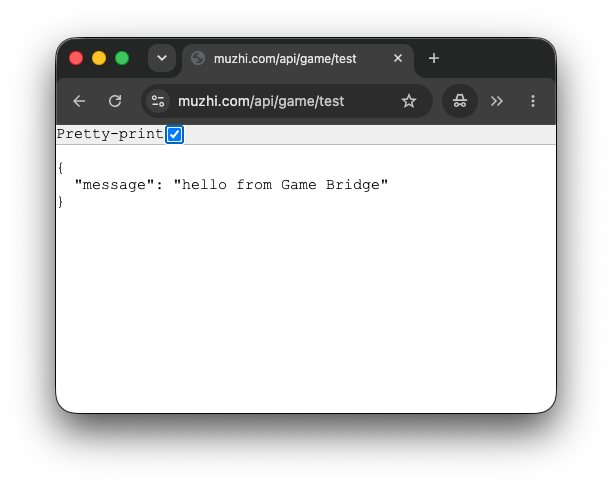
The Pretty-Print Checkbox
Situation
This morning, we set the first goal for a new experiment.
Tianjing is in England. Donald is in Toronto. She has two work-in-progress Chinese chess projects:
an iOS CChess app
a p5.js CChess project
Someday, we want them to talk to each other through a Game Bridge.
But we decided not to start with chess.
We started with the smallest possible message:
hello
First, we added a tiny endpoint to the Museum Brain Node server:
/api/game/test
It returned:
{
"message": "hello from Game Bridge"
}
We tested it locally.
Then we tested it through the real public path:
https://muzhi.com/api/game/test
Nginx carried the request to Node.
Node answered.
The bridge was alive.
Turning Point
Then Donald opened the URL in a browser.
There it was:
{
"message": "hello from Game Bridge"
}
And then he noticed a little checkbox:
Pretty-print
He clicked it.
For the first time in his life. 😂
Apparently, programmers from Donald's generation did not grow up with this cute little thing.
We used to stare at machine output exactly as it came.
Now the browser politely says:
Would you like me to make that JSON easier on your eyes?
Yes, please. 😄
Emergence
The funny part is that Pretty-print is not the important technology here.
The important technology is the invisible road behind it:
Browser → HTTPS → Nginx → Node → Game Bridge
But the Pretty-print checkbox made that road suddenly visible.
The result was no longer an abstract piece of server code.
It was a message traveling through a real production system and arriving in a form a human could immediately understand.
Learning
A bridge does not need to understand the thing it carries.
Our first Game Bridge knows nothing about Chinese chess.
It doesn't know what a rook is.
It doesn't know the board coordinates.
It doesn't know Tianjing.
It only knows how to receive a message and return a message.
That is enough for Version 1.
Next, we want to make the message itself travel:
iOS CChess → Game Bridge → p5.js CChess
and back again.
But today, we have something even smaller:
the bridge says hello.
And Donald discovered Pretty-print. 😂
Theme
Small doors can lead to very large rooms.
What Is Possible
A production server that already runs a Living Museum can also become a communication bridge for real student projects.
How Does It Happen
Start with one endpoint, one message, one test, and verify every layer before adding complexity.
Why Does It Matter
Good engineering does not begin by building the whole bridge.
It begins by proving that one tiny message can cross it.