
Living Museum of Learning
The Teacher Is a Bridge, Not the Protocol Designer
Situation
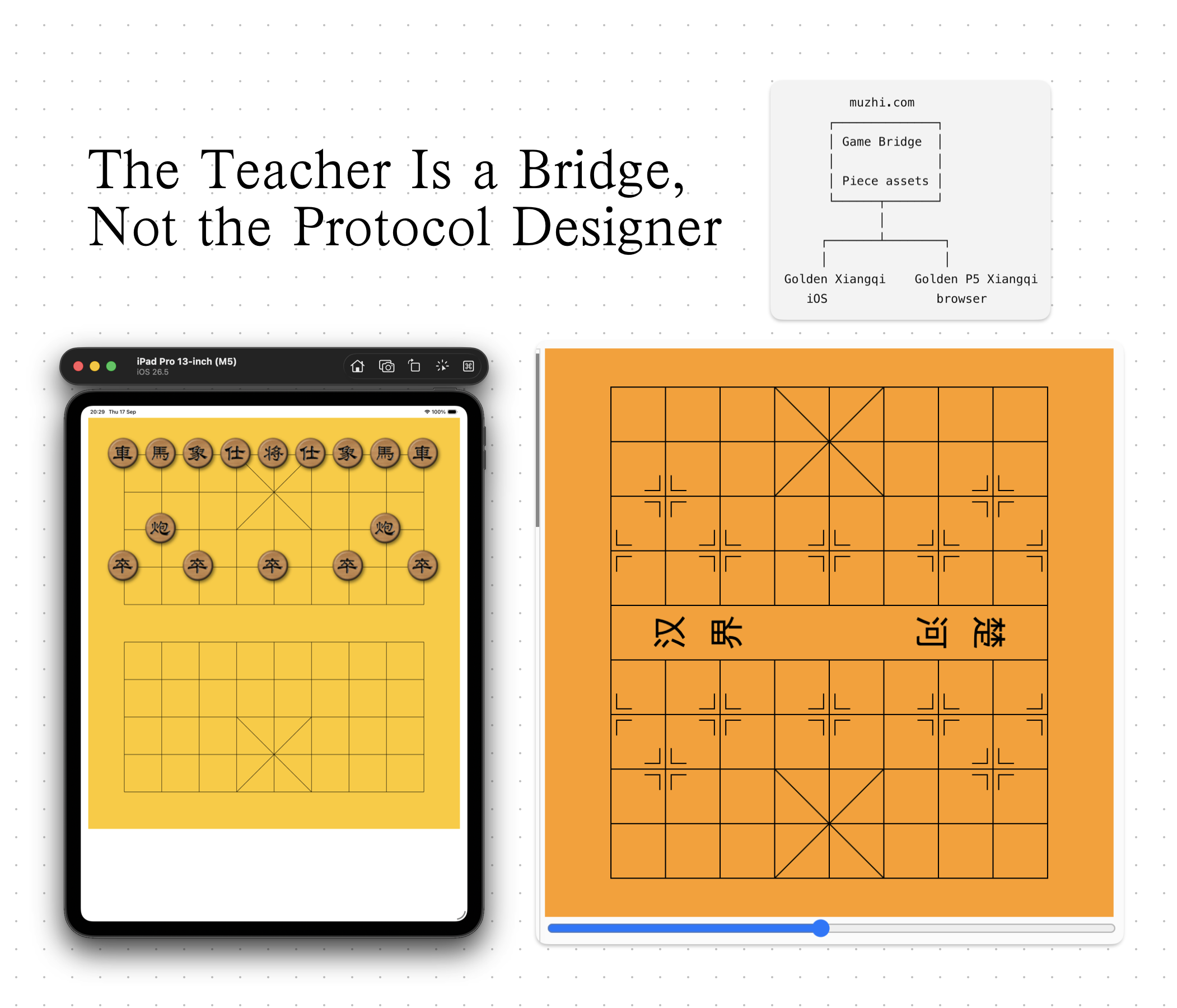
We were building a small Game Bridge between two versions of Tianjing's Chinese chess game:
her iOS CChess
her p5.js CChess
Before either program knew anything about chess networking, we built something much simpler.
A message could travel from one side to the other.
iOS CChess
│
▼
Game Bridge
│
▼
P5 CChess
And then back again.
At first, the messages were almost ridiculously simple:
"hello from iOS"
"hello from p5.js"
That was enough.
We didn't need to understand chess pieces, coordinates, turns, captures, or game state.
We just needed to prove that the bridge worked.
Turning Point
Then came the interesting question.
Once the communication channel works, who should design the language spoken across it?
Not Donald.
Tianjing.
She already has two worlds:
iOS CChess
↕
Game Bridge
↕
P5 CChess
Now she can decide what these worlds should say to each other.
Perhaps a message means "move this piece."
Perhaps it contains a starting position and an ending position.
Perhaps she invents something we haven't imagined.
The important part is not which protocol she chooses.
The important part is that the protocol becomes hers.
Emergence
This made me think about teaching.
Teachers are often treated as if their job were to provide the language of learning:
Here is what you need to know.
Here is how you should think.
Here is the correct procedure.
Here is the protocol.
But perhaps the teacher's more important job is to build the bridge.
Make communication possible.
Open the doors.
Provide enough infrastructure for the learner to cross from one world to another.
Then step back.
The student can become the designer.
In our little Chinese chess experiment, Donald is building the Game Bridge.
Tianjing will design the protocol.
And that is not just a programming exercise.
It is a model of learning.
Learning
A learner becomes more independent when they are responsible not only for using a language, but for deciding what the language should express.
The teacher provides infrastructure without taking ownership of the learner's thinking.
A bridge connects two worlds.
It does not tell travelers where they must go.
A protocol enables communication.
It does not decide what the participants should mean.
Theme
Teachers can build bridges.
Students can design the languages of their own learning.
What Is Possible
A student can move from using someone else's system to designing a system of communication of their own.
How Does It Happen
Build the smallest useful bridge first. Prove that communication works. Then hand the design responsibility to the learner.
Why Does It Matter
Because learning becomes something the student creates—not merely something the teacher transmits.