
Living Museum of Learning
When the Pulley Started to Make Sense
Situation
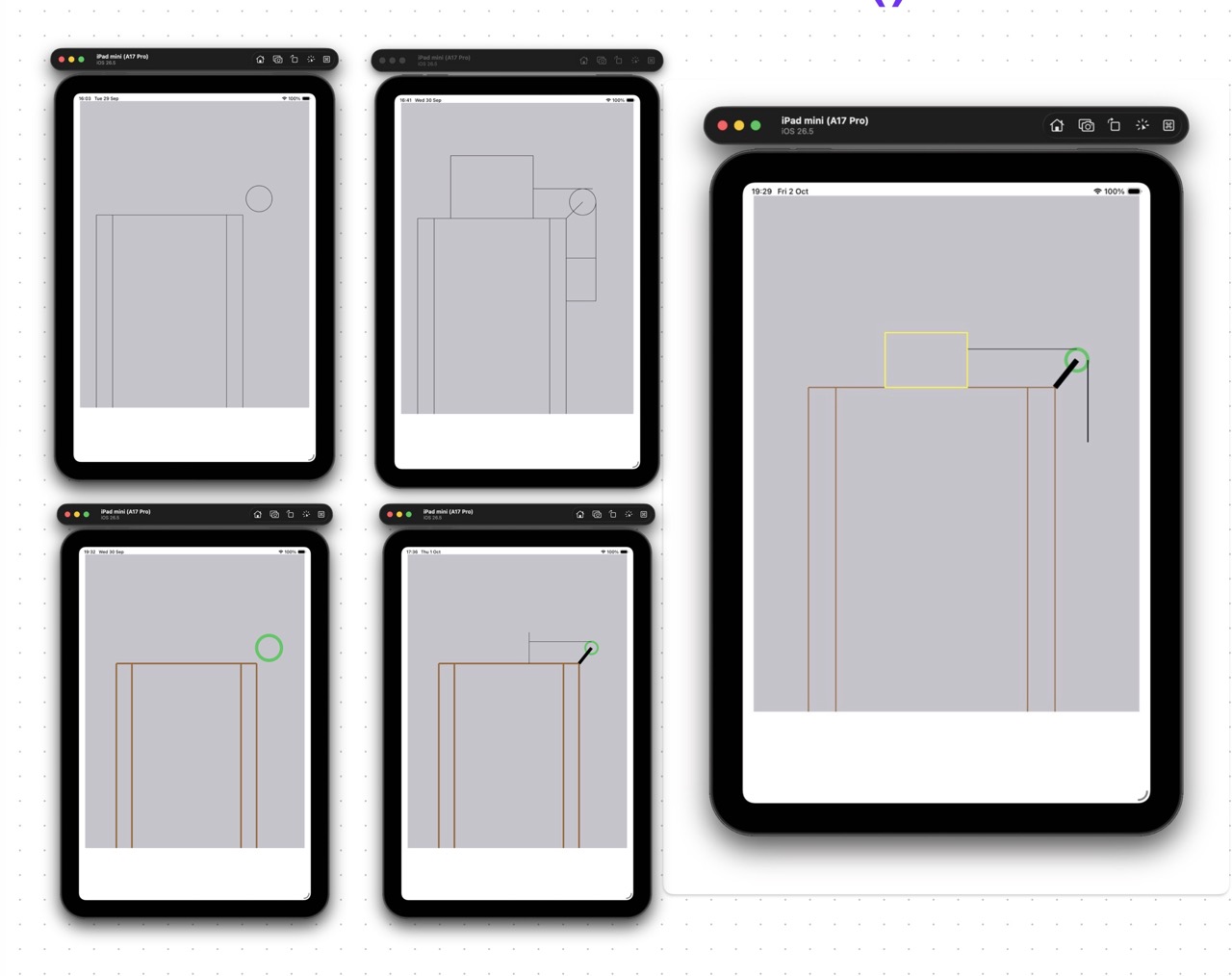
Enning started with something wonderfully simple: a few lines, a circle, and a table.
At first, the goal was simply to draw a pulley.
But once the drawing began to grow, so did the questions.
Where should the wheel go?
Where should the rope begin and end?
How should the support connect to the wheel?
Which numbers should she choose herself?
And which numbers should be calculated from other numbers?
The pulley was quietly turning into something much more interesting than a picture.
Turning Point
Then came a very real bug.
The weight on the right looked wrong.
Not just aesthetically wrong.
Physically wrong.
The rope was not passing through the center of the weight.
That meant the code was faithfully drawing a model—but the model itself did not faithfully describe the physical object.
LOL.
This was the moment when drawing became modeling.
Emergence
Across five versions, Enning gradually replaced arbitrary coordinates with relationships.
The table acquired structure.
The wheel acquired a support.
The rope acquired meaningful lengths.
The boxes acquired width and height.
And then we started talking about independent values and dependent values.
Some numbers are choices.
Others should follow from those choices.
That distinction is small in words, but enormous in programming.
Instead of saying:
“Put this thing at x = 590.”
she was beginning to think:
“This thing belongs here because it is related to that thing.”
The pulley was becoming a system.
And when the system disagreed with reality, she fixed the model rather than simply moving pixels around.
Learning
This is one of those moments when programming, geometry, and physics quietly become the same lesson.
Enning was learning that a computer drawing is not necessarily a model.
A model has relationships.
Change one independent value, and the dependent parts should respond appropriately.
The deeper lesson was not how to draw a pulley.
It was how to move from:
coordinates → structure → relationships → model.
That is a remarkably important transition for a beginning programmer.
Theme
Learning to model reality
A child can start programming by telling the computer where to put things.
Then, almost unnoticed, programming becomes something else:
telling the computer why things belong where they are.
What Is Possible?
What else can Enning turn from a collection of lines into a system of relationships?
How Does It Happen?
By drawing, noticing, breaking things, asking why, and rebuilding.
Why Does It Matter?
Because the moment a program begins to represent the real world, correctness is no longer just about whether the screen looks right.
It is about whether the computer's world makes sense.