Living Museum of Learning
The First Shot: 0.850…
Situation
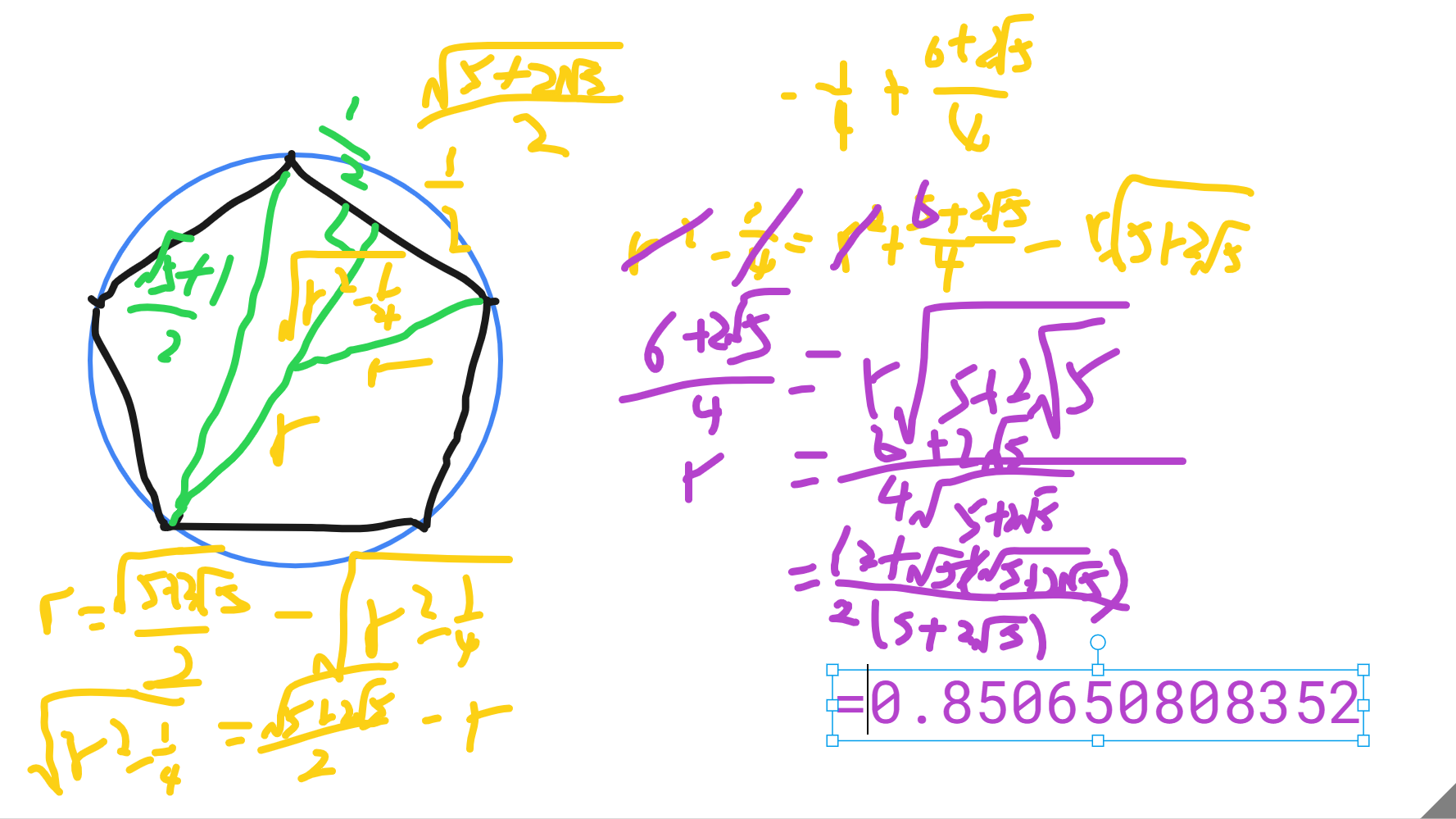
In the first half hour of class, Leo continued a construction he had begun earlier: building pentagons from the centers of the triangular faces of the icosahedron he had created in p5.js.
Then we abandoned the routine and entered a mathematical rabbit hole.
Leo drew a circle. I suggested placing five markers on it to make the pentagon easier to draw. As more lines appeared, I asked him to preserve a copy of his diagram before we added anything that might turn out to be messy, wrong, or useless.
The original diagram was safe. Now we could experiment.
Turning Point
“Do you know similar triangles?”
“Yes,” Leo answered.
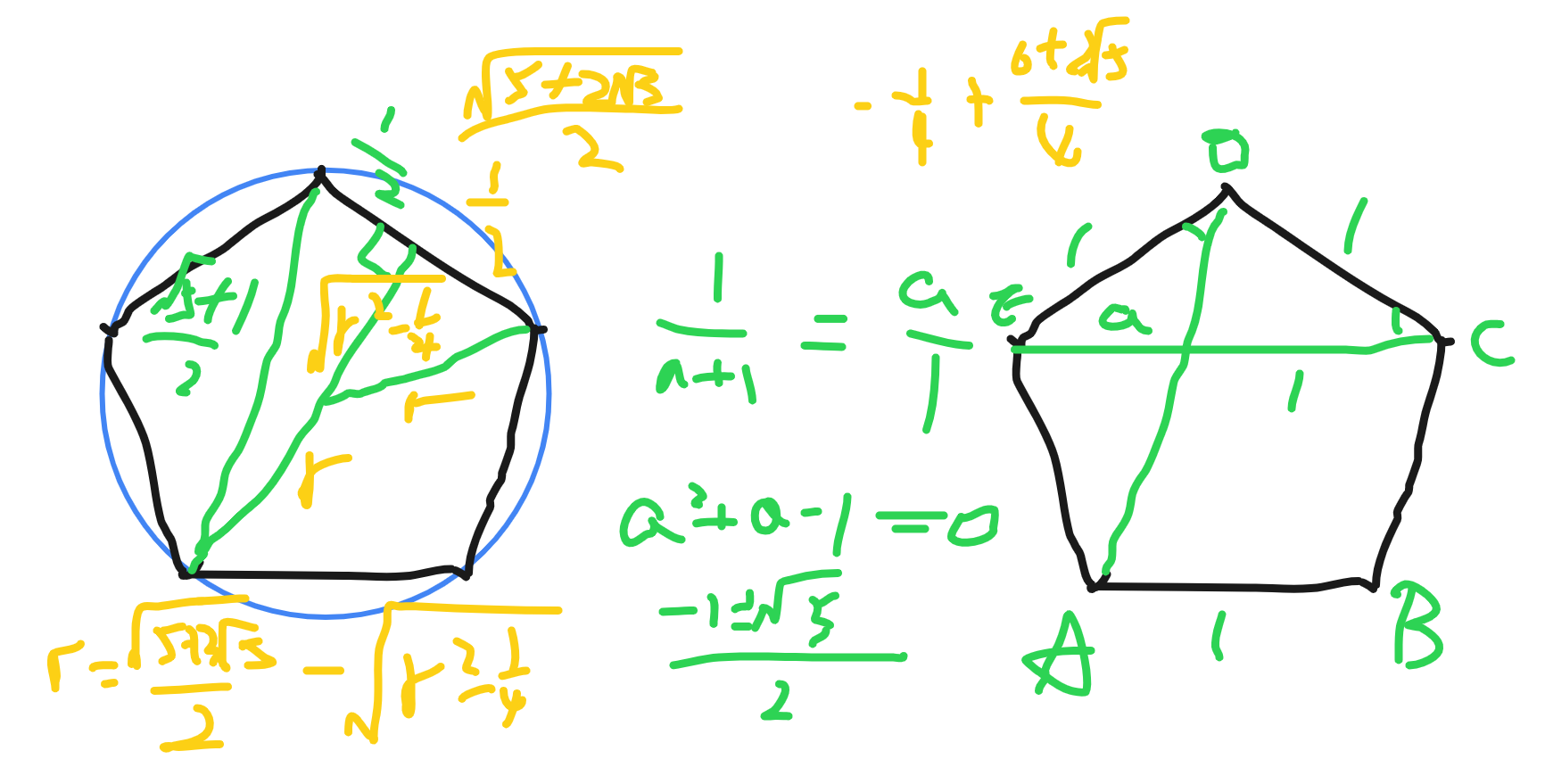
“Try to find any hidden triangles. Oh, by the way, you're already familiar with the golden ratio. There are tons of it here in the pentagon and pentagram.”
I wasn't even sure he cared about that last remark. LOL.
With a nudge, Leo immediately spotted two large triangles and proved the critical equal angles that established the similarity between the small and large triangles. We also recognized a rhombus.
Then the geometry began to yield its secrets.
Leo assigned the pentagon's side a length of a, though I told him he could simply use 1 if he preferred. He calculated a segment of length φ, the golden ratio, and eventually arrived at an equation involving r.
The geometry had led us to algebra.
Emergence
The equation was linear, not quadratic. But its solution was anything but visually friendly: a long expression filled with square roots nested inside other square roots.
“This equation looks more scary than it actually is,” I told him.
I knew Leo's algebra was strong. There was no reason to hide the real mathematics from him.
First, I asked him to estimate the answer.
“Greater than 1 or smaller?”
“Smaller.”
“Like 0.4, 0.5, ...”
“Eh,..., 0.8,” he answered firmly.
We opened the Windows calculator. The expression was so long that I suddenly remembered a shortcut Albert often used.
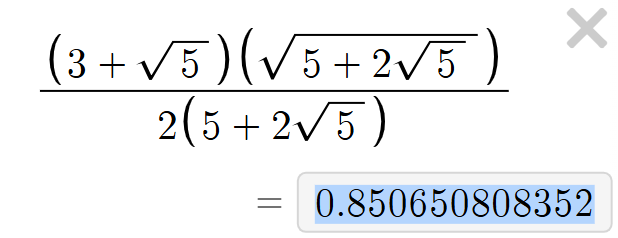
“Wait a minute. We can just input the expression in Desmos, right?”
Leo entered the expression. The number appeared:
0.850…
It looked right in the diagram. It was close to his estimate. And it was the value we had expected from the geometry.
But the real peak of the class was not simply obtaining the answer.
We had completed what was probably the longest calculation of Leo's life, and we had made no mistakes.
Well, almost. I helped him add one missing pair of parentheses. LOL.
First shot. Correct.
Learning
A geometric construction can become a laboratory for mathematical discovery. Hidden triangles lead to similarity; similarity reveals ratios; the golden ratio leads to an exact expression; and numerical evaluation gives us a way to check whether the result makes sense.
Estimating before calculating is not a distraction from rigorous mathematics. It is part of rigorous mathematics. A result should not merely emerge from a sequence of operations; it should also make sense in the world that produced it.
And long calculations are not necessarily beyond a student's reach. When each step is understood, even an intimidating expression can be carried through carefully to the end.
Sometimes the teacher's most valuable contribution is not supplying the next step, but knowing when the student already has the tools to take it.
Theme
Mathematical Confidence
What Is Possible?
Can a student travel from a 3D object to a pentagon, from a pentagon to the golden ratio, and from geometry to a formidable algebraic expression—all in one class?
How Does It Happen?
Preserve the diagram. Look for hidden relationships. Use what you know. Estimate before calculating. Check the result against the original geometry. And don't be afraid of an expression just because it looks scary.
Why Does It Matter?
Because mathematical confidence is built not by avoiding difficult work, but by discovering that you can carry it through—and arrive at the right answer on your first attempt.