
Living Museum of Learning
The “Magic Seven” Debug Story
This is a class moment I will never forget in my life.
It all began with a student, Harry, who had been accepted by both Harvard and CMU for his programming achievements.
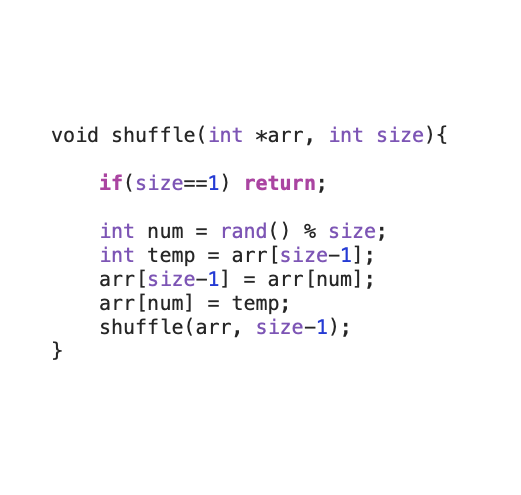
Years ago during a remote lesson, he wrote a shuffle program using recursion to randomly permute an array.
The algorithm worked perfectly for inputs like 52, 20, 6, 5, 4, and 3.
But when he entered a seemingly harmless number — 7 — something strange happened.
No matter how many times we ran it, the last element always stayed in place.
It behaved as if it was under a “curse”.
We reproduced the phenomenon:
$ ./a.out
7
1 2 3 4 5 6 7
4 3 6 1 2 5 7 ← last element always remains 7
At first, we suspected a logical error in the code.
But after careful inspection, the algorithm itself was correct.
The real issue turned out to be deeper — inside the behavior of `rand()`.
We discovered that the pseudo-random number generator in C is not truly random.
It is based on deterministic internal patterns, and certain modulus interactions can produce pathological cases — especially with small values like 7.
This interaction created a hidden structural bias, which made the last element invariant under certain conditions.
What looked like a “magic number bug” was actually a system boundary effect.
The issue was not in the logic we wrote —
but in the assumptions we made about randomness itself.
This became a powerful lesson:
bugs are not always mistakes in code;
sometimes they are collisions with the structure of the system underneath.
Real-world programming is not just about correctness.
It is about understanding the hidden constraints of the environment:
libraries, randomness, hardware behavior, and implementation details.
The most interesting bugs often reveal where abstraction breaks down.
How deterministic systems can produce unexpected invariant behavior under specific inputs.
Through interactions between recursive swapping logic and non-uniform pseudo-random number generation.
Because debugging is not just fixing errors — it is discovering the boundaries of computation.