
Living Museum of Learning
Albert’s Rotating Solids
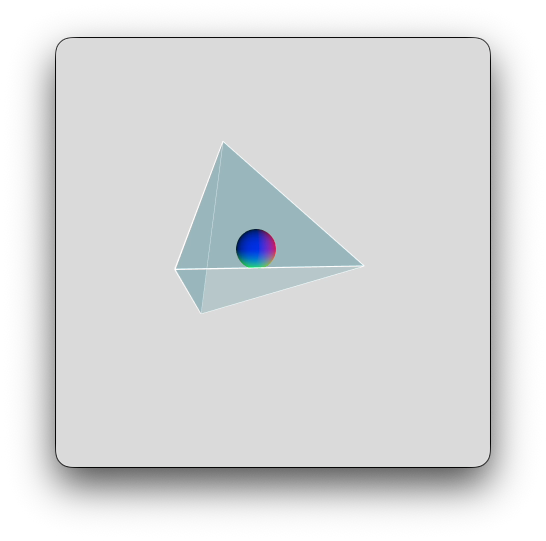
Albert created a 3D animation in p5js: a transparent tetrahedron slowly rotating along the X, Y, and Z axes, with a small colored sphere at its center.
The result was visually striking—geometry, color, and motion combined into a simple but elegant spatial system.
A few seconds of animation already showed something important:
He was not just drawing shapes. He was building space.
Later, the focus shifted to a regular octahedron.
At first, Albert tried to approach it through computation—assuming edge length 1, considering distances such as √2, and preparing for a more traditional geometric calculation.
I stopped him and asked a different kind of question:
"Do you think this will involve a lot of computation, some, or none?"
After thinking for a moment, he realized something unexpected:
With a proper vertex arrangement, the octahedron required essentially no computation at all.
Not even square roots.
The structure collapsed into symmetry.
We then explored why this happens.
The four vertices of a square in the horizontal plane are all equidistant from its center—this is intuitive.
The deeper question was:
Is the same true when extending upward to the apex of the octahedron?
Through discussion, Albert saw that the full structure is governed by symmetry:
the base square is symmetric,
the top vertex is symmetric with respect to it,
distances that looked like “calculations” are actually consequences of structure.
What initially appeared to require computation turned out to be determined entirely by symmetry.
By the end of the session, Albert had nearly completed a rotating octahedron in p5js:
transparent geometry,
smooth rotation in 3D,
a colored sphere at the center,
clear spatial structure.
The mathematics was no longer separate from the code.
It was embedded in it.
After the lesson, I suddenly remembered a connection to Leonardo da Vinci’s circle and his friend Luca Pacioli.
I sent Albert a message:
“Isn’t a regular octahedron essentially supported by three mutually perpendicular squares?
This feels similar to Pacioli’s construction of the dodecahedron using golden rectangles, right?”
Albert replied immediately:
“Yes.”
This sequence revealed two complementary ideas:
First:
Beautiful geometry often emerges before full mathematical formalization.
Second:
Many “hard computations” disappear when symmetry is properly understood.
Albert experienced both:
first through visual construction (tetrahedron animation),
then through structural insight (octahedron symmetry).
He did not merely compute shapes.
He recognized them.
3D geometric structures can be explored visually before formal computation is introduced.
Code becomes a medium for discovering symmetry, rather than just implementing formulas.
When students see that computation can disappear into structure, geometry becomes a field of insight rather than calculation.
What looked like a √2 problem turned out to be a symmetry problem.
That shift—from calculation to structure—is exactly where real geometric thinking begins.