Living Museum of Learning
The Missing Minus Sign
A student came to a teacher with a strong desire to move forward quickly.
He often said:
"You haven't taught me high school algebra yet. I want to jump ahead and skip my school math."
The ambition was real.
The curiosity was real.
But there was a hidden challenge.
When the teacher checked his foundations, he discovered that some elementary ideas were still fragile.
Grade 3-level calculations were comfortable.
But some Grade 4 fraction problems created unexpected difficulties.
The question became:
Should we rush ahead?
Or should we build the foundation that allows future ideas to stand?
Then came an unexpected moment.
The student participated in the Waterloo Beaver Computing Challenge and achieved a perfect score:
12/12
The result was for a contest level designed for older students.
This changed something.
For the student, the family, and the teacher, it revealed a powerful truth:
A child can have both strengths and gaps.
A student can solve challenging logical problems while still having unfinished foundations.
The goal is not to label the student as "ahead" or "behind."
The goal is to discover the complete learner.
The Challenge
After the contest success, the student continued exploring programming ideas.
He could easily understand:
i
i + 2
i * 2
i - 4
These felt natural.
But one tiny expression stopped him:
4 - i
The goal was simple:
Print:
4
3
2
1
0
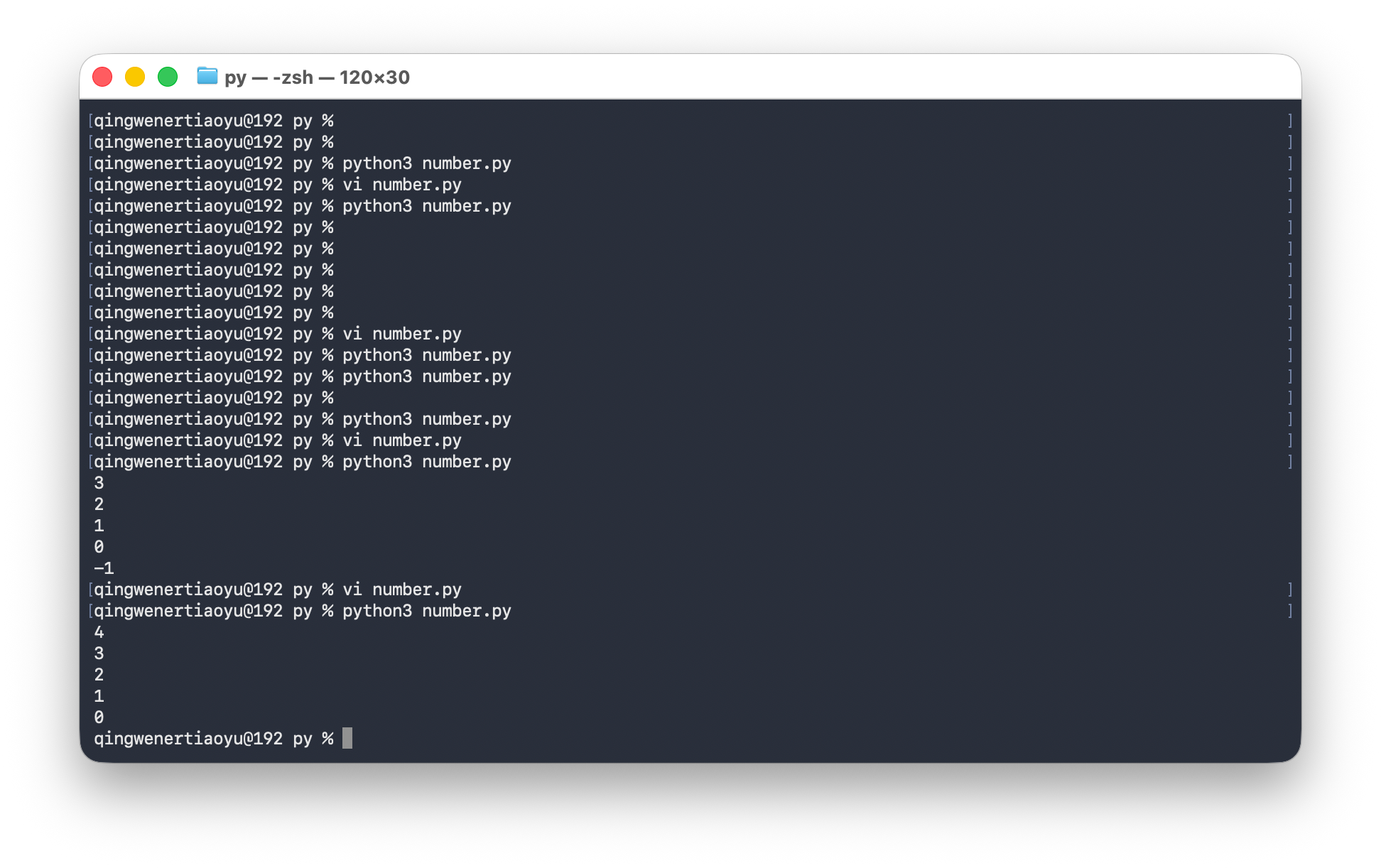
He struggled with this idea for an entire day.
The difficulty was not calculation.
It was a hidden door in mathematical thinking.
He understood:
"Take i and do something."
But he had not yet discovered:
"A relationship can be described from either direction."
Original Artifact
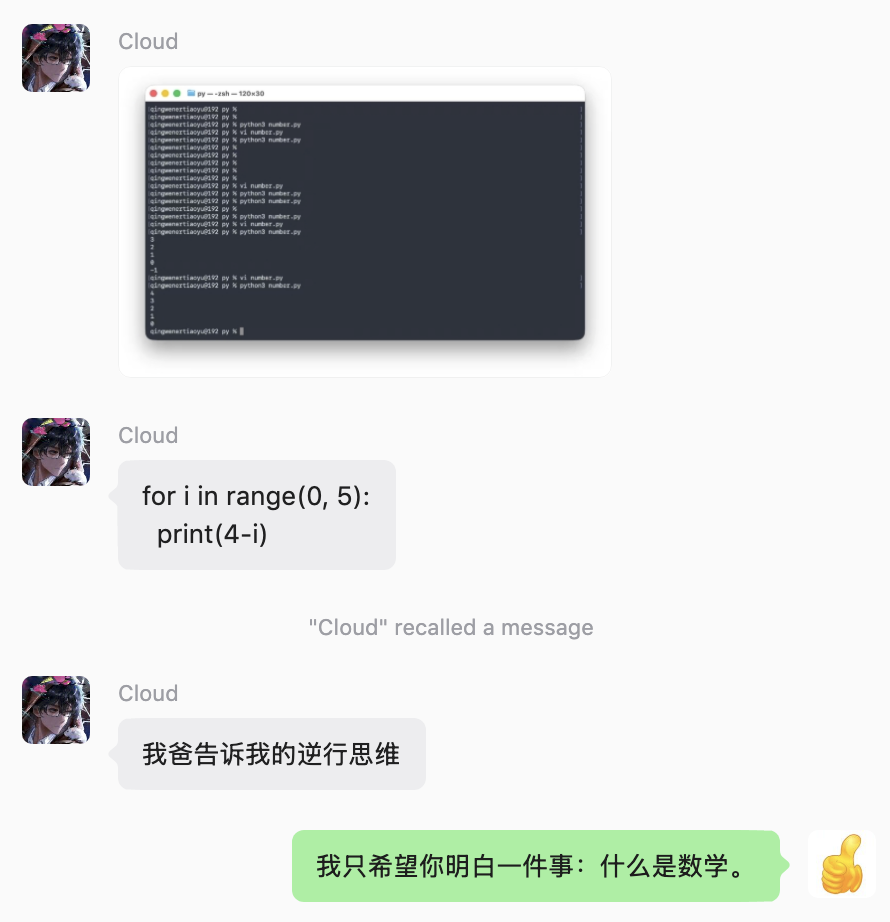
During the struggle, the student honestly expressed:
看不懂
为啥给我打电话
我都说了搞不懂了
那你打个电话我就能懂了吗
English Translation:
I don't understand it.
Why are you calling me?
I already told you I don't get it.
If you call me, will I suddenly understand it?
This was not a failure.
It was evidence of an honest learner facing a real thinking challenge.
Instead of giving the answer, the family continued the discussion.
The student's father encouraged him to think.
The breakthrough finally came.
The student wrote:
for i in range(0, 5):
print(4-i)
Output:
4
3
2
1
0
Then he explained:
我爸告诉我的逆行思维
English Translation:
My dad taught me reverse thinking.
A programming exercise became a family learning moment.
A mathematical expression became a new way of seeing.
Mathematics is not about collecting formulas.
It is not about skipping levels.
It is about building the ability to see relationships.
The expression:
4−i
looks simple after understanding it.
But before understanding it, it is a doorway.
Real learning happens when a student moves from:
"I can do it."
to:
"I understand why it works."
A student who struggles with a small idea today can discover a much deeper way of thinking tomorrow.
Through patience, honest questions, family support, and the courage to stay with a difficult problem.
The purpose of education is not to rush ahead. It is to build thinkers who can eventually go anywhere.
A perfect contest score did not end the learning journey.
It revealed the beginning of a more mature one.
The 12/12 was impressive.
But the real victory was the five lines of code that came after a whole day of struggle. 🌱