
Living Museum of Learning
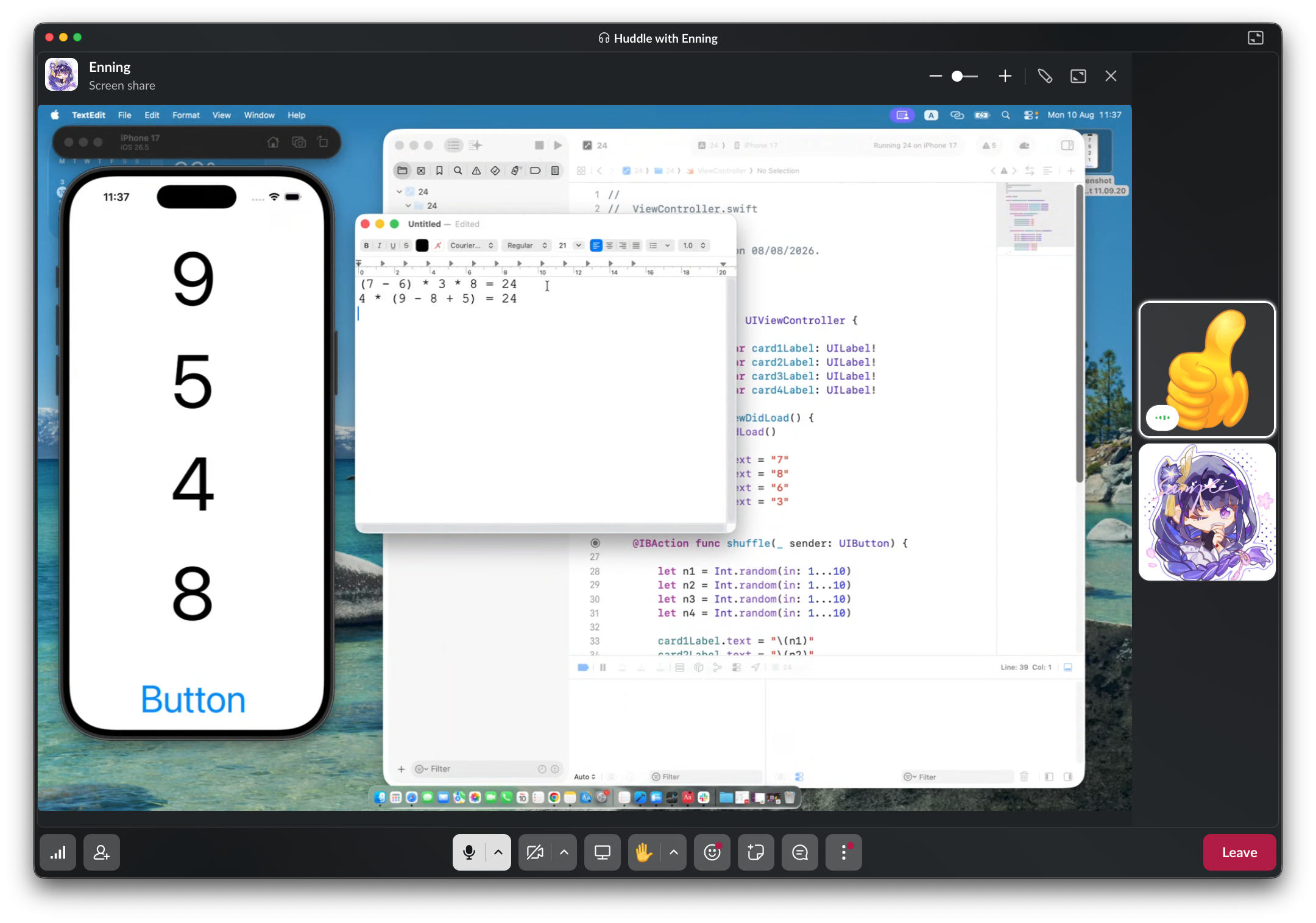
The First Game She Built
This was Enning's fourth class.
Her typing practice had reached TypingClub lesson 14.
At the end of one round, Donald asked:
“How many stars?”
Enning laughed:
“No. Hey hey.”
She tried again.
“Wow, 5 stars!”
Enning laughed even louder.
It was a tiny moment, but it captured something important:
Try. Miss. Try again. Succeed. Enjoy it.
Meanwhile, her first iOS project was beginning to become a real application.
The project was called 24.
Until now, the four cards had simply displayed fixed numbers.
Now Enning was going to make them random.
Donald introduced one line:
let n1 = Int.random(in: 1...10)
Enning's first attempt was wonderfully literal.
She used n1 for all four cards.
She had understood the idea, but not yet the pattern.
Donald didn't give her the other three lines.
She figured them out.
Soon her app had:
let n1 = Int.random(in: 1...10)
let n2 = Int.random(in: 1...10)
let n3 = Int.random(in: 1...10)
let n4 = Int.random(in: 1...10)
Now pressing the button produced four new random cards.
Her first iOS program had crossed an important boundary:
It was no longer just an exercise.
It was a real game.
Donald immediately changed the meaning of the program:
“We can use the app created by Enning to play real 24 games! Yeah!”
And they did.
Enning solved the first two puzzles with her own app.
Puzzle One
The four cards produced:
7, 6, 3, 8
Enning found:
7 - 6 * 3 * 8 = 24
But Donald did not simply say, “Wrong.”
Instead:
“Could you add a space for each operator?”
“Could you add one on the right hand side?”
“Is it correct? Double check.”
The goal was becoming bigger than finding 24.
She was learning how to present and inspect her own work.
They paused the game and created a better dictionary because one word kept appearing:
parentheses
Once the vocabulary was available, they returned to the problem.
And Enning noticed what had been missing.
The expression became:
(7-6)*3*8=24
She had not merely corrected an answer.
She had discovered why the original expression was wrong.
This tiny 24 puzzle contained several lessons at once.
Write clearly.
Check the expression.
Know the vocabulary.
Don't trust the first answer.
Go back when something doesn't make sense.
The teacher didn't need to announce any of these lessons.
They emerged naturally from the puzzle.
That is what made the moment valuable.
The Second Puzzle
The next four numbers were:
4, 9, 5, 8
Enning found:
4*(9+5-8)=24
Donald noticed the missing spaces again.
“You forgot the spaces again?”
“Oops.”
😂
But this time, Donald pushed the mathematics further:
“Can we find an easier way to calculate?”
Then:
“Is 9 - 8 easier?”
Suddenly the expression became:
4*(9 - 8 + 5)
which means:
4*(1 + 5)=4 * 6=24
Enning now had a much easier mental calculation.
Perhaps the surprising part was not the answer.
It was the discovery that mathematics can be reorganized to make thinking easier.
Instead of carrying around (9+5-8), she could notice:
9 - 8 = 1
and then simply calculate:
1 + 5 = 6.
A small puzzle had become a lesson in mathematical strategy.
The App Becomes a Tool
The most beautiful part came next.
Enning asked:
“Do I have homework?”
Donald answered:
“Yes. Crack ten 24 puzzles using your own app. If it's too hard you can skip it.”
Enning:
“Ok.”
Then:
“Thank you.”
And Donald:
“It’s so much fun to work with you, Enning.”
The homework was no longer:
“Write this code.”
It was:
Use something you built yourself.
Her program had become a tool for learning mathematics.
What Changed
In just one class, Enning moved through an entire cycle:
Typing → Coding → Generalizing → Debugging → Vocabulary → Mathematical reasoning → Self-checking → Strategy → Game
She began by copying one variable four times.
She ended by using her own application to solve mathematical puzzles.
That is a remarkable transformation for a fourth class.
But the most important transformation may be invisible in the code.
At every step, she was learning to ask:
Is it correct?
Can I make it clearer?
Can I find an easier way?
What does this word mean?
Can I try again?
These are the habits of a learner.
The code was only the surface.
Underneath it, Enning was learning a much more powerful program:
Try → Check → Question → Understand → Improve → Try again.
A beginner can turn a tiny piece of Swift code into a real application—and then use that application to explore mathematics.
Give the learner just enough help to move forward, then let her discover the pattern, catch the mistake, find the vocabulary, and improve the solution herself.
Because the ultimate goal of teaching isn't to produce correct answers.
It is to produce someone who can notice when an answer might be wrong, figure out why, and find a better way.
Museum Note
Enning's first random-number app was only a few lines of Swift.
But it changed the relationship between her and the computer.
The computer no longer simply displayed what she had written.
It surprised her.
It gave her new numbers.
It created new problems.
It exposed mistakes.
It gave her something to investigate.
And then it became a game.
She built the tool.
The tool became her teacher.
And for the first time, Enning wasn't just learning how to make an app.
She was learning how to learn with one.