
Living Museum of Learning
Seven Days: From “What Is a Computer Program?” to “Should Everyone Receive It?”
When Tianjing first entered Donald's world, she didn't know what a computer program was.
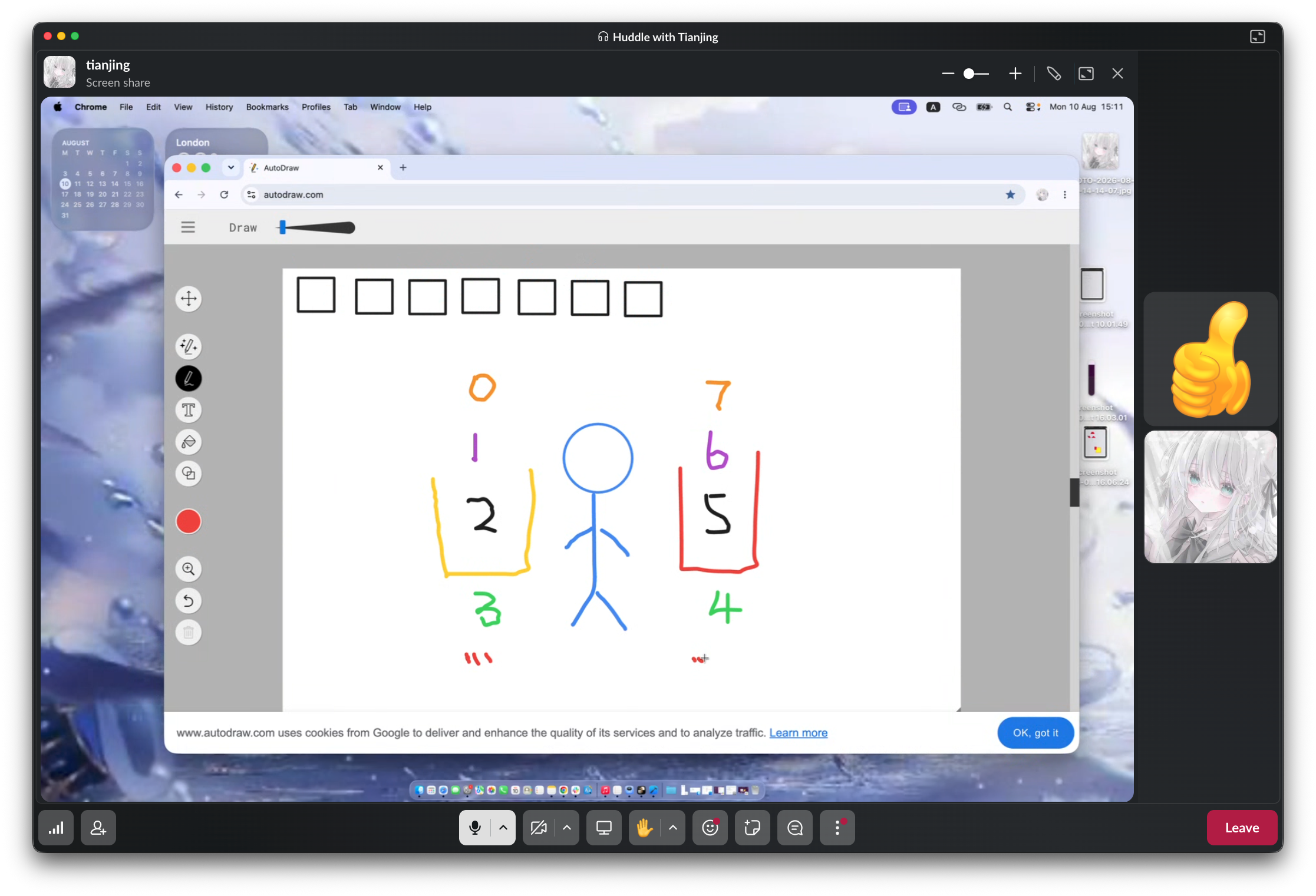
She was already careful and curious. Give her a whiteboard instruction and she would draw a stickman, two pockets, seven chocolates, and different-colored objects with remarkable care and elegance.
But the world behind the drawings was still new.
Python was new.
Unix was new.
vi was new.
Typing was new.
Computer programs were new.
Even English was sometimes a barrier.
She knew practical words such as “grid”, especially when she needed to use them in homework. But many other words remained unfamiliar.
One seemingly simple Python problem became a perfect example.
Tianjing spent almost an entire day thinking about the pattern 4 - i.
Donald finally reframed it with something concrete:
7 - i chocolates.
Suddenly the abstract expression had a physical meaning.
“Is that simple?” Donald teased.
“Punch your butt a few times. Next time, keep your mind open.”
She laughed.
“I kept thinking ‘i bla bla bla…’”
The important lesson wasn't the answer.
It was learning that when a first interpretation gets stuck, open the model and try another one.
Then came something that made Donald stop.
Tianjing sent a screenshot in Slack.
On her computer, she couldn't see the expected Reply button. Donald could see that her screen was still showing “sending…”, even though the message had already arrived on his computer.
Instead of simply asking why Slack was broken, Tianjing asked:
“Should everyone receive it?”
Donald was stunned.
She had been using computers for only days, yet she was already asking about the intended behavior of the communication system.
Who should receive the message?
What does the sender see?
What does the receiver see?
Why can two computers show different states?
She didn't know the vocabulary for any of this.
But she was beginning to ask the right kind of question.
Seven Days
In only seven days, Tianjing had become comfortable with:
Unix terminal commands
vi commands
typing practice
Python
mathematical notation
visual modeling
whiteboard representations
Slack
and using a dictionary while working
At one point, Donald helped set up a better dictionary for her.
She right-clicked a word and saw its translation.
“Wow!”
That tiny reaction mattered.
An unfamiliar English word was no longer necessarily a wall.
There was a tool.
She could look it up.
Then keep going.
Tianjing's progress wasn't simply a collection of new skills.
She was learning a new way of entering a world.
When she didn't know a word, she could look it up.
When a mathematical symbol confused her, she could change the representation.
When a computer behaved unexpectedly, she could ask what the system was supposed to do.
When given a detailed visual instruction, she could construct it carefully.
And when she got completely trapped by an idea, she could laugh and try again.
That last part may be the most important.
Seven days ago, Tianjing didn't know what a computer program was.
Seven days later, she was already asking a question that made a teacher think:
“OMG. What a question.”
A child with almost no programming background can enter mathematics and computing remarkably quickly when the environment gives her the right tools, language, and encouragement.
Concrete representations, immediate feedback, carefully chosen challenges, accessible language tools, and permission to make mistakes turn confusion into exploration.
Because sometimes the most important transformation is not learning a command or solving a problem.
It is discovering:
“I can enter this world.”