
Living Museum of Learning
The Day TJ Almost Shocked the Mathematical World
Tianjing is 13.
She has been learning Python through small experiments, geometric drawings, loops, and increasingly interesting mathematical patterns.
On August 11, she was ready for something new: the Collatz conjecture.
Before writing a program, Donald asked her to explore the sequence manually.
The rule is simple:
If the number is even, divide it by 2.
If the number is odd, multiply it by 3 and add 1.
Repeat.
She started with 3.
Then she tried other starting numbers, writing down the sequence one step at a time.
This was not yet a programming exercise.
It was a mathematical experiment.
During one of her manual experiments, TJ made a calculation mistake.
She reached:
8 → 25
and, following the resulting sequence, thought she had discovered a loop.
She went back to 8 and announced:
“it loops”
Donald immediately saw the comedy of the situation.
If 8 really went to 25, and the resulting sequence truly created an unexpected loop, TJ would have discovered something enormous.
So he told her:
“If the sequence went like that, you would shock the whole mathematical world immediately.”
TJ laughed.
😂
The joke was playful, but the mathematical lesson underneath it was serious.
A surprising result is exactly what a mathematician should pay attention to.
But it is also exactly what a mathematician should check carefully.
TJ went back and found her mistake.
The mysterious loop disappeared.
Instead of being discouraged, she simply corrected the calculation and continued exploring.
Then she chose two more starting numbers and played with their Collatz sequences manually.
This is the moment that makes the experiment special.
She did not say:
“The answer must be wrong because Donald says so.”
She did not simply ask for the correct sequence.
She rechecked her own work.
Then she continued experimenting.
A small arithmetic error had turned into a lesson about mathematical investigation.
TJ was learning much more than the Collatz rule.
She was practicing a complete cycle of mathematical thinking:
Choose a starting number.
↓
Apply a rule.
↓
Observe what happens.
↓
Notice something surprising.
↓
Make a hypothesis.
↓
Check the calculation.
↓
Correct the mistake if necessary.
↓
Try another example.
This is exactly the kind of thinking that cannot be reduced to memorizing formulas.
And there was another beautiful connection to her programming lessons that day.
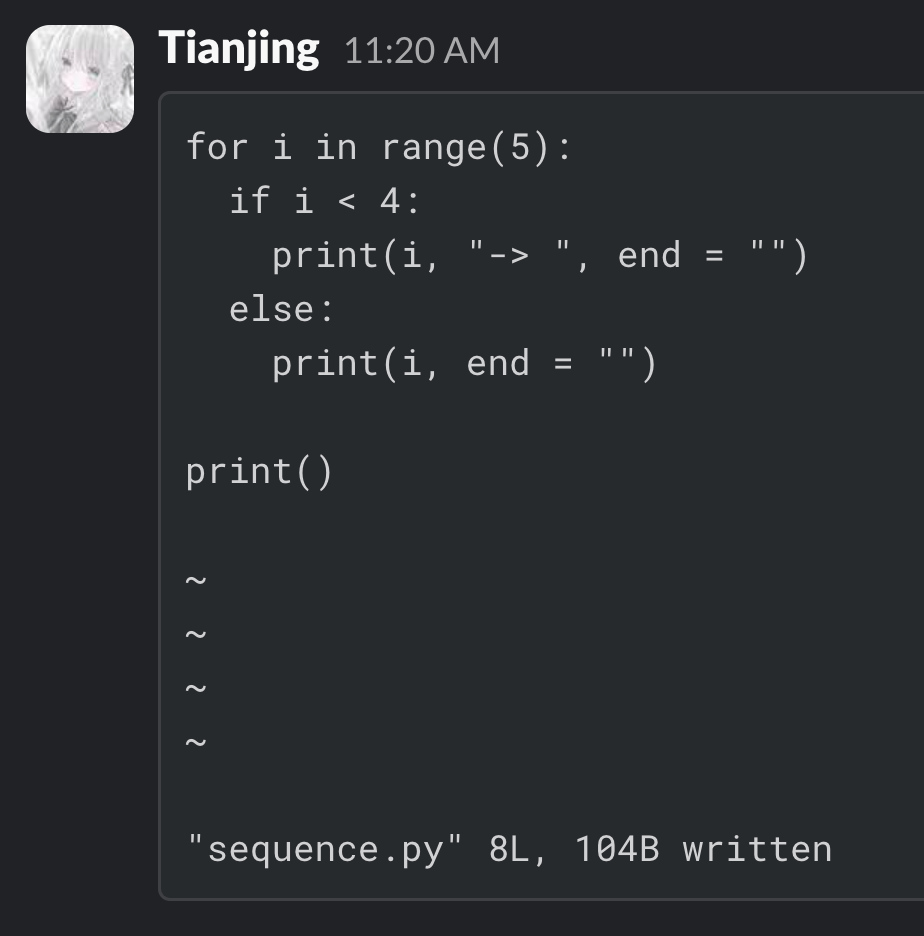
Earlier, TJ had submitted Python code using for loops.
She had also encountered a bug in her program and asked:
“这个是错的吗”
Donald explained the missing colon and the difference between a variable i and the string "i".
She tried again.
Then:
“还是不可以”
Donald was preparing to debug it with her.
Then suddenly:
“可以了”
She had fixed it herself.
Later, she even surprised Donald by explaining why:
print("\n")
creates two line breaks:
one comes from \n, and another comes from print() itself.
So the Collatz experiment was not an isolated mathematics lesson.
It became another step in a larger learning pattern:
encounter something unexpected → investigate → find the cause → understand it → continue.
The Beautiful Mistake
The mistake 8 → 25 is worth preserving.
In a conventional classroom, an incorrect calculation is often something to erase.
Here, it became part of the exhibit.
Because without the mistake, TJ might not have experienced the excitement of thinking:
“It loops!”
And without that excitement, she might not have felt the next important lesson:
A surprising mathematical discovery must survive careful checking.
For a 13-year-old beginning to explore mathematics computationally, that is a precious experience.
She briefly imagined herself having broken the Collatz conjecture.
Donald briefly imagined the headline:
13-year-old Tianjing Qi shocks the mathematical world. 😂
Then reality returned.
She corrected the calculation.
Picked two more numbers.
And kept going.
Learning Momentum
There is a beautiful progression happening here.
TJ started with simple Python commands.
Then came for.
Then repeated geometric patterns.
Then sequences.
Then debugging.
Then manually exploring Collatz.
The computer has not yet been asked to do all the work.
First, TJ is learning to play with the mathematics herself.
Soon she can write the program.
And when she does, the computer will not be replacing her mathematical thinking.
It will become her experimental partner.
She will be able to ask:
What happens if I start with 3?
What about 8?
What about 27?
What about 100?
How long does each sequence take to reach 1?
The possibilities suddenly become much larger.
That is the moment when a simple Python lesson becomes something else:
a young learner beginning to conduct mathematical experiments.
A 13-year-old beginning programmer can move from simple Python syntax to debugging, sequence generation, manual mathematical experimentation, and eventually computational exploration of a famous unsolved problem.
Start with a simple rule. Let the learner calculate by hand. Allow mistakes. Treat surprising results as discoveries worth investigating. Encourage the learner to check, correct, and try again. Only then bring in the computer to explore at a larger scale.
Because the deepest purpose of programming education is not merely to make code run. It is to cultivate a learner who sees something strange and thinks, “Wait—why did that happen?” Then checks it, learns from it, and keeps exploring.
Exhibit Note
The sequence that was supposed to shock the mathematical world turned out to be a calculation error.
But the learning moment was real.
And perhaps that is even better.
TJ did not solve the Collatz conjecture today.
She did something more appropriate for a beginning mathematician:
She wondered whether she had. 😄