
Living Museum of Learning
After Freedom: What Will We Do With It?
Some families arrive at education through ordinary circumstances.
Some arrive carrying a much bigger story.
This is one of those families.
A father made extraordinary sacrifices to bring his family to a place where they could live with greater freedom and opportunity. Their story is private, and this exhibit deliberately leaves out the details.
What matters here is what happened after the door to freedom opened.
I have the privilege of working with his two daughters, two sisters only a few years apart.
And on August 11, something happened in our family learning group that made me think about the meaning of that freedom.
The girls were practicing mathematics, programming, English, and computer skills.
One was debugging Python.
The other was building geometric figures in p5.js.
They were asking questions, making mistakes, solving problems, submitting homework, and gradually becoming more confident learners.
Meanwhile, their father was explaining a practical challenge at home: the girls can easily become absorbed in endless video scrolling. He had therefore become careful about letting them freely open certain apps and devices.
It was a very ordinary parenting problem.
But in this family, the conversation suddenly touched something much deeper.
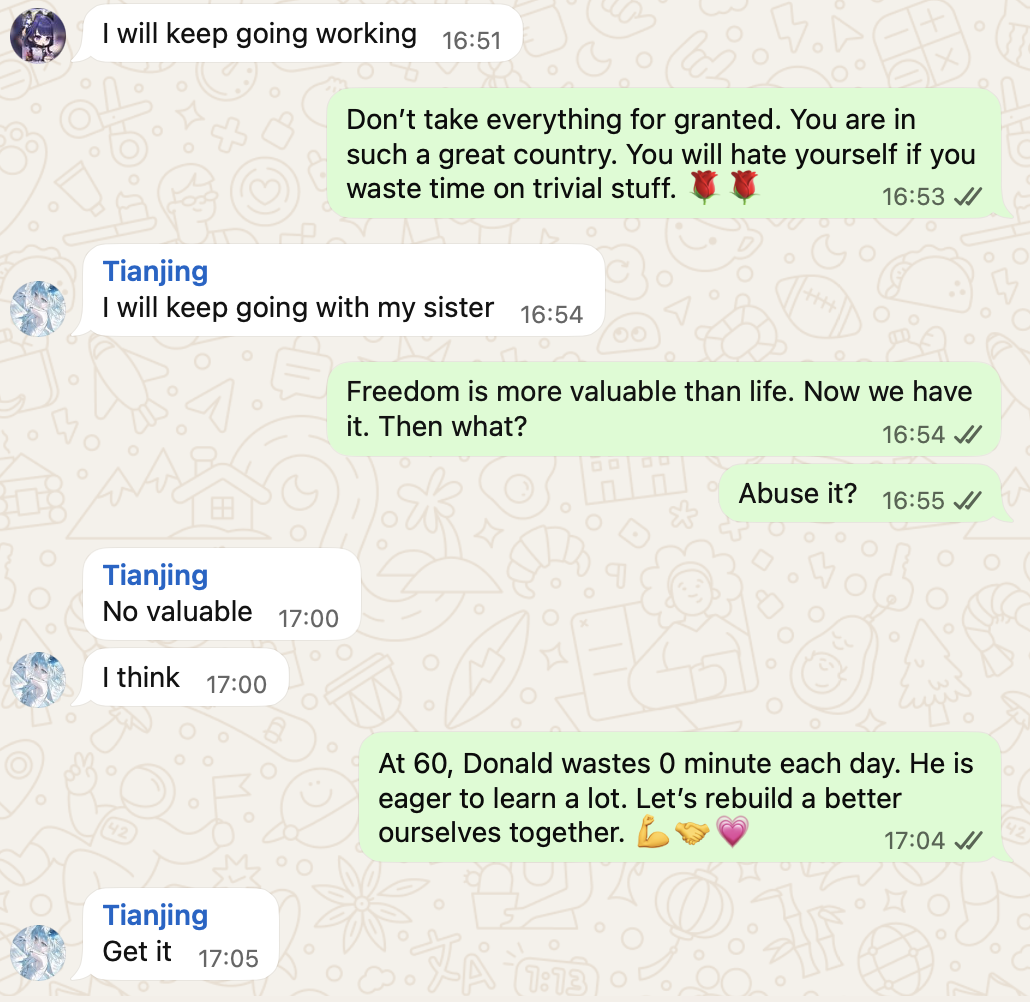
I told the girls:
“Don’t take everything for granted. You are in such a great country. You will hate yourself if you waste time on trivial stuff.”
Then I asked:
“Freedom is more valuable than life. Now we have it. Then what?”
And then, almost provocatively:
“Abuse it?”
The question was not about homework.
It was about what a person does with an opportunity that somebody else fought extraordinarily hard to obtain.
Freedom gives us choices.
But freedom alone does not tell us how to use those choices.
We can spend them scrolling.
Or we can spend them learning.
We can consume.
Or we can build.
We can let our attention disappear into trivial things.
Or we can use that attention to become better at something that matters.
The girls' answers were simple.
Tianjing said:
“I will keep going with my sister.”
That sentence stayed with me.
Not:
“I will keep going.”
But:
“I will keep going with my sister.”
The two girls had spent the day learning in different ways.
Tianjing had been exploring Python loops, debugging errors, generating sequences, and manually playing with the Collatz conjecture.
At one point she made a calculation error and briefly thought she had discovered a loop.
I joked that if she really had, she would shock the mathematical world.
She laughed, checked her work, found the mistake, corrected it, and continued exploring.
Her sister Enning had started with essentially no coding experience only days earlier.
She had already completed her first iOS 24 game.
Then she moved into p5.js, drawing a grid, triangle, parallelogram, and trapezoid.
She had begun looking up unfamiliar English words in a dictionary on her own.
And later that same day, when given a 24-point problem, she found one solution:
4 × 7 − (10 − 6) = 24
Then, when asked for another:
10 + 7 × (6 − 4) = 24
Two sisters.
Different strengths.
Different paths.
Both moving.
There is something I have learned from working with this family:
Freedom creates possibility.
But possibility needs direction.
A powerful computer can be used to write programs—or to watch endless videos.
A free afternoon can be used to explore mathematics—or disappear without leaving anything behind.
Access to education can become another obligation—or an invitation to discover a world that was previously unreachable.
The goal is not to make children work every minute.
It is to help them recognize the extraordinary value of their own attention.
That is why I keep telling them to practice.
Practice Python.
Practice English.
Practice mathematics.
Practice typing.
Practice thinking.
Not because every minute must be productive, but because skills compound.
One small discovery makes the next discovery easier.
One solved problem gives confidence for the next problem.
One new English word opens another sentence.
One programming concept opens another algorithm.
That is learning momentum.
A Teacher's Perspective
I feel genuinely honored to help this family.
The father took an enormous risk to change the circumstances in which his children would grow up.
I cannot take credit for that.
I can only try to honor it by helping the girls make good use of the opportunities they now have.
My role is much smaller:
Sit with them.
Play mathematics.
Explore algorithms.
Debug code.
Introduce books.
Ask questions.
Give them problems that are just a little harder than yesterday's.
And sometimes remind them:
You have this opportunity. What are you going to do with it?
There is no need to tell them what kind of person they must become.
Just keep the door open.
Let curiosity pull them forward.
The Next Generation
Later that afternoon, I told the girls about a dream of mine.
I have never been to England.
Someday, I would love to visit Cambridge and see the places connected with Newton.
I joked with Tianjing that perhaps she could guide me around Cambridge one day.
And I told Enning that perhaps she could welcome me to Oxford.
It was playful.
But underneath the joke was something real.
A child who is learning Python today may one day walk through the same university towns where generations of mathematicians and scientists changed the world.
Today she is learning:
for
if
print()
line()
Tomorrow it may be calculus.
Then algorithms.
Then number theory.
Then something none of us can predict yet.
That is what freedom makes possible.
A family can cross an enormous boundary in search of freedom and opportunity. Children who inherit that opportunity can turn it into knowledge, skills, curiosity, and a future that nobody can fully predict.
Not through one dramatic transformation, but through thousands of small choices: open the computer, practice, ask a question, make a mistake, check it, try again, look up a word, solve another problem, help a sister, and keep going.
Because freedom is not merely the absence of restriction. It is the possibility of choosing what to do with one's time, attention, curiosity, and life. The most meaningful way to honor an opportunity may be to use it well—and to help the next person use it well too.
Closing Note
The family's private story belongs to them.
This exhibit records only what I was fortunate enough to witness:
Two sisters learning.
A father who cares deeply about what they do with their freedom.
And a teacher who feels lucky to be invited into their journey.
Their father fought to open a door.
Now the girls are learning what lies beyond it.
Keep going.
With your sister. ❤️