Living Museum of Learning
The Day Two Worlds Started Moving
Our 🌱 Living Museum of Learning keeps growing.
And lately, so do the stories around two sisters learning mathematics, English, programming, and problem solving together.
On the same morning, two very different learning adventures were unfolding.
Tianjing was working with Python turtle.
Enning was working with p5.js.
One was discovering coordinates.
The other was discovering transparency.
And neither needed to become the other.
Turning Point I — Enning Discovers Transparency
Enning had already created several colorful circles in p5.js.
I gave her a tiny hint:
“You can try to add a 4th argument (or parameter) in the color of your purple circle to test.”
She replied:
“Ok”
About an hour later:
“I just changed”
“It became transparent”
🤩
She had discovered the fourth color parameter—alpha—through experimentation.
I hadn't told her what the parameter meant.
She changed it.
She observed the result.
And she figured it out.
That is a tiny example of scientific thinking:
change → observe → infer.
Turning Point II — TJ Discovers Coordinates
Meanwhile, Tianjing learned goto() in Python turtle.
And then I realized something hilarious:
I had never actually told her where the turtle window's origin was. 😂
Not a problem.
She investigated goto() for a while.
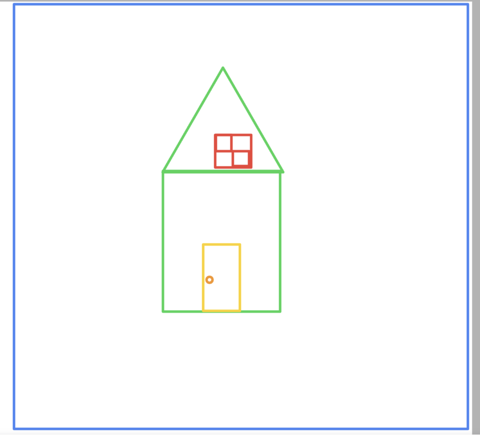
Then I asked her to first draw a house by hand on AutoDraw.
We saw:
a green triangle;
a green rectangle;
a red window;
a yellow door;
an orange doorknob.
Then we went back to Python.
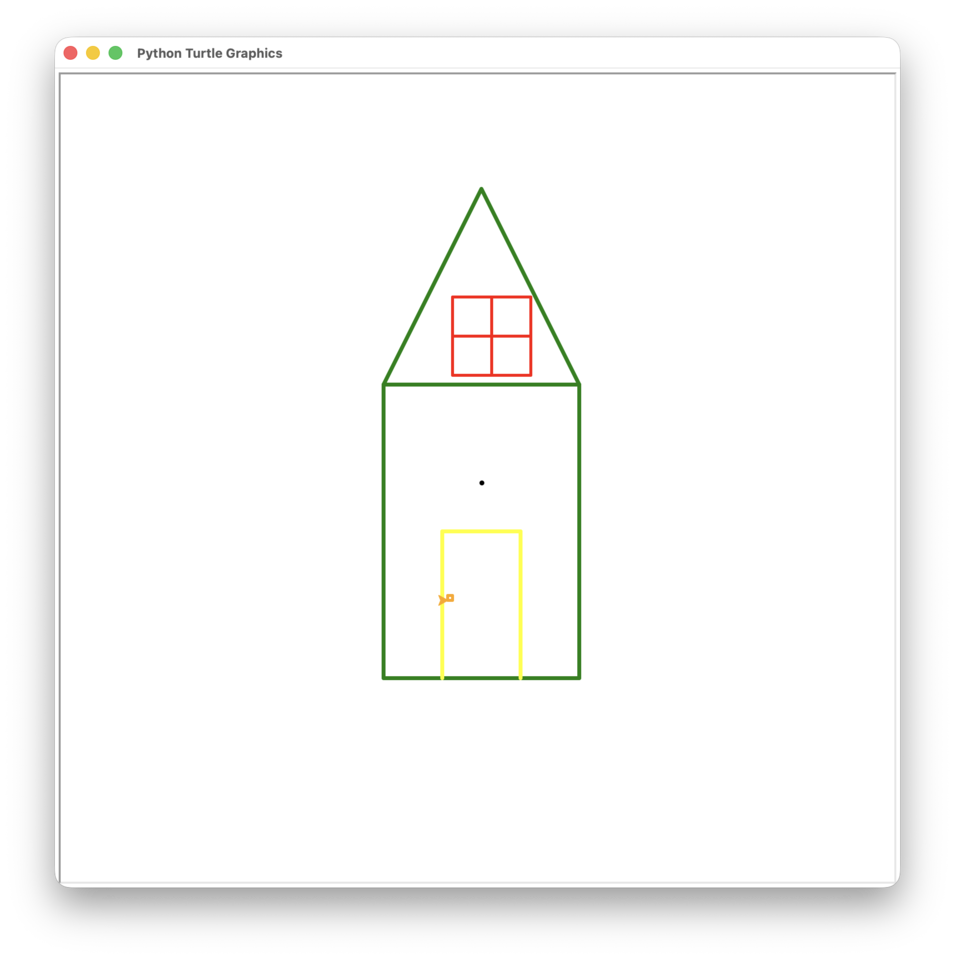
This time, the turtle became the pen.
And suddenly the geometry had to become numbers.
Tianjing carefully calculated coordinates because this was the first time she was controlling the entire picture through coordinates.
It was also an opportunity to notice something important:
The turtle coordinate system she was using was different from the coordinate system she had encountered in iOS, where the origin is at the top-left.
She finished the part she hadn't completed during class.
Again:
draw → observe → calculate → code → adjust.
And Then There Was 24
The story had actually started earlier.
Yesterday afternoon, Cindy and I were sitting in McDonald's drinking coffee.
Yes, yes—I stopped drinking coffee and my decades-long migraine disappeared. 😂
A miracle in the medical world!
Just kidding.
I simply stopped drinking coffee.
But I certainly didn't ban Cindy from drinking hers. 😄
While sitting there, I found some screenshots from a game of Golden 24 and sent them into the sisters' family group.
Tianjing looked at one of them and asked:
“What is A?”
And then...
silence.
😂
Her older sister Enning, meanwhile, had already become a little 24-point superstar.
She solved one problem after another.
When I challenged her to find a second solution, she did:
10 + 7 × (6 − 4) = 24
while I was sitting in McDonald's, five time zones away from England.
The battle eventually seemed to stop at:
5, 8, 8, 9
At least, I thought it had stopped.
The Quiet Challenge
Later, I woke up from my afternoon nap.
I didn't say anything.
I simply resent the buried screenshot of the four cards:
5 8 8 9
No explanation.
No question.
No hint.
A few minutes later:
Enning: (9-5)*8-8
😂
Of course.
She was still playing.
The battle wasn't over at all.
Look at what happened across just one day.
Enning
p5.js
→ circles
→ color parameters
→ transparency
→ independent discovery
→ 24-point reasoning
→ another solution
→ recognizes a silent challenge
→ solves it.
Tianjing
Python
→ for
→ if
→ output formatting
→ multiples of 7
→ goto()
→ coordinate systems
→ geometric construction
→ careful calculation.
Two sisters.
Two different paths.
Two different rhythms.
But both are developing the same deeper capability:
Turn an unfamiliar problem into something you can experiment with.
One of my favorite things about teaching these two girls is that I don't need to manufacture a perfectly linear curriculum.
Life keeps generating the curriculum.
A circle creates a question about transparency.
A goto() creates a question about coordinates.
A screenshot creates a 24-point puzzle.
A forgotten coordinate system becomes an opportunity to investigate.
A buried problem from yesterday becomes today's surprise.
And sometimes the best teaching move is to say nothing at all.
Just send:
5 8 8 9
and wait.
Once curiosity starts moving, yesterday's questions become today's tools, and today's discoveries become tomorrow's starting points.
A beginner can move from following instructions to independently investigating functions, parameters, coordinates, colors, geometry, and mathematical puzzles.
Give meaningful problems, provide small hints when needed, let learners experiment, and don't rush to provide answers.
Sometimes the most powerful teaching intervention is simply:
“Have you tried?”
Because real learning is not a sequence of completed assignments.
It is the gradual development of a learner who sees a new problem and thinks:
“I can probably figure this out.”
And then tries.
The Last Line
Enning made a purple circle transparent.
Tianjing learned to control a turtle with coordinates.
And somewhere between England and Toronto, four cards were quietly waiting.
5 · 8 · 8 · 9
Enning saw them.
And solved them.
The museum keeps growing.
The sisters keep growing.
And apparently, the 24 game isn't finished yet. 😂🌱