
Living Museum of Learning
The Week Enning Changed the Lens
When Donald first heard from Enning's father that his older daughter could not enter Grade 9 at the local high school, he did not even know her name yet.
His response was immediate:
“Can I also give Tianjing's sister some help?”
That simple question opened a door.
Enning was 16, several years older than her younger sister Tianjing and Cloud, yet her formal educational path had fallen behind her age. It would have been easy to see only the gap.
Donald saw a learner.
Then came one extraordinary week.
At the beginning, Enning herself said:
“I'm not good at logical reasoning …”
But the week that followed began to challenge that belief.
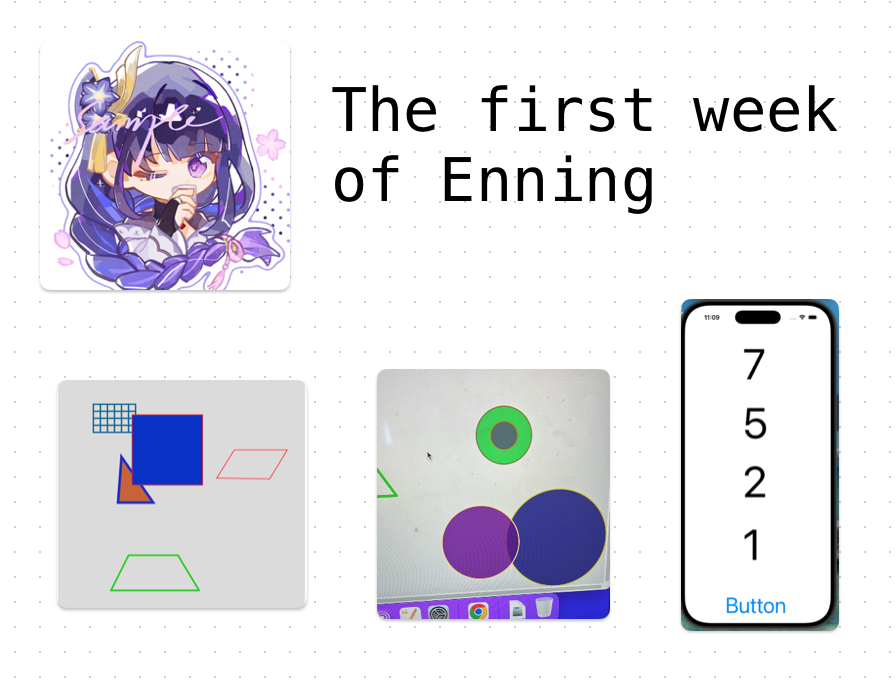
She became a 24 Game queen.
She taught herself the P5JS function circle().
She figured out how to make her purple circle transparent while placing it above a blue circle.
She completed dozens of lessons on TypingClub, learning new English words along the way.
She created her first fully functioning iOS app: a 24 Game, and then used the app she had built to practice the very skill she was learning.
One week.
A completely different girl.
The transformation was not simply that Enning learned more.
She began to demonstrate something more fundamental:
she could learn.
And she could learn independently.
She didn't wait for every detail to be explained. She explored. She experimented. She discovered functions. She solved problems. She corrected mistakes. She built something and then used what she built to practice.
Even her performance on the same IQ test taken by Tianjing and Cloud became more interesting on closer inspection.
Enning scored 13/19, the same raw score as Cloud, but when she returned to review her answers, she corrected at least three of them.
The score was only a snapshot.
The second pass revealed something more valuable:
Enning can reconsider her own thinking.
And then came another experiment: the 2020 Waterloo Beaver Computer Competition for Grades 5–6. Cloud had already revisited his one mistake and achieved 12/12.
Now Enning gets to try.
The result matters less than the exercise itself: English reading, mathematical interpretation, logical reasoning, persistence, checking, and self-correction—all at once.
A school placement can tell us where a student is expected to be.
It cannot tell us how far that student can go.
If Enning learns with Donald every day, Grade 9 mathematics does not need to remain something she fears. It can become a foundation.
And the foundation can lead much further:
mathematics → programming → problem solving → deeper mathematics → independent learning.
This is not merely about helping a 16-year-old “catch up.”
It is about discovering what becomes possible when the assumptions surrounding a learner are removed.
A New Lens
Perhaps the most important change this week happened not in Enning's notebook or on her computer.
It happened in the eyes of the adults around her.
For some time, her parents may have been looking at her through an old pair of glasses:
She is behind.
She cannot enter Grade 9.
She is not strong at logical reasoning.
But after one shining week, those glasses deserve another look.
Because the evidence now says:
She became a 24 Game queen.
She taught herself programming.
She learned English vocabulary while typing.
She built a working iOS app.
She used her own creation to keep learning.
Maybe Donald did not give Enning a new pair of glasses.
He simply gave everyone a chance to see her without the old ones.