
Living Museum of Learning
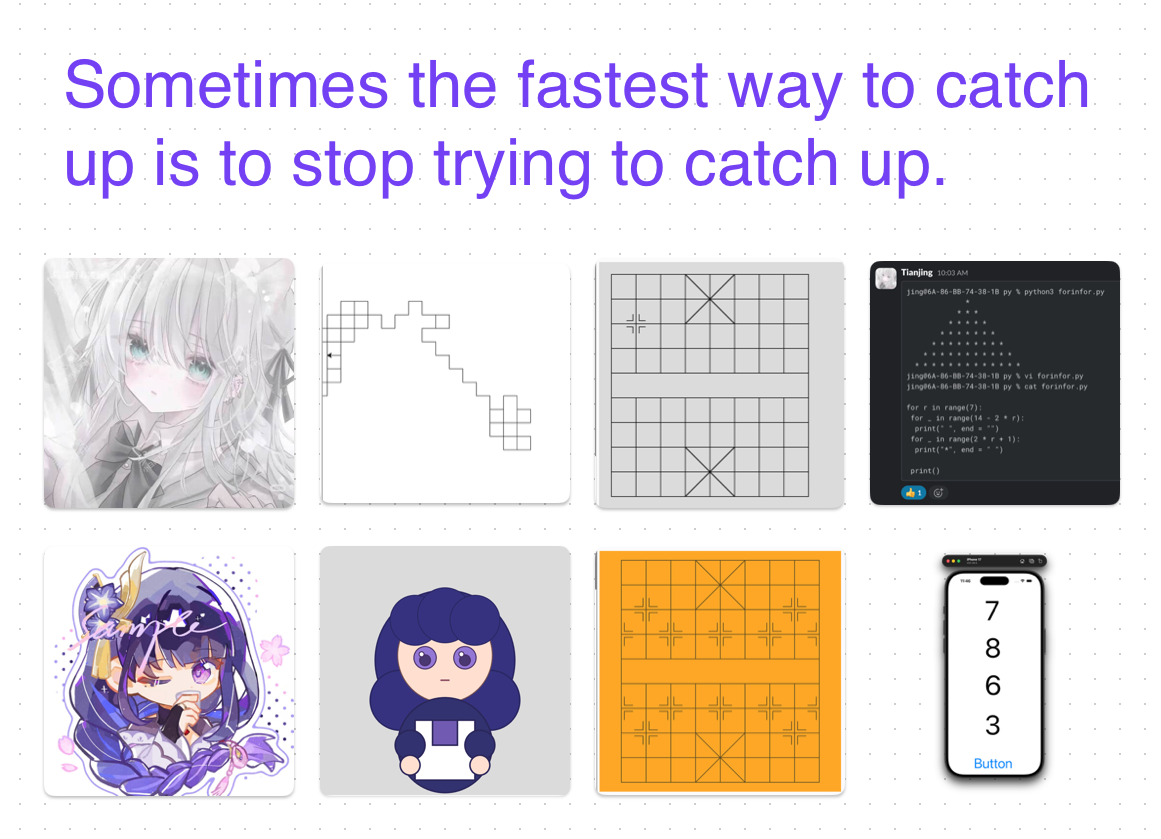
We Didn’t Rush to Catch Them Up
Two weeks ago, Tianjing and Enning arrived with very little English, no coding experience, little confidence, and plenty of self-doubt.
Grade 2 mathematics in English was difficult. They didn't know touch typing. They were talking less and less at home.
With the new school year in England only a few weeks away, it would have been easy to panic.
Start the math.
Catch up the English.
Fill the gaps.
Work harder.
But Donald did something that looked almost opposite to that.
He didn't rush them into catching up.
Instead, he gave them something that seemed less urgent:
fun.
They began making things.
Enning made her unforgettable “circle girl” in p5.js, built her first iOS app, 24, and became fascinated by the 24 puzzle. She cracked 7 7 2 1 in less than two minutes and nearly went 12/12 on the Beaver computational-thinking contest.
Tianjing began using the command line and vi, played with random walks in Python turtle, drew a Chinese chessboard in p5.js, and learned to tame for loops by making different * triangles.
They weren't “catching up.”
They were discovering that they could do things they had never imagined doing.
And something else quietly changed.
They began talking more.
They began trying more.
They began making things without being afraid of making mistakes.
They began accumulating evidence against their own self-doubt.
Then, yesterday, Donald finally opened Khan Academy with them.
Grade 2 math went well.
Suddenly the door that had seemed too difficult two weeks earlier was open.
There are still more than two weeks before Grade 9 begins.
Perhaps now they can try one grade a day.
Not because Donald suddenly became more anxious about catching up.
Because the girls are finally ready to enjoy catching up.
You didn't rush to catch them up because you wanted them to catch up.
You slowed down because you wanted them to become learners first.
And strangely, that may be exactly why they can now move faster.
The first phase was not about filling missing knowledge.
It was about rebuilding something more fundamental:
“I can learn this.”
Once that belief became real through Python, Swift, p5.js, puzzles, little drawings, little apps, and countless tiny surprises, mathematics could return without feeling like a punishment for being behind.
The catch-up was waiting.
Confidence had to come first.