
Living Museum of Learning
Three Tiny Doors
Today, three tiny moments happened during ordinary math work.
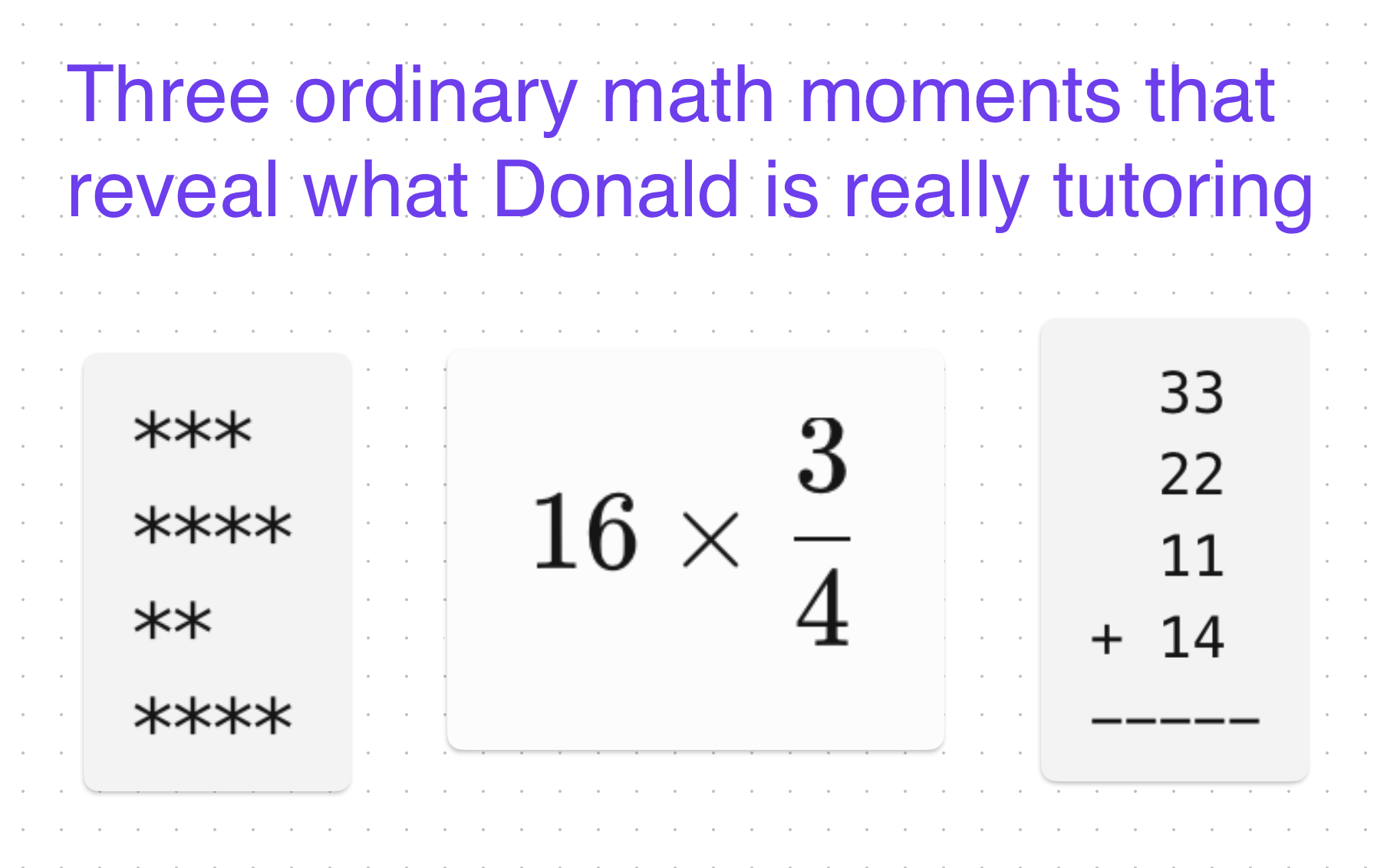
Enning was doing a Grade 2/3 problem and began counting:
1, 2, 3, ... 13.
I stopped her.
I circled the bottom three lines:
***
****
**
****
“Hey, did you see the bottom obvious 10?”
She stopped counting.
Cloud was doing:
16 × 3/4
He went straight toward multiplication.
I stopped him:
“Always cancel first.”
He had finished Grade 8.
You can hardly believe that a student could reach Grade 8 without having that voice firmly installed in his head.
But the uncomfortable truth is that many North American kids do essentially the same thing every day, again and again.
Including kids I've taught or met:
Nicole. Ryan. William. Fergus. Corey. ...
They aren't stupid.
They've simply been trained to execute before looking.
Then Tianjing had:
33
22
11
+ 14
-----
The familiar school procedure says: start from the ones place.
I circled the top three rows instead.
Why not see:
33+22+11=66
first, and then add 14?
Another tiny door.
In each case, the student was about to follow a perfectly familiar procedure.
Donald interrupted before the procedure took over.
Not:
“Here's the answer.”
But:
“Look again.”
Enning's 13 became an obvious 10.
Cloud's multiplication became cancellation.
Tianjing's column addition became grouping.
Three children. Three different problems.
But underneath them was the same discovery:
The problem you see first is not necessarily the problem you should solve.
And the most painful part of Cloud's story is not that he multiplied first.
It's that this tiny voice—
“Always cancel first.”
—may have reached him five years later than it should have.
A child can spend years becoming faster at a procedure that should have been questioned at the beginning.
The cost isn't merely a few extra seconds per problem.
It is the accumulated habit of calculation before observation.
Donald is trying to interrupt that habit whenever he sees it.
Not by replacing one school trick with another, but by teaching a more fundamental reflex:
Stop. Look. What is the structure?
And this is why the tiny arithmetic moments matter.
In a chess project, a Rubik's Cube project, or a serious coding project, there may be hundreds or thousands of moments like these.
The subject changes.
The door remains.
A problem can become dramatically smaller when you see its hidden structure.
Sometimes one sentence from the right teacher changes the student's entire approach.
A tiny thinking habit, repeated for years, can save enormous amounts of effort—and open room for much deeper learning.
How many children are spending years doing multiplication first when somebody could have taught them to look first?