Living Museum of Learning
The Ice-Cream Bucket Wants to Turn Upside Down
Tianjing's class today started with unfinished work from the Grade 7 Khan Academy course challenge.
At first, it looked like we were simply going to finish some math.
But three small questions caught my attention.
Each one contained an idea that I didn't want her to rush past.
The first involved routes.
Someone had 3 ways to go from A to B, and 3 ways to come back.
Instead of letting her simply answer the question, I sensed something worth putting on the whiteboard.
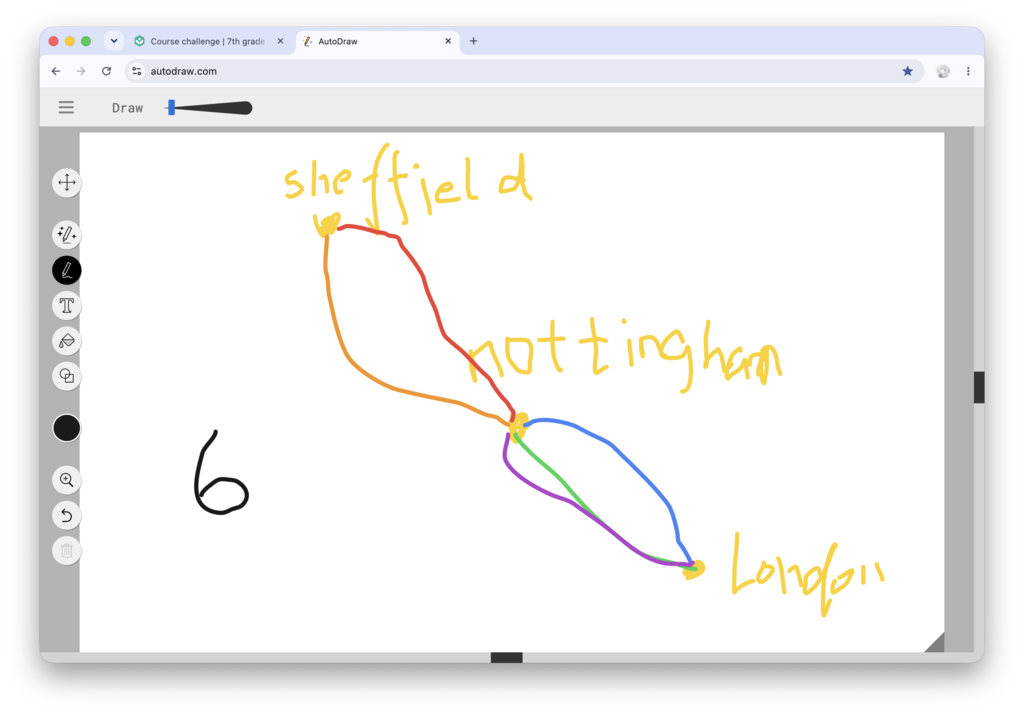
I asked Tianjing to create three cities.
She immediately wrote:
Sheffield → Nottingham → London
There were 2 ways between Sheffield and Nottingham.
There were 3 ways between Nottingham and London.
She immediately said:
“6 ways from S to L.”
I asked:
“Is there a multiplication here?”
She thought for a moment.
“Yes? 2 × 3 is 6.”
There it was.
She had not merely calculated 6.
She had seen that the two stages of choices could be combined by multiplication.
Then she went back to the original problem and connected our own example with the original 3 × 3.
I told her:
“This is very important in your future learning.”
She nodded.
I could see that she understood the importance, even though she obviously couldn't yet know all the places this idea would take her.
And I learned something myself.
From those three cities, I finally figured out where Tianjing lives.
Apparently, I needed a Grade 7 routes problem to discover that. 😂
The Number in the Corner
The next question involved:
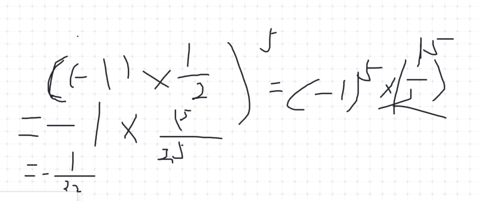
(-1/2)^5
Tianjing asked:
“Is this times 5?”
This wasn't a deep mathematical hole.
She simply wasn't yet familiar with the notation.
I told her:
“Not times 5. The 5 is high on the top right corner.”
😂
Once that distinction was clear, she knew that the exponent meant multiplying -1/2 by itself five times.
She worked through the powers:
1/4 → 1/8 → ... → -1/32
I then showed her another way to look at it by separating the pieces:
(-1/2)^5 = (-1)^5 × (1/2)^5
Now the sign and the denominator could be seen separately.
The 32 had somewhere to come from.
She quietly said:
“Oh.”
And we moved on.
No dramatic hole to repair.
Just a small piece of mathematical notation becoming familiar.
Turning Point — The Dice
The third problem involved dice.
This time I simply said:
“This is also very important in your future learning, either CS or math.”
This time Tianjing repeated it back:
“Oh, very important.”
😂
She is beginning to recognize that some apparently ordinary problems are really introductions to ideas that will matter much later.
We don't need to explain the entire future today.
Sometimes it is enough to recognize:
Keep this idea. You'll need it again.
Into the Third Dimension
The second half of the class moved from Khan Academy into p5.js.
The day before, Tianjing had already tried 3D X, Y, and Z in Desmos.
Today she wanted to explore them in p5.js.
We created a 600 × 600 WebGL canvas and added orbitControl() so she could rotate the view and move around the 3D world.
Then we built a coordinate system.
We deliberately used:
X = red
Y = green
Z = blue
I liked this convention because we didn't need arrowheads or even labels saying X, Y, and Z.
The colors themselves told us which axis was which.
Then Tianjing began placing objects into the space.
A box at (100, 0, 0).
A sphere at (0, 100, 0).
A cone at (0, 0, 100).
A cylinder farther along Z at (0, 0, 200).
A torus farther along Y at (0, 200, 0).
She was no longer simply drawing shapes.
She was giving them positions in space.
Five New Friends
The world quickly filled with shapes:
box
sphere
cone
cylinder
torus
Each had its own size.
Each had its own position.
Each could be viewed from different angles.
And translate() became a way to move objects through the coordinate system.
The 3D world was becoming something she could manipulate rather than something she merely observed.
The Ice-Cream Bucket
Later, Tianjing was working on her homework.
Then came the question:
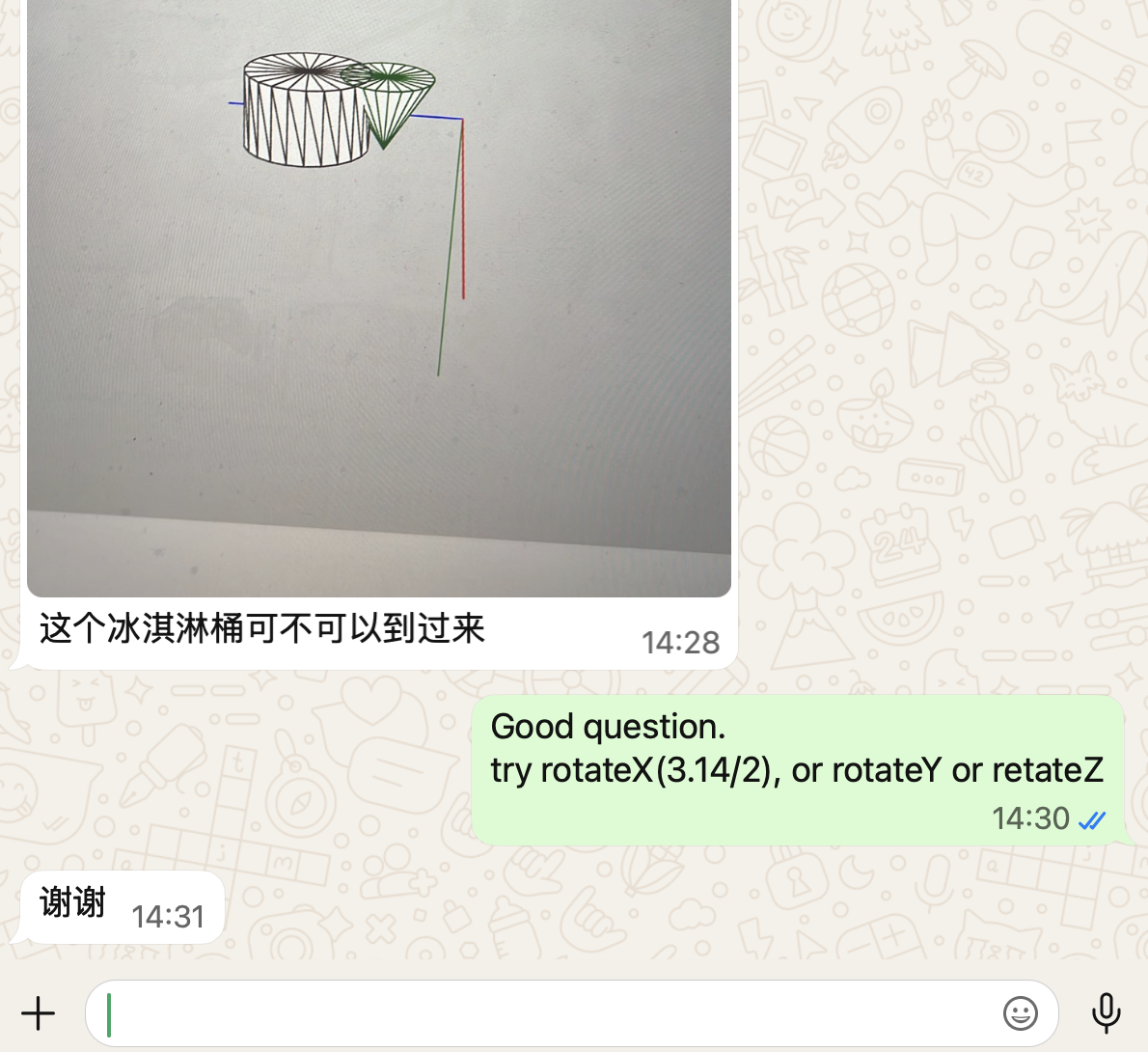
“这个冰淇淋桶可不可以倒过来?”
Can this ice-cream bucket be turned upside down?
This question made me especially happy.
She wasn't asking:
“What does rotateX() mean?”
She had an object in front of her.
She had an idea of how she wanted the object to look.
And she wanted to know whether she could transform it.
I answered:
“Good question.”
Then I suggested trying:
rotateX(3.14/2)
or
rotateY
or
rotateZ
I didn't tell her which one was correct.
She had to experiment.
Her response came almost immediately:
“谢谢”
😂
Enough information.
Back to work.
Learning
Today's class moved through several seemingly unrelated ideas:
3 × 3 routes
(-1/2)^5
dice
X-Y-Z coordinates
3D shapes
translation
rotation
But underneath them was a common habit:
Don't stop at the answer. Ask what structure is hiding underneath it.
The routes problem became multiplication of choices.
The exponent became repeated multiplication.
The dice problem opened toward probability and combinatorial thinking.
The coordinate system became a way to describe position.
And the 3D objects became things that could be transformed.
Once the representation was there, Tianjing naturally started asking:
“What can I do with it?
Door 1 — Multiplication of Choices
Two choices followed by three choices create six possible paths.
Door 2 — Mathematics That Returns Later
Probability, combinatorics, and careful notation can look small today and become important foundations later in both mathematics and computer science.
Door 3 — A World You Can Manipulate
Once coordinates describe a 3D world, position is only the beginning. Objects can be moved, rotated, and explored from different viewpoints.
Reflection
What I loved about today's class was the transition.
In the first half, Tianjing was learning to notice mathematical structure inside ordinary questions.
In the second half, she was using coordinates and code to build a world where she could experiment with that kind of structure herself.
And somewhere along the way, the student stopped asking only:
“What is the answer?”
and started asking:
“Can I turn this thing upside down?”
😂
That is a beautiful transition.
A teacher can tell a student what a function does.
But when the student asks whether an ice-cream bucket can be turned upside down, the function has already become hers.
She has moved from learning the vocabulary of a system to wondering what the system can do.
And that's where the fun begins.