
Living Museum of Learning
The Girl Who Wouldn't Stop Making Things
Three years younger than Enning, Tianjing was preparing to enter Grade 9.
Enning was in a very different place.
Her father had once reached the point of giving up and asked Donald to help her younger sister instead.
It would have been easy to let the story become:
Tianjing is the promising one.
Enning is the difficult one.
But that wasn't the story waiting to emerge.
A few weeks later, Enning began learning programming.
She started with something almost absurdly simple:
circle()
No grand curriculum.
No complicated computer-science project.
Just a circle.
Then Donald gave her room to play.
And Enning produced something nobody had explicitly taught her to make.
A girl made of circles.
Circle Girl
The project was simple in code and surprisingly rich in imagination.
Circles became hair.
Circles became eyes.
Circles became a face.
Circles became a body.
A collection of primitive shapes became a recognizable person.
Donald called it:
Circle Girl.
It was already a little shocking.
The student who was supposed to be learning a basic drawing function had spontaneously discovered a much bigger idea:
Simple primitives can be composed into something meaningful.
But the story had another surprise.
The “circle girl” was Mom.
Without planning it that way, Enning had created an abstract portrait of her mother.
The project was no longer merely a programming exercise.
It had become a small piece of personal expression.
More Than Circles
Two weeks later, the vocabulary had changed.
The flat world of circle() had become a 3D world.
Enning learned:
sphere()
box()
cone()
cylinder()
torus()
She learned to position objects with translate().
She learned to move around the scene with orbitControl().
She learned that a 3D object can look completely different when viewed from another direction.
And then she started combining the pieces.
Not because somebody gave her a picture to copy.
Because she wanted to make something.
The Ice-Cream Cone
Her homework was simply to build something with the new shapes they had met.
Enning submitted:
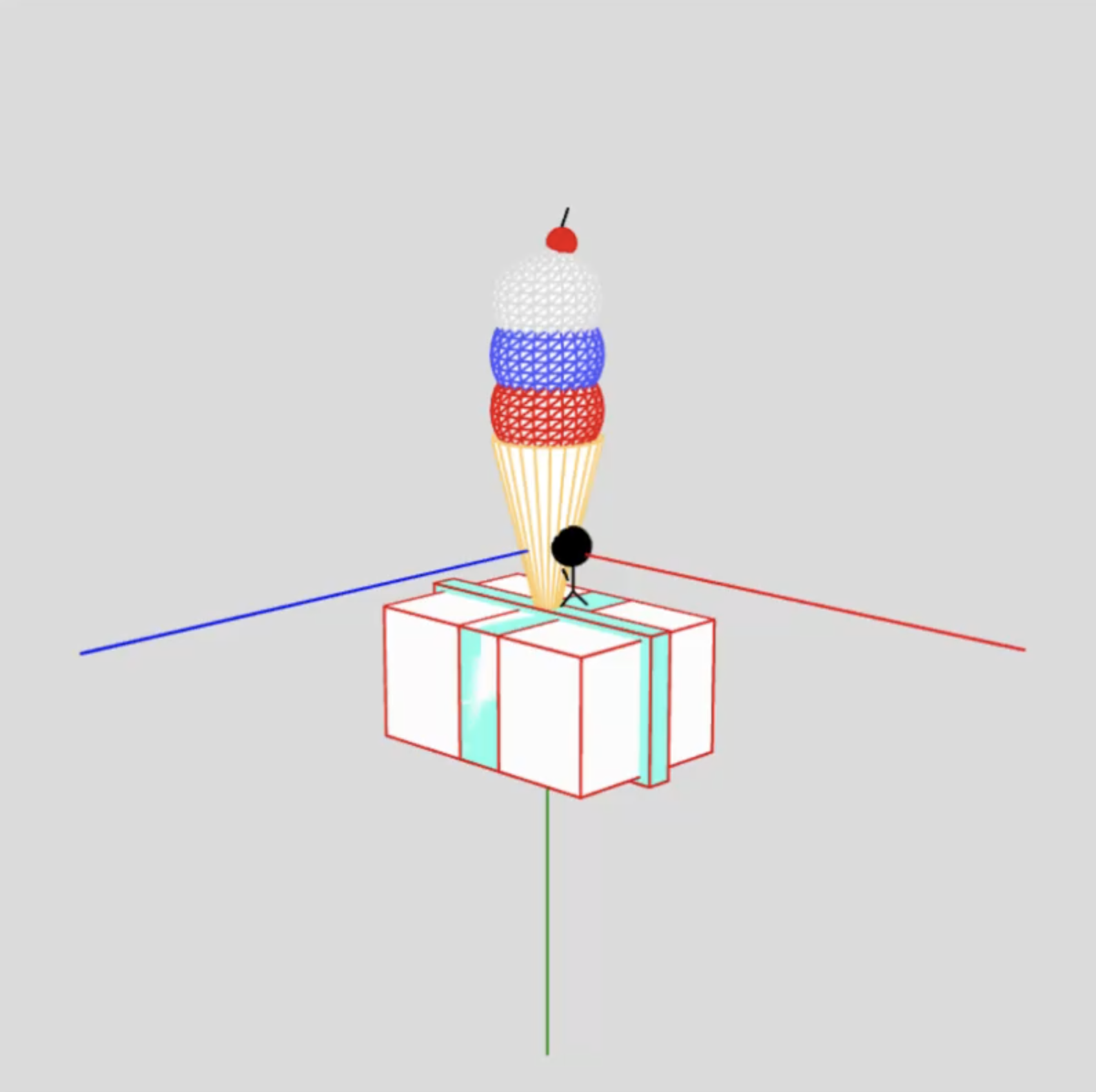
an ice-cream cone with three scoops and a cherry on top.
The cone became the cone.
Three spheres became three scoops.
A tiny sphere became the cherry.
She positioned the pieces one by one, building the dessert out of primitive 3D objects.
It was a small project.
But it contained a pattern that had already appeared two weeks earlier.
Circle Girl had been built from circles.
Now the ice cream was built from 3D primitives.
The shapes had changed.
The creative instinct had not.
The Unexpected Detail
Then Enning noticed something Donald hadn't expected her to notice.
She looked at the finished scene and asked:
“就是不知道为什么这个盒子上的绿色会闪”
“I just don't know why the green on this box is flickering.”
😂
That question was more interesting than the finished ice cream.
Because she wasn't asking:
“How do I make an ice cream cone?”
She had already made one.
She was looking carefully at her creation and noticing behavior she didn't understand.
And this time, even Donald didn't immediately have the answer.
The likely explanation is a classic computer-graphics problem: several box surfaces in her scene occupy almost exactly the same space, so the rendering system can have trouble deciding which surface should appear in front.
But the important thing isn't whether she knew the term.
The important thing is that she noticed the phenomenon and asked why.
A bug had become a question.
The Teacher's Reply
Donald, instead of immediately launching into debugging, replied:
“Delicious ice cream with a cute cherry top ”
Enning responded:
😁
😂
The technical investigation could wait.
The creation deserved to be enjoyed first.
There is something fascinating about Enning's progression.
At first she learned a primitive:
circle
Then she discovered composition:
many circles → a girl
Then she discovered that the creation could carry personal meaning:
the girl → Mom
Then the vocabulary expanded:
sphere + cone + cylinder + box + torus
And once again:
simple primitives → something recognizable
This time:
3D shapes → ice cream
But now something else has appeared.
She is beginning to observe the behavior of the system itself.
Not just:
“What can I draw?”
but:
“Why is that surface flickering?”
That is a different kind of curiosity.
From Circle Girl to 3D Girl
Two weeks ago, Enning was a girl who had just learned how to make circles.
She surprised us by turning circles into a person.
Today she is a girl who can enter a 3D coordinate system, place objects in space, combine primitive shapes, and create an ice-cream cone with three scoops and a cherry.
And then she notices something strange in the rendering.
She asks about it.
The progression is not:
easy → hard
It is:
make → compose → create → notice → question
That is much more interesting.
Door 1 — Composition
A complex creation can emerge from simple primitives.
Door 2 — Creative Ownership
An assignment becomes something personal when the student decides what to make.
Door 3 — Curiosity About the System
Once a student starts noticing unexpected behavior and asking why, programming becomes an investigation rather than a sequence of instructions.
Reflection
Three years younger, Tianjing was the student everyone could easily imagine moving forward academically.
Enning's story looked very different.
Her father had once effectively said:
“Help her sister.”
But a student's future is not always visible from the place where she happens to be standing today.
Two weeks after learning circle(), Enning made Circle Girl.
Then the circle girl turned out to be Mom.
Two weeks later, circles had become spheres, cones, cylinders, boxes, and toruses.
And those shapes became an ice-cream cone with three scoops and a cherry.
Then came the question:
“Why is the green on this box flickering?”
That last question may be the most exciting part.
Because making something is wonderful.
But noticing that something is behaving strangely and asking why is the beginning of another level of learning.
Perhaps the most dangerous thing we can do with a child is decide too early what kind of learner she is.
Sometimes the child we think needs to be rescued turns out to be the child who simply needed a different door.
And once she finds it—
she may not want to stop.