
Living Museum of Learning
Now I Need My Map
The dream had been sitting there for a while: turn Ethan's icosahedron into a real 3D soccer ball for his 2026 World Cup project.
The World Cup already had its green soccer court and goals. But the ball itself was still missing. And this was not going to be a flat circle pretending to be a soccer ball. The ball had to emerge from the geometry of the icosahedron: 20 hexagons and 12 pentagons.
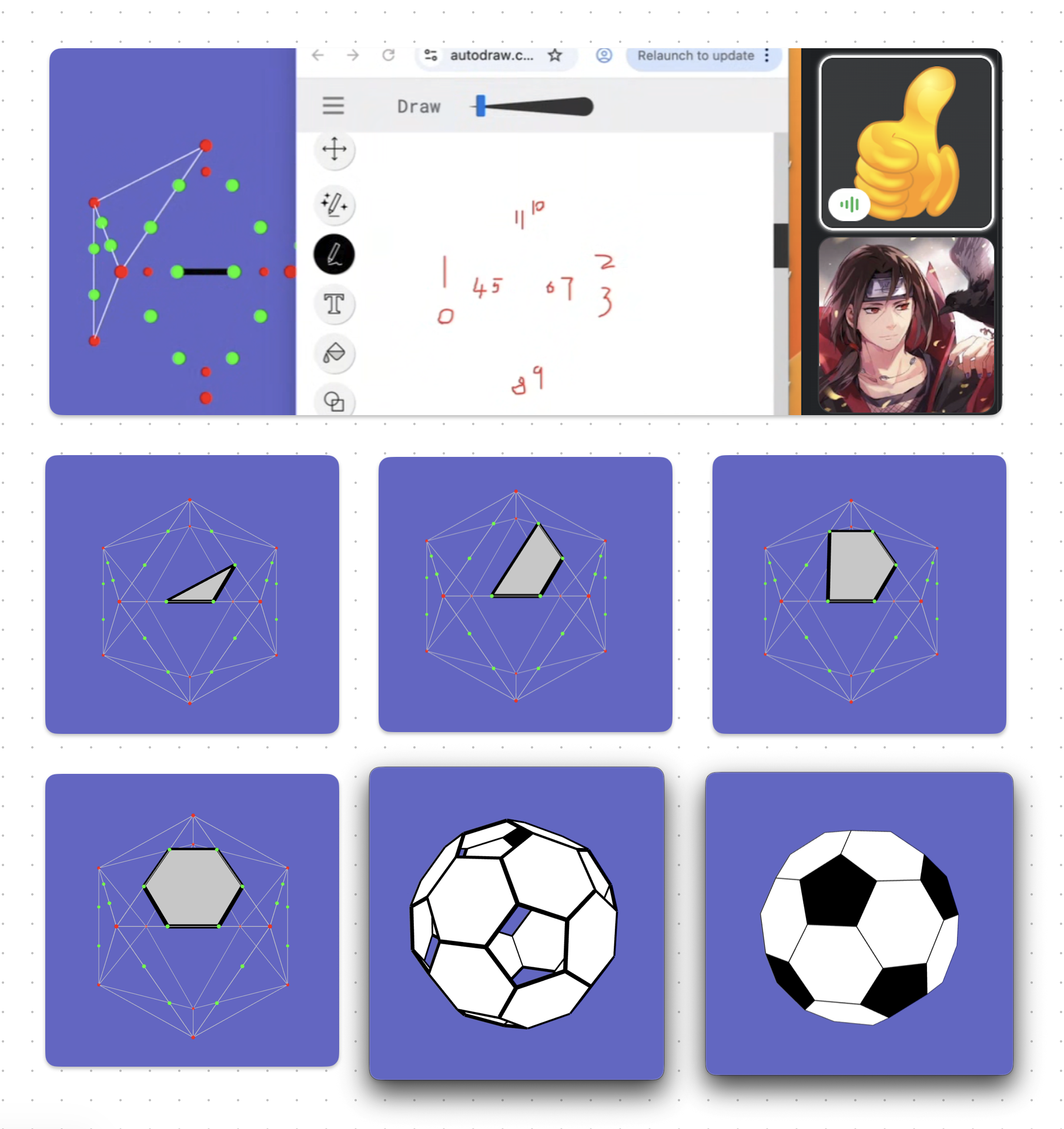
In class today, Ethan first focused on just one hexagon. He immediately understood how to take the three vertices of one triangular face and cut each edge at one-third points. The triangle gradually revealed the six points needed for a hexagon. He captured the journey step by step: triangle, four sides, five sides, and finally the complete hexagon.
Then he rendered all 20 hexagons surprisingly quickly.
But the 12 pentagons looked different. There were no convenient "pentagon points" sitting directly in the original vertex list.
I was wondering how we were going to find the five vertices surrounding each center vertex.
Ethan wasn't worried.
"Uncle, it's fine. Remember the 3 pages of calculation I sent you last time? I covered all the pentagons already. So I just need to group all points of the 5 triangles sharing the common vertex."
That was the moment the problem changed.
Ethan wasn't looking for a new mathematical solution. He remembered that he had already solved the mathematics. Now he only needed to translate that structure into code.
For one vertex, the five surrounding vertices define five triangles sharing that common vertex. Taking the one-third point along each of those five edges produces the five vertices of the pentagon.
One mathematical idea became one reusable function:
drawPentagon(center, neighbor1, neighbor2, neighbor3, neighbor4, neighbor5)
Then came the unexpected tool.
"Now I need my map."
A week earlier, Ethan had created a strange little diagram on the online whiteboard. He had scattered the numbers 0 through 11, representing the 12 vertices of the icosahedron, and organized them around three golden rectangles.
At the time, it looked almost too simple and too strange to be useful.
But Ethan understood it.
Today the old whiteboard drawing was still there.
His "weird map" suddenly became a working mathematical instrument.
From it, Ethan could read the five neighbors of each vertex and turn them into the twelve pentagons.
For example:
drawPentagon(0, 1, 4, 8, 9, 5);
The map had become an external memory of the icosahedron's structure.
It did not try to look like a 3D icosahedron. It simply preserved the relationships Ethan needed.
That tiny diagram was enough.
One black pentagon appeared.
Class ended.
But Ethan wasn't finished.
Thirteen minutes later, he posted a video of the completed spinning soccer ball.
He had rendered all 20 hexagons and all 12 pentagons. Then he simplified the code.
The mathematical object had become a living object.
The most important achievement today was not the soccer ball.
It was the transition from knowing a structure to being able to use it.
Ethan remembered his earlier mathematics instead of starting over. He used a homemade map instead of keeping every relationship in his head. He recognized that the pentagons came from five triangles sharing a common vertex. He turned repeated geometric ideas into reusable functions. And once the structure worked, he went back and simplified his program.
The strange little map was especially important.
Good thinking does not always look elegant while it is being created. Sometimes a rough drawing, a scattered collection of numbers, or a diagram that makes sense only to its creator is exactly what is needed.
A week later, that "weird" map became the key to finishing the soccer ball.
The map did not merely record Ethan's thinking.
It allowed him to think.
A soccer ball can emerge from an icosahedron: 20 hexagons and 12 pentagons.
Understand the local structure: one triangular face creates a hexagon, while five triangles sharing one vertex create a pentagon.
The most powerful tool may not be the final answer, but a representation you created earlier that suddenly makes the next problem easy.