
Living Museum of Learning
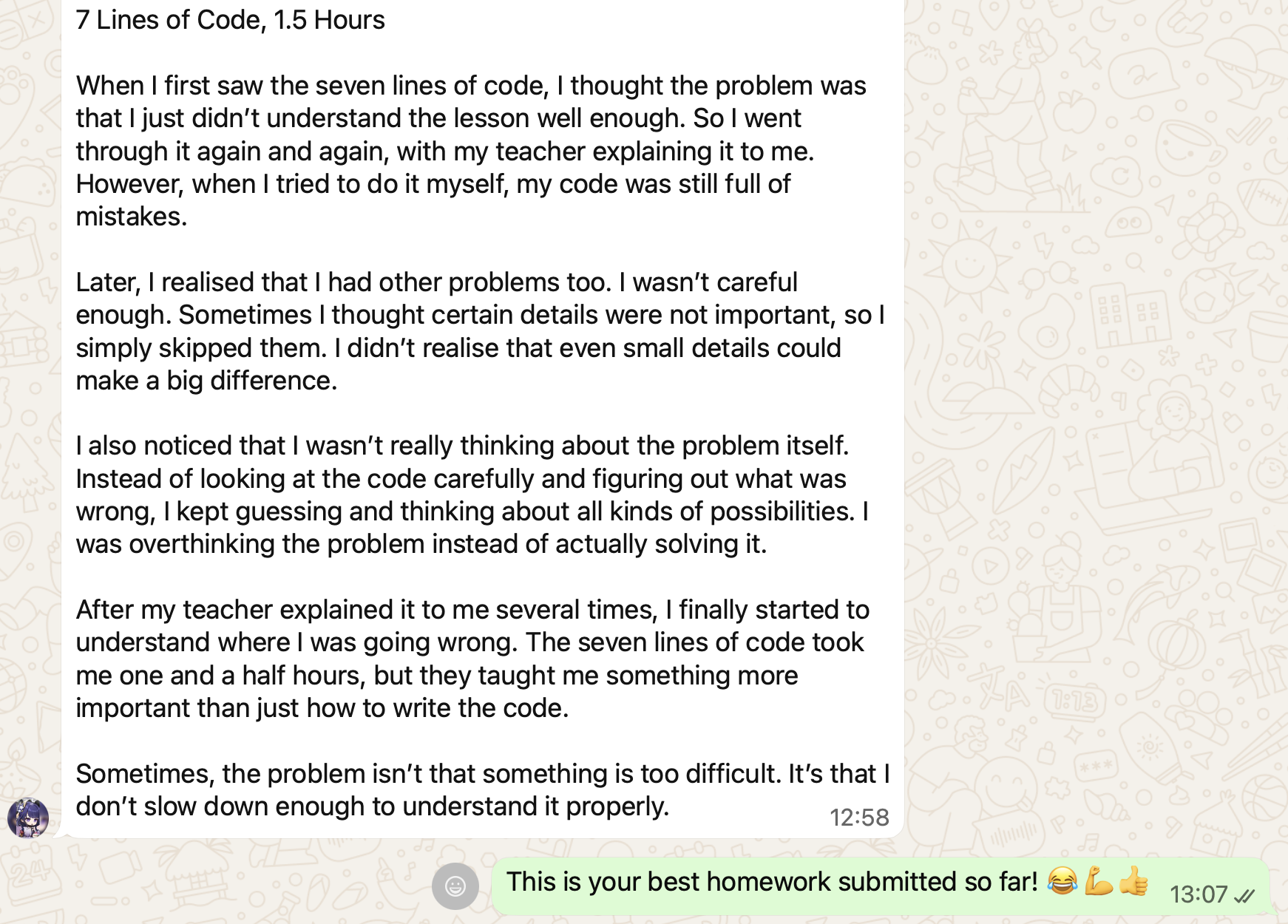
Reflection: 7 Lines of Code, 1.5 Hours
After a three-hour P5JS class, Enning had one final assignment: write a reflection titled “7 Lines of Code, 1.5 Hours.”
The assignment was not to explain the code.
It was to think about what had happened during those 90 minutes.
She submitted a surprisingly honest answer.
At first, Enning thought the problem was simply that she had not understood the lesson well enough.
She went through the lesson again and again, with her teacher explaining it.
But when she tried to solve the problem herself, the mistakes continued.
That forced her to look for another explanation.
She wrote:
“I wasn’t careful enough.”
She realized that she sometimes decided certain details were unimportant and skipped them.
Then she went one step deeper.
She noticed that she wasn't really analyzing the problem itself. Instead, she kept guessing and considering different possibilities.
Her own description was:
“I was overthinking the problem instead of actually solving it.”
This is a small but important shift in self-awareness.
A student can easily explain a mistake by saying:
“I don't understand.”
That explanation feels natural, but it doesn't always tell us what to do next.
Enning's reflection moved beyond that.
She began separating different problems:
Maybe I don't understand.
Maybe I wasn't careful.
Maybe I skipped a detail.
Maybe I didn't examine the problem carefully enough.
Maybe I started guessing instead of solving.
These are very different problems, and therefore require very different responses.
The most valuable part of the homework was not that Enning identified the correct programming technique.
It was that she began to identify her own problem-solving behavior.
The seven lines of code became a mirror.
They showed her that having knowledge is not enough. A student also needs habits for using that knowledge.
When a problem appears, she can reach immediately for something familiar.
Or she can pause and ask:
What is actually happening?
What do I really need?
Which details matter?
What can I test first?
This is the beginning of a more deliberate problem-solving habit.
And perhaps that is why the homework became more valuable than the code itself.
The code could be fixed by the teacher.
The reflection had to be written by Enning.
She had to look back at her own thinking and say:
“This is where I was going wrong.”
That is a different kind of learning.
Not just learning how to solve a problem.
Learning how to notice how I solve problems.