
Living Museum of Learning
When the Living Gallery Became Editable
The Living Gallery began differently from the Mathematicians and Books wings. Those two wings were designed from the beginning around MuseCoreStudio's data stores and exporters. The Living Gallery was not.
The first Living Gallery projects—LG-0001 through LG-0017—were manually built inside the generated museum repository. Each project was an independent P5.js webpage. Most contained an index.html, a sketch.js, and a thumbnail.png.
One project, LG-0006, was different. It was a substantial Game of Life project made from ten JavaScript files loaded in a deliberate order. It was already working perfectly, and there was no good reason to rewrite it merely to satisfy a newer data model.
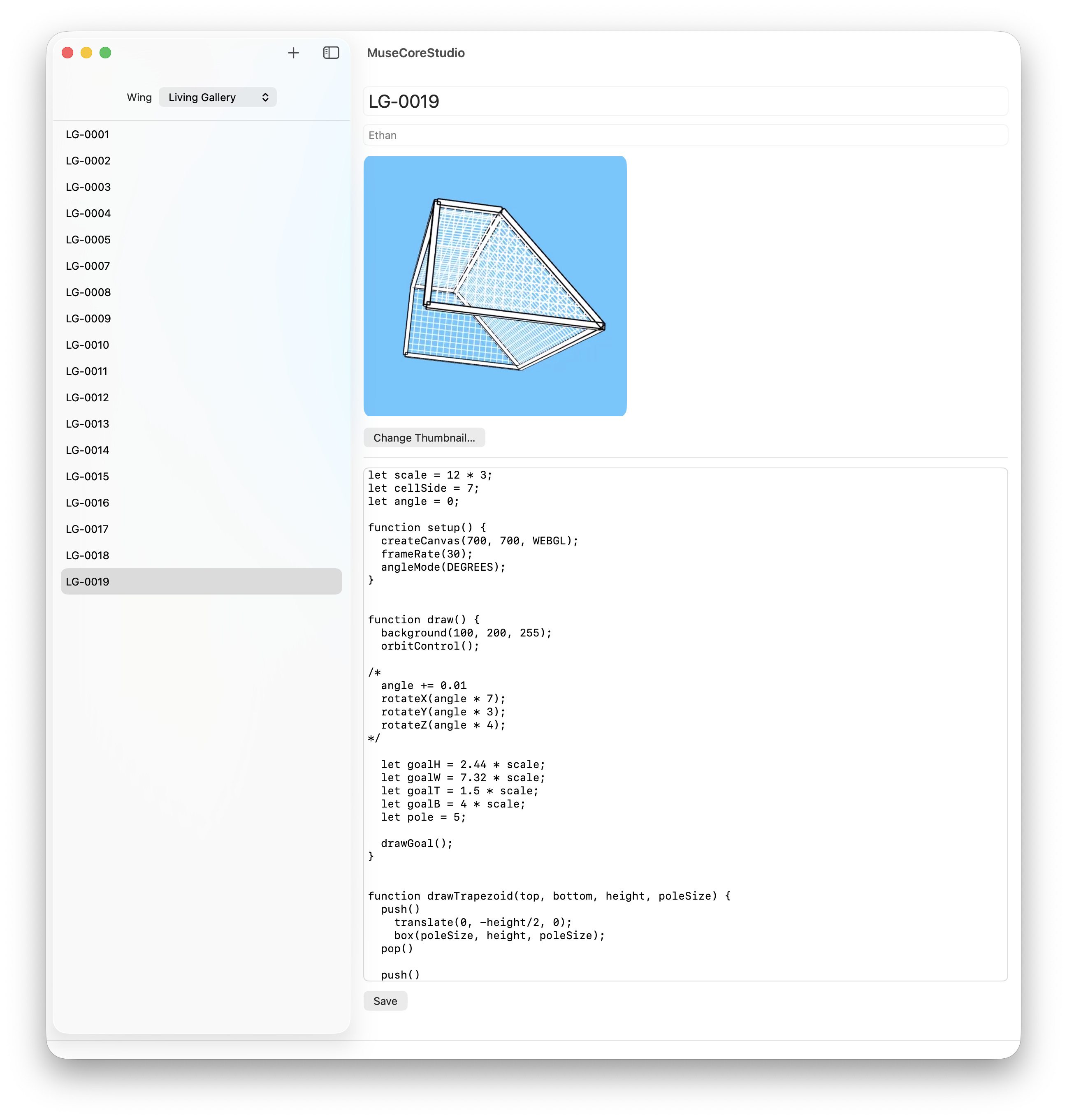
By September 2026, MuseCoreStudio had learned how to create, edit, and export Living Gallery projects. LG-0018 and LG-0019 were the first projects created natively through the new system.
The remaining question was whether the old gallery could be brought under the same source-of-truth architecture without destroying its history.
Instead of rewriting the old projects, Donald migrated the single-file projects into the Living Gallery source repository.
LG-0001–LG-0005 and LG-0007–LG-0017 became JSON records containing their existing P5.js code and thumbnail references. Their original JavaScript was preserved rather than reconstructed.
LG-0006 was deliberately left alone. Its ten JavaScript files remained exactly where they had always been. MuseCoreStudio simply learned that this one historical project was a legacy project and kept it in the gallery.
The result was a simple rule:
New Living Gallery projects use one editable JavaScript file. Historical exceptions are preserved rather than forcibly converted.
The Living Gallery now had a genuine source of truth.
The source repository contained the editable records for 18 projects, while LG-0006 remained a preserved legacy project. The gallery exporter generated all 19 gallery entries in their proper historical order.
Then came the real test.
LG-0018 was assigned to Enning's 3D bicycle project.
LG-0019 was assigned to Ethan's soccer goal project.
These were not artificial test records. They were real student creations.
A new museum exhibit would be created at the same time, and everything would be published together.
A software system becomes real when it survives contact with the work it was built to support.
The migration did not require every old project to conform to the newest design. It only required the system to know what it owned and what it should preserve.
One simple model covered almost every Living Gallery project. One historical exception did not force the entire architecture to become complicated.
More importantly, the Living Gallery stopped being a collection of files that Donald had to remember how to maintain.
It became editable museum content.