
Living Museum of Learning
3.2, 2.3, and a Red Axis
Enning and I started with something that should have been simple: multiplication.
It wasn't.
For almost 45 minutes, we wrestled with calculations such as 800 × 0.12 and 3.2 × 5.13. Enning was surprisingly confused by the mechanics of multiplication. At one point, she wrote the numbers vertically with their decimal points lined up, apparently carrying over the visual habit of addition.
So I deliberately told her to forget about the decimal points for the moment. I let her write 3.2 × 5.13 as it was and try different ways to calculate the product.
Her first attempt essentially treated multiplication like addition.
Then I tried to give her another way in. I used the simplest possible example:
2 × 3 = 3 × 2
Multiplication is commutative. We can switch the two factors.
Except I had unknowingly chosen the worst possible example for this particular moment.
Enning had just been working with 3.2.
When I said we could switch the two numbers, she didn't switch the two factors 3.2 and 5.13.
She started changing the digits inside 3.2.
3.2 was becoming 2.3.
I nearly went to heaven. 😂
Only later did I realize that I was the real drama king. My innocent 2 × 3 = 3 × 2 example had accidentally planted the exact interpretation that sent our drama queen in completely the wrong direction.
After roughly 45 minutes of arithmetic, we changed gears.
There were only about 15 minutes left, so we returned to Enning's 3D bike.
Something interesting happened.
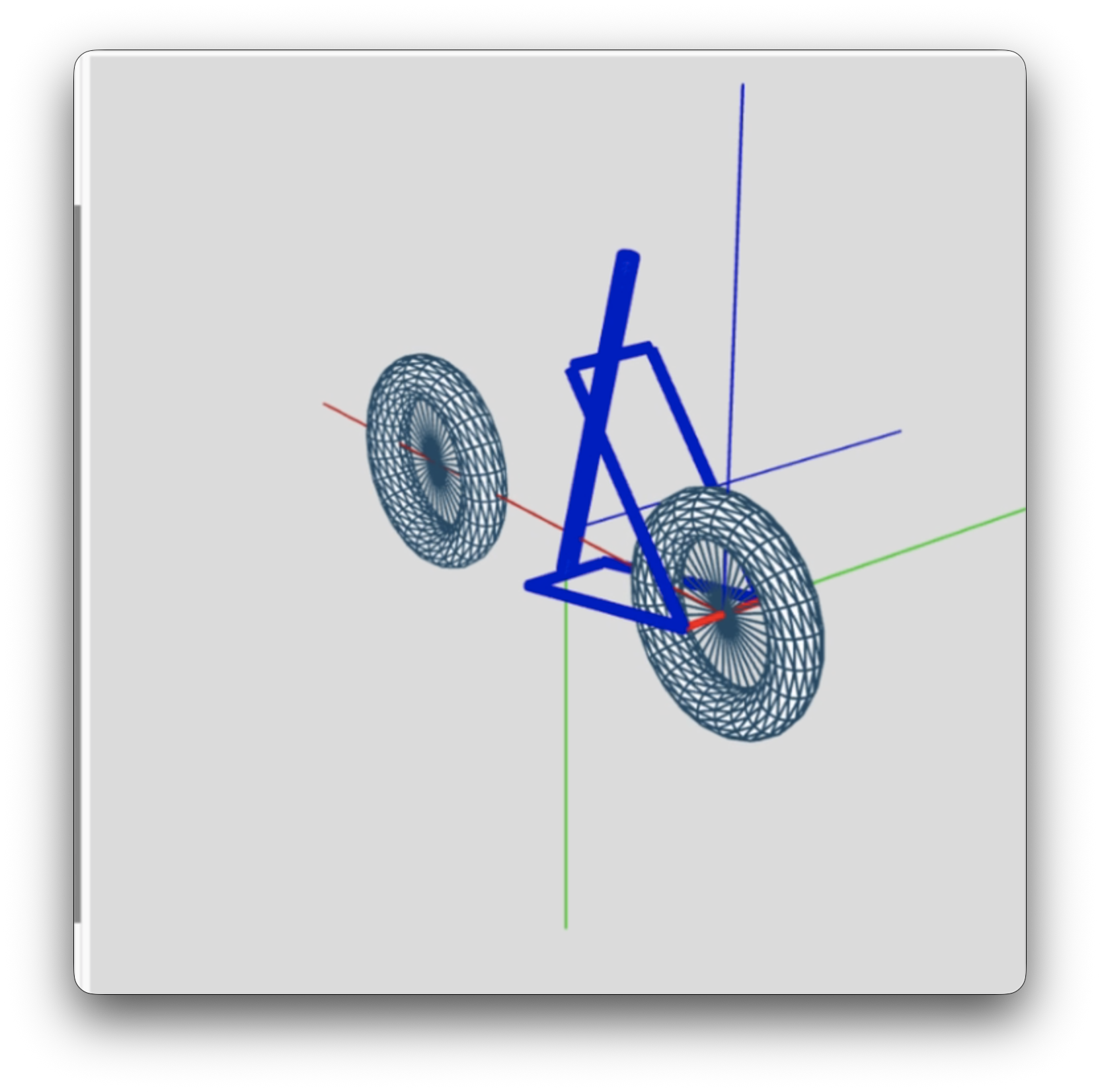
The bike was no longer just a collection of shapes she was trying to place. Enning was becoming increasingly comfortable thinking about the relationships between objects in a 3D coordinate system.
The frame was taking shape. The two wheels were there. The rear fork and lower bars were connected to the rest of the structure.
The rear wheel was still floating between the rear forks, so Enning added another piece: a red rear axis.
function rearAxis() {
translate(-100, 0, 0)
push()
rotateX(90)
drawXYZ()
stroke(255, 0, 0)
cylinder(1, 37)
pop()
}
And then:
drawTire(-100)
drawTire(100)
rearFork()
rearForkLowBar(20)
rearForkLowBar(-20)
seatBar()
rearAxis()
The -100 wasn't just a number anymore. It identified where the rear wheel belonged.
rotateX(90) wasn't just a mysterious command. It changed the orientation of the cylinder.
The red axis made the geometry visible.
In those last 15 minutes, Enning seemed much more at home inside the 3D system.
The contrast was striking: we had spent most of the class fighting over the meaning of digits in a multiplication problem, and then she was happily reasoning about coordinates, orientation, and the physical structure of a bicycle.
The real surprise came after class.
I had left the room when Cindy said something like:
“I heard you talking about doing multiplication manually. Every word sounds strange and unfamiliar.”
At first I thought perhaps she had simply forgotten the old procedure.
Then, on our way to badminton, Cindy revealed the truth.
She works with numbers every day. She has been an accountant for about 30 years.
But she hasn't manually multiplied numbers like that for decades.
The numbers never left her professional life. The manual procedure did.
For years, tools have handled the actual products.
Suddenly our strange little multiplication lesson had acquired another layer.
Enning was trying to reconstruct a procedure she found confusing.
Cindy, despite spending her working life surrounded by numbers, had almost completely stopped using that procedure.
And I was the person in the room who still spoke the old language fluently enough to teach it.
Maybe that's one reason learning is so funny.
What looks like “basic mathematics” from one generation can sound like an ancient technology to another.
And then, after all that arithmetic, Enning went back to something much more alive to her: building a bicycle that actually exists in three dimensions.
This wasn't really a lesson about getting the right answer to 3.2 × 5.13.
It was about discovering what a learner actually understands.
Enning's mistakes were informative.
When she lined up decimal points, she was revealing that she was importing a structure from addition into multiplication.
When she changed 3.2 into 2.3, she revealed that “switch the factors” was not yet the same mental operation as “switch these two digits.”
The teacher's example became part of the problem.
That matters.
A good explanation isn't simply correct. It has to be interpreted by the learner in the way the teacher intended.
And then the 3D bike offered a completely different kind of learning.
Instead of memorizing a procedure, Enning could see what her numbers and transformations were doing. A coordinate such as -100 had a visible purpose. A rotation had a visible consequence. A cylinder could become an axle. Geometry became something she could build and inspect.
The same learner who struggled for 45 minutes with manual multiplication could spend the final 15 minutes becoming increasingly comfortable with a 3D construction system.
That isn't a contradiction.
It is a reminder that different forms of understanding can become accessible through very different doors.
Learning is not a straight line from “easy” to “hard.”
Sometimes a supposedly elementary procedure can be surprisingly difficult. Sometimes a much more sophisticated system becomes intuitive once the learner has something meaningful to create.
And sometimes the teacher discovers that the example intended to clarify an idea has accidentally become part of the confusion.
There is another lesson hiding in Cindy's story too.
Human beings don't simply accumulate knowledge forever. We use tools. We abandon procedures. We retain concepts while letting mechanical techniques disappear from daily life.
Ten years without manually multiplying doesn't make an accountant unfamiliar with numbers.
It makes the old way of producing the numbers unfamiliar.
That is part of the history of computation—and part of the history of learning.
A learner can move from struggling with elementary arithmetic to constructing a connected 3D bicycle in the same class.
A tiny piece of code can become a physical-looking object in a world the learner can explore.
Through experimentation, mistakes, conversation, concrete examples, visual feedback, and the freedom to try another way.
Sometimes the most useful discovery comes from a wrong answer.
Because learning is not merely the acquisition of procedures.
It is the development of ways to see, question, construct, correct, and create.
And when a learner's creation enters the Living Gallery, the lesson doesn't have to end with the class.
The bicycle keeps living.
Living Creation
Enning's 3D bicycle is now part of the Living Gallery as LG-0018.
Instead of turning her creation into a heavy video file, the museum can preserve the actual P5.js program and let visitors experience it live.
See Enning's 3D Bike in the Living Gallery:
The story stays here.
The creation stays alive there.
And the two can meet through a simple link.
Copy → Paste → Publish → Alive.