Living Museum of Learning
Twelve Points, Three Golden Rectangles
Situation
Leo came to his third class with Python and algorithms still relatively new.
We started with a simple-looking problem:
Find the second largest number among seven numbers.
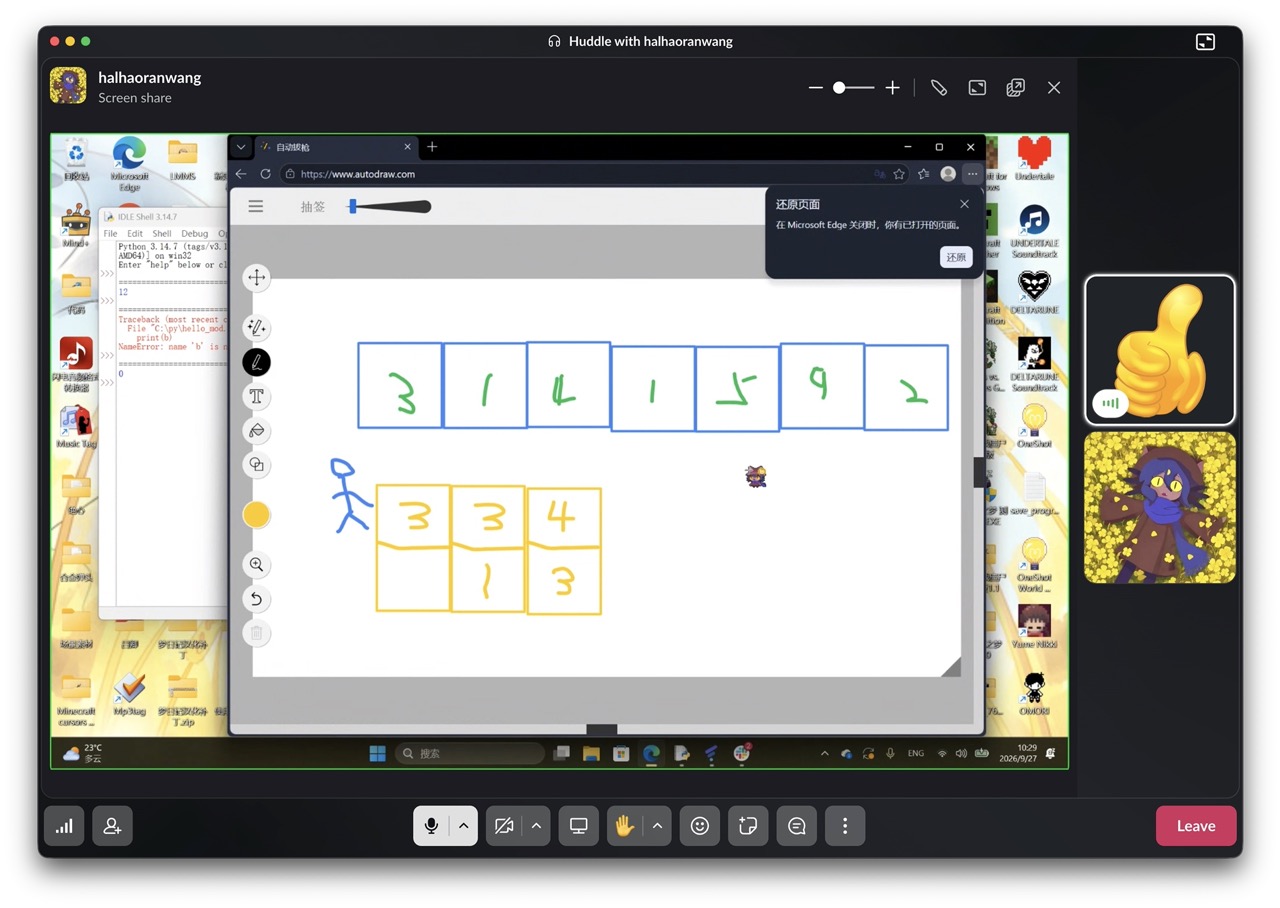
I asked him to draw seven “rooms” on the whiteboard. Then I watched him discover how to represent the problem physically.
He decided he needed two pieces of paper—one for the largest number and one for the second largest.
I was lit up.
“Put some numbers in those rooms. What about π?”
Leo immediately put a π in the first room.
“No,” I laughed. “The digits of π: 3, 1, 4... Then we don't have to struggle to invent seven random numbers.”
He filled the rooms with digits of π and started moving the numbers through his two pieces of paper.
The algorithm was surprisingly clean: only one iteration through the numbers was needed.
Then we went back to Python.
He worked hard to make his code behave exactly like the algorithm he had constructed on the whiteboard. When the code didn't work, I trained him to speak the execution out loud against the actual test data.
His voice was slow, but firm:
“A is ... B is ... A is greater than 12...”
Eventually, his program correctly found the second-largest number in several randomly generated arrays.
We could have stopped there.
We didn't.
Turning Point
I suddenly asked:
“Do you know the golden ratio?”
“Yes. 0.618.”
“Cool. Could you draw a diagram and show me how you get it?”
I wasn't sure how much work this would be for him. I simply wanted to see what he would do.
Instead of drawing the familiar golden rectangle, Leo drew a line segment, divided into two parts, x and 1 - x.
He quickly moved to the equation and found the positive root.
“Where is the second root?” I asked.
“The length can't be negative,” he answered.
Good.
Then I asked him to calculate 1/x.
He got φ.
That wasn't the ending.
It was the lead.
Emergence
“Do you use Desmos?”
Yes.
“Do you use 3D?”
No.
“No problem. Click here to enter. You don't have trouble understanding X, Y, Z, right?”
“No, no trouble.”
I trusted him.
“Put four vertices of a golden rectangle on the X-Y plane.”
He put one in the first quadrant.
“Oh! Let it be centered at the origin. I forgot to mention that.”
Then:
“Put a second one perpendicular to the first one.”
He did.
“Then the third one.”
He did.
“How many vertices are there?”
“12.”
But the arrangement wasn't symmetric enough.
“Can they be more symmetric?”
He was confused.
“Okay, turn it. Keep going. Stop. Look from this angle. All 12 points are between two parallel planes, right? The distance between the two planes is the short side of the golden rectangle. So the whole thing can be more symmetric, right?”
Now he agreed.
We went back to the whiteboard.
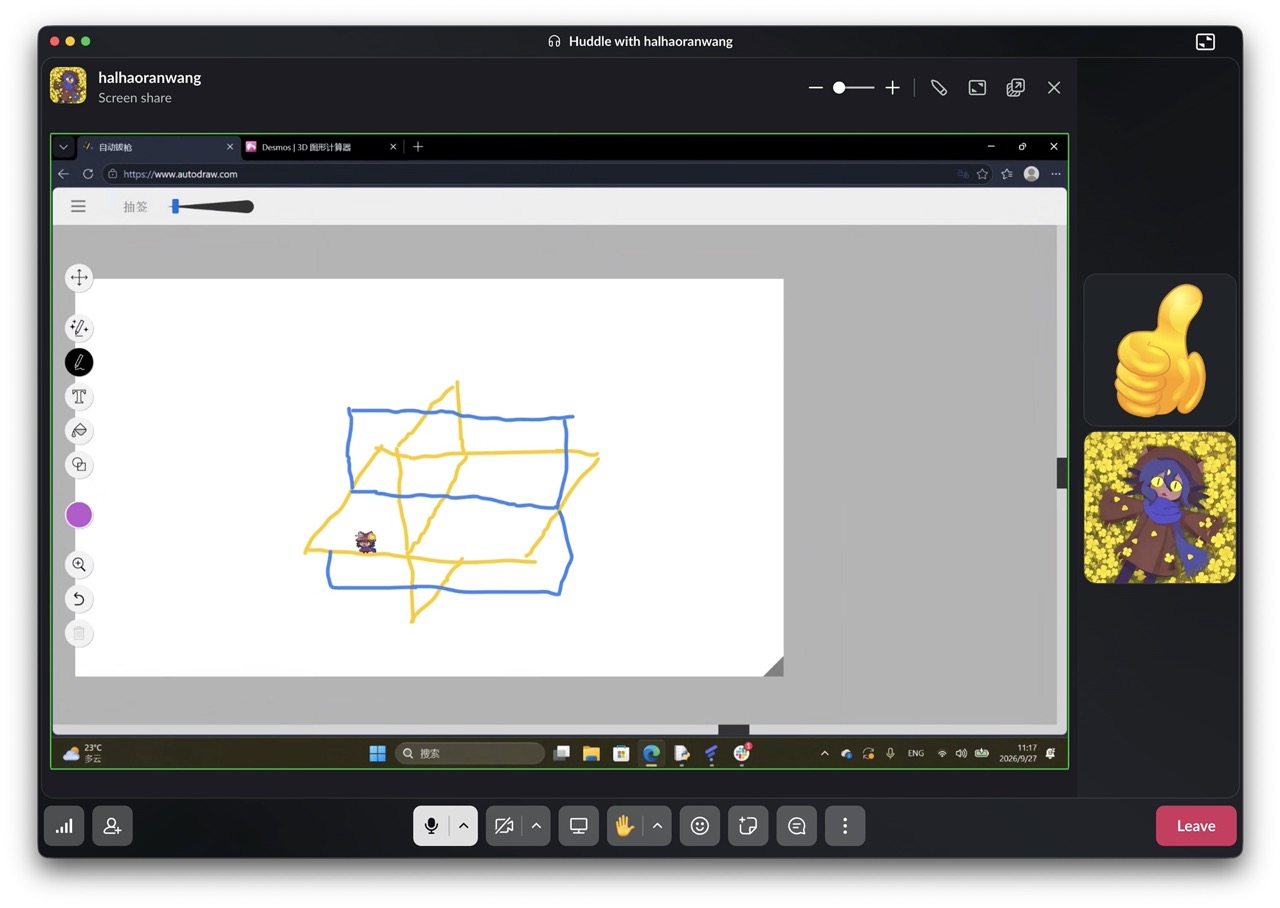
“Draw two A4 papers perpendicular to each other.”
He did—but the intersection line had the length of the long side on both pieces.
“Any other way?”
He found another arrangement, this time with the intersection line equal to the short side on both pieces.
“Any other way?”
He paused.
I could tell he was beginning to see it, but his hand wasn't quite able to draw the three-dimensional relationship.
So I gave him a little help:
“One paper cuts into the other, right?”
Then:
“Now add the third paper. Same style.”
His head was spinning.
“No. You want this third paper to cut into the other pieces of paper similarly, right?”
And then he saw it.
The structure was suddenly there: three mutually intersecting golden rectangles, arranged with the symmetry of the 12-vertex solid associated with the golden ratio.
I didn't need to name the object first.
He could see the structure.
“Now adjust your 12 vertices in Desmos to match this setting.”
Leo went back to the computer, busy switching coordinates and entering expressions involving values such as √5 - 1.
The geometry had become numbers again.
Learning
Leo's third class traveled through several kinds of thinking without ever announcing that we were changing subjects.
He learned that an algorithm can begin as something physical: two pieces of paper representing two pieces of information.
He learned to translate that mental model into Python.
He learned that debugging isn't merely staring at code. Sometimes it means saying the machine's state aloud and following what actually happens.
He took a number he already knew—0.618—and reconstructed where it came from.
He moved from a line segment to a golden rectangle, from a golden rectangle to 3D coordinates, and from three rectangles to a highly symmetric twelve-vertex structure.
Most importantly, he experienced something that cannot easily be taught by giving him a finished diagram:
When an arrangement doesn't look symmetric enough, keep looking.
The computer can display the points.
The mathematics tells you where they belong.
But sometimes the fastest way to discover the mathematics is to draw two pieces of paper and ask:
“Any other way?”
A Small Imperfection
The network was unstable and cost us about 20 minutes.
We extended the class by roughly another 30 minutes to keep going.
In the rush at the end, Leo's twelve Desmos points did not all make it to their proper “seats.” 😄
And that was perfectly fine.
He had already seen enough.
The final coordinates, the polished 3D model, and everything that comes after belong to next time.
The object wasn't finished.
The thinking was.
Theme
Thinking across representations
What Is Possible
A simple programming problem can become geometry, algebra, and 3D mathematics when a learner is allowed to keep asking “what else?”
How Does It Happen
By moving freely between paper, numbers, equations, Python, coordinates, and visual space—without treating any one of them as the destination.
Why Does It Matter
Because deep learning often happens before the answer is finished. Sometimes the most valuable thing a student takes away is not the completed object, but the experience of seeing a structure emerge.