
Living Museum of Learning
Khan Academy Lost to His Own Dice Game
Situation
Cloud came to class with a new attitude.
Just before class, he had reminded his mother to finish breakfast early because class was about to start. A few days earlier, he might have entered the study five minutes late. Today, he was watching the clock himself.
Then, during class, we were talking about a dice experiment.
Sal was manually rolling and counting the results.
I said:
“We can do this experiment too.”
So we opened the Terminal.
Cloud knew some basic Python. Not everything he typed was fully understood yet. 😂 But suddenly his fingers were moving incredibly fast.
He wrote a program that could roll three six-sided dice repeatedly, determine whether their sum was at least 10, and count how often he won.
Turning Point
Cloud quickly realized that the computer could do the tedious part for him.
While Sal was still manually counting, Cloud was running thousands—and then millions—of experiments.
But he didn't stop when the experiment worked.
He started polishing it.
He added instructions.
He added a choice to start the game.
He added the number of tries.
He printed WIN and LOSE.
He calculated the probability.
And then he suddenly said something even more interesting:
“This will be my first ... game.”
The probability experiment had quietly turned into a game.
Emergence
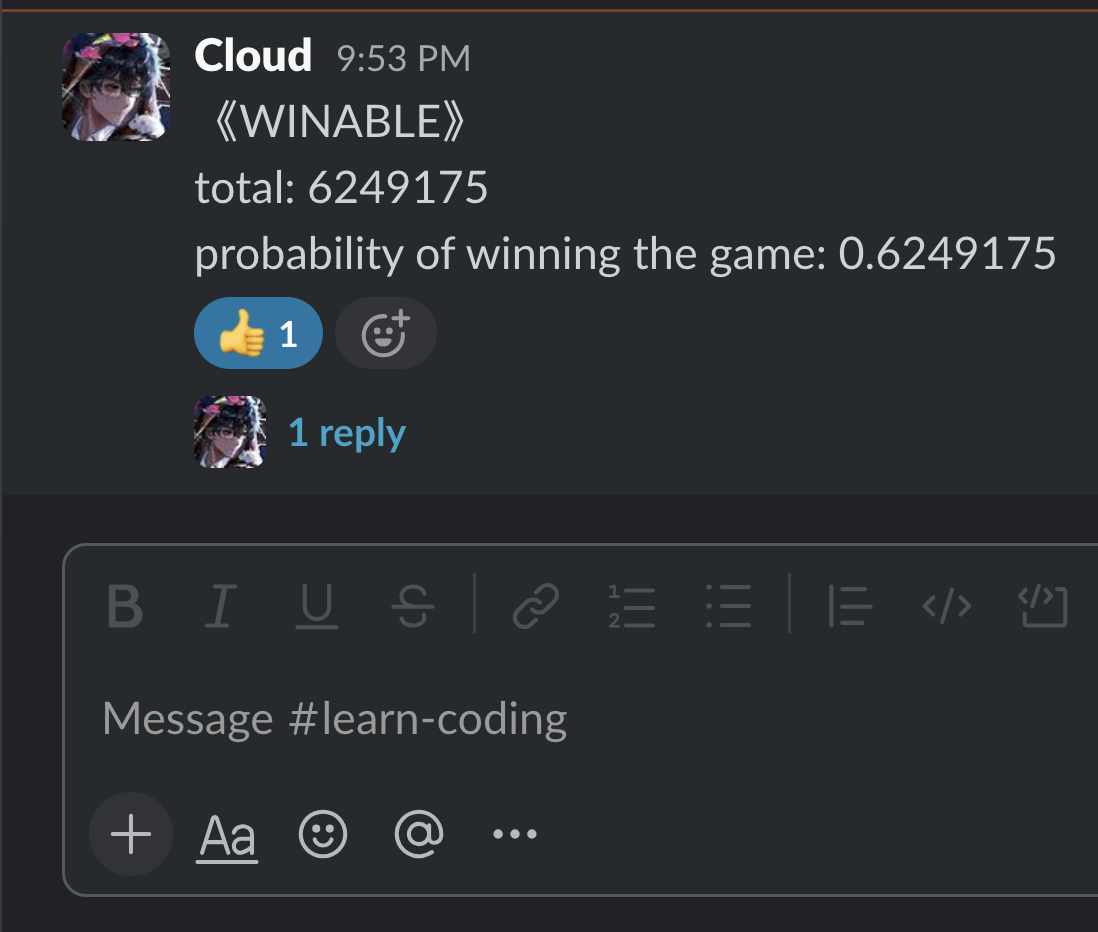
Cloud eventually simulated 10,000,000 rolls of the three-dice game.
His program reported:
probability of winning the game: 0.6249175
That's 62.49175%, remarkably close to the exact probability of 62.5%.
The mathematics had become an experiment.
The experiment had become a program.
The program had become a game.
And the game had become something Cloud couldn't stop working on.
Near the end of class, we were supposed to continue with a Khan Academy practice.
Cloud looked at it and said:
“Can we end the class now? I am too excited to focus on these.”
😂
Learning
Sometimes a child doesn't need another exercise.
He needs a question that he wants to answer badly enough to build something.
Cloud didn't merely learn that the probability was about 62.5%.
He experienced something more powerful:
mathematics can become code,
code can become an experiment,
and an experiment can become a game.
He also discovered that a computer can perform millions of mathematical experiments in the time it takes a person to count a few.
For Cloud, this was perhaps the first time probability stopped being something to calculate and became something he could play with.
Theme
Curiosity can turn mathematics into a creation.
What Is Possible?
What happens when a child stops solving the problem and starts building the experiment?
How Does It Happen?
Give the curiosity somewhere to go—and let the child take it further than the lesson plan.
Why Does It Matter?
Because sometimes the strongest evidence that learning is happening is not a correct answer.
It is a child saying:
“Can we keep going? I'm too excited to stop.”