
Living Museum of Learning
The Parabola Leo Discovered
Situation
Our math-and-coding fun continued with a whiteboard, a straight line, and a dot.
I asked Leo to draw some points that were the same distance from the dot and the line. He found four.
Then I asked a different question:
“Given a compass and straightedge, can we construct one of those points precisely?”
Before long, Leo had demonstrated that constructing a line-segment perpendicular bisector and an angle bisector was a piece of cake.
“Cool! Then back to our original problem, Leo.”
Turning Point
A few minutes later, Leo came back with a solution.
I had been thinking about parallel lines. Leo had found another route!
His construction was remarkably simple:
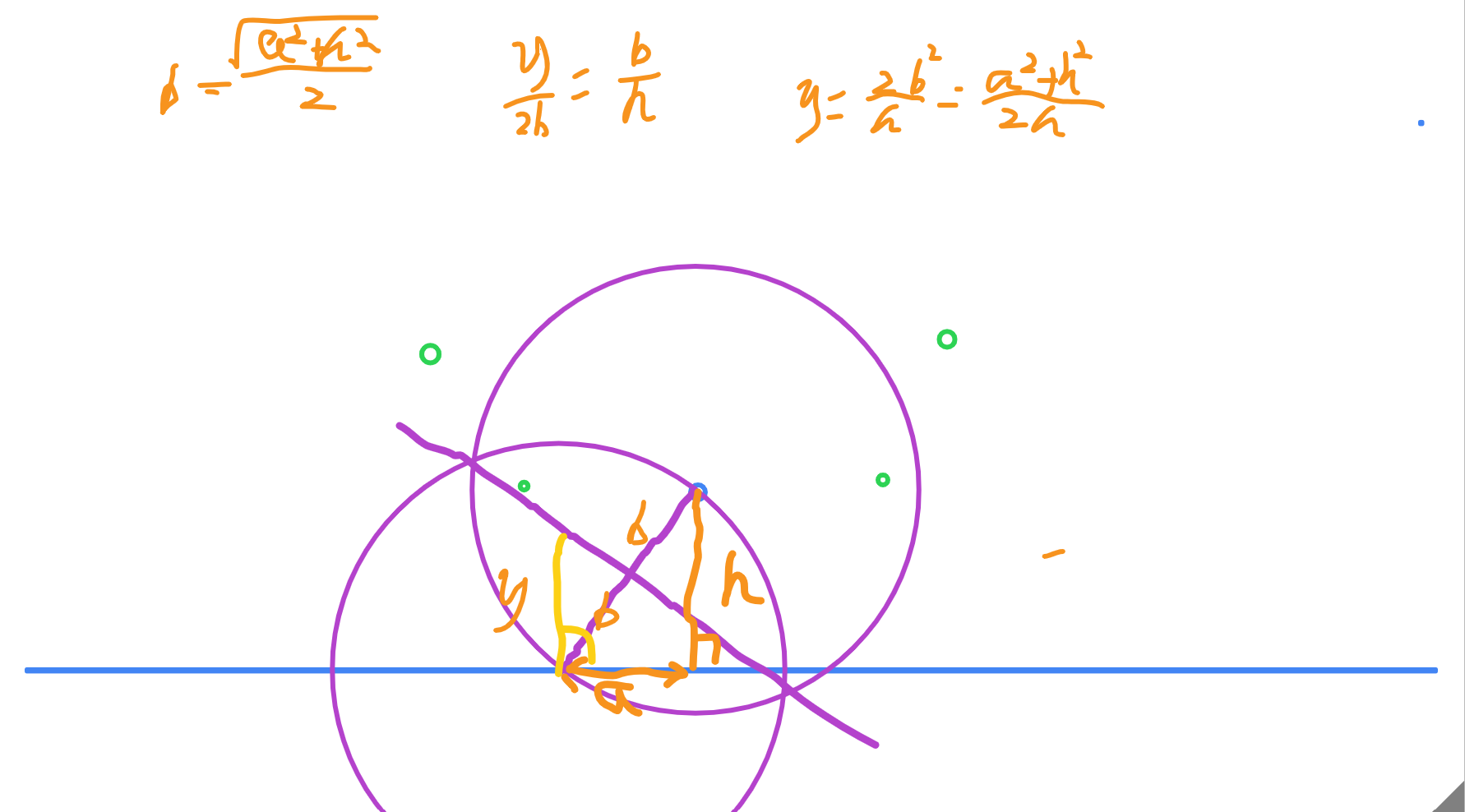
Draw any slanted line from the focus F to meet the given line at D.
Construct the perpendicular bisector of segment FD.
Draw the perpendicular to the given line through D.
The two constructed lines intersect at P.
That's it.
No complicated curve drawing. No guessing coordinates. Just a slanted line, a perpendicular bisector, and a perpendicular.
Emergence
Why does Leo's construction work?
Because P lies on the perpendicular bisector of FD, it is equally distant from F and D:
PF = PD.
And because D lies on the given line and PD is perpendicular to that line, PD is exactly the distance from P to the line.
Therefore,
PF = distance from P to the given line.
That is the defining property of a parabola!
Every time Leo chooses another slanted line from F to the directrix, his construction produces another point on the same parabola.
From Geometry to Code
We then moved the experiment into p5.js.
Rather than drawing all the construction lines repeatedly, we calculated the horizontal displacement a and used algebra to find the corresponding height y.
Let the distance from the focus to the directrix be h. Choose coordinates so that the focus is (0, h), the directrix is y = 0, and the constructed point is P = (a, y).
From PF = PD, we obtain:
a² + (y − h)² = y²
Expanding both sides and cancelling y² gives:
a² + h² = 2hy
Therefore,
y = (a² + h²) / (2h)
The square root that might appear in an intermediate calculation disappears from the final expression!
Leo's p5.js program used precisely this formula to calculate and plot points on the parabola.
What We Learned
A geometric construction can reveal the defining property of a curve.
A perpendicular bisector gives us equal distances.
The geometry can be translated into an algebraic equation.
Algebra can simplify a construction into a compact computational formula.
A few lines of code can turn a mathematical discovery into an experiment.
The Bigger Picture
I had one approach in mind. Leo found another.
He began with a geometric question, constructed a point using classical tools, and then used algebra to help a computer plot the resulting curve.
The beautiful part wasn't simply that he found a parabola. It was that he found his own way to construct one.
Sometimes the best mathematical discoveries begin with a line, a dot, and a question.